
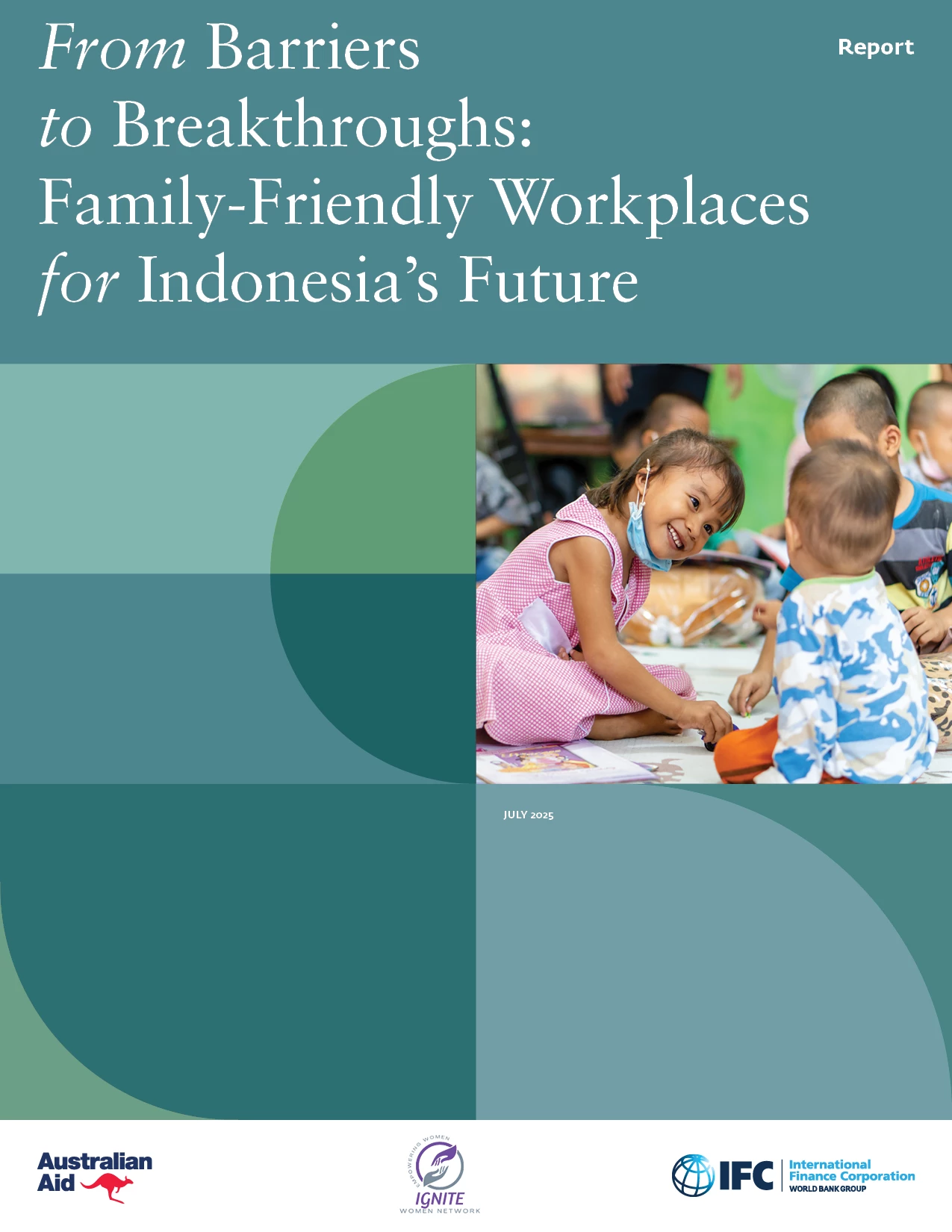
Jakarta, Indonesia, July 22, 2025 — Investing in family-friendly workplaces could strengthen Indonesia’s economy by improving productivity and enabling greater workforce participation, particularly among women. By addressing care-related challenges faced by many employees, businesses can create more inclusive environments, enhance performance, and support long-term economic growth.
These insights come from a new report, From Barriers to Breakthroughs: Family-Friendly Workplaces for Indonesia’s Future, published by the International Finance Corporation (IFC), a member of the World Bank Group and the largest global development institution focused on the private sector in emerging markets. The research surveyed over 2,000 employees from 13 private sector Indonesian companies across industries including financial services, manufacturing, consulting, retail, e-commerce, and food and beverages. Collectively, these companies employ 33,000 workers, 69 percent of whom are women.
The report reveals that unmet care responsibilities are a hidden cost to businesses. Half of working parents say childcare duties affect their performance, leading to an average loss of four workdays per employee each year, equivalent to 1.7 percent of total wage bills. Family-friendly policies, such as flexible work arrangements, childcare support, lactation rooms, and on-site or backup care, can reduce absenteeism and support women returning to work after childbirth.
“Care responsibilities are often an invisible drag on productivity,” said Euan Marshall, IFC Country Manager for Indonesia. “This research shows that when businesses take practical steps to support working parents, such as by providing flexible work arrangements or childcare support, they not only retain talent but also strengthen performance. Investing in people is good business.”
According to the International Labor Organization (ILO), more than one-third of Indonesia’s 208 million working-age people are outside the labor force, representing a significant untapped resource. Women far outnumber men in this group, with only 53 percent of women in the labor force, markedly lower than the 81 percent of men, a disparity that has persisted for the past two decades.
The World Bank estimates a 25 percent rise in women’s workforce participation could add up to $62 billion to Indonesia’s GDP. Yet caregiving responsibilities, especially childcare, continue to shape the choices working parents must make. Without access to reliable care, many working parents, particularly women, are unable to fully participate in the workforce. IFC’s report shows that family-friendly workplace policies can ease these pressures, helping more women thrive at work and contributing to inclusive economic growth.
The study, conducted with the support of the Australian Government, also found that 40 percent of employees take care of elderly relatives or family members with disabilities, with nearly a quarter responsible for both children and aging family members. These pressures contribute to absenteeism and staff turnover, underscoring the need for inclusive, flexible workplace solutions.
Developed in collaboration with IGNITE Women Networking and Mentorship Program, a national initiative aimed at empowering more Indonesian women to attain executive leadership roles, the report builds on IFC’s global Tackling Childcare initiative, which has delivered results in over 20 countries since 2017. It also sets the stage for IFC’s continued collaboration with the private sector in Indonesia to co-create practical care solutions that boost productivity, support working families, and advance inclusive economic growth.
About IFC
IFC — a member of the World Bank Group — is the largest global development institution focused on the private sector in emerging markets. We work in more than 100 countries, using our capital, expertise, and influence to create markets and opportunities in developing countries. In fiscal year 2024, IFC committed a record $56 billion to private companies and financial institutions in developing countries, leveraging private sector solutions and mobilizing private capital to create a world free of poverty on a livable planet. For more information, visit www.ifc.org.
Stay Connected with IFC on social media.
Contacts
Stay Informed
Sign up to have customizable news & updates sent to you.