

The World Bank Group Environmental, Health, and Safety (EHS) Guidelines are technical reference documents of Good International Industry Practice (GIIP). They are comprised of the General EHS Guidelines and Industry-Sector EHS Guidelines. When one or more members of the World Bank Group are involved in a project, the EHS Guidelines are applied as described in their respective policies and standards.
The EHS Guidelines specify the performance levels and measures that are generally considered to be good GIIP and achievable in new facilities by using existing technology at reasonable costs.
The applicability of the EHS Guidelines should be tailored to the hazards and risks identified for each project based on the results of an environmental assessment that considers site-specific variables, such as host country context, assimilative capacity of the environment, and other project-specific factors. The applicability of specific technical recommendations should follow GIIP and be based on the professional opinion of qualified experts.
The World Bank Group is currently updating the EHS Guidelines to reflect the most current GIIP.
General EHS Guidelines
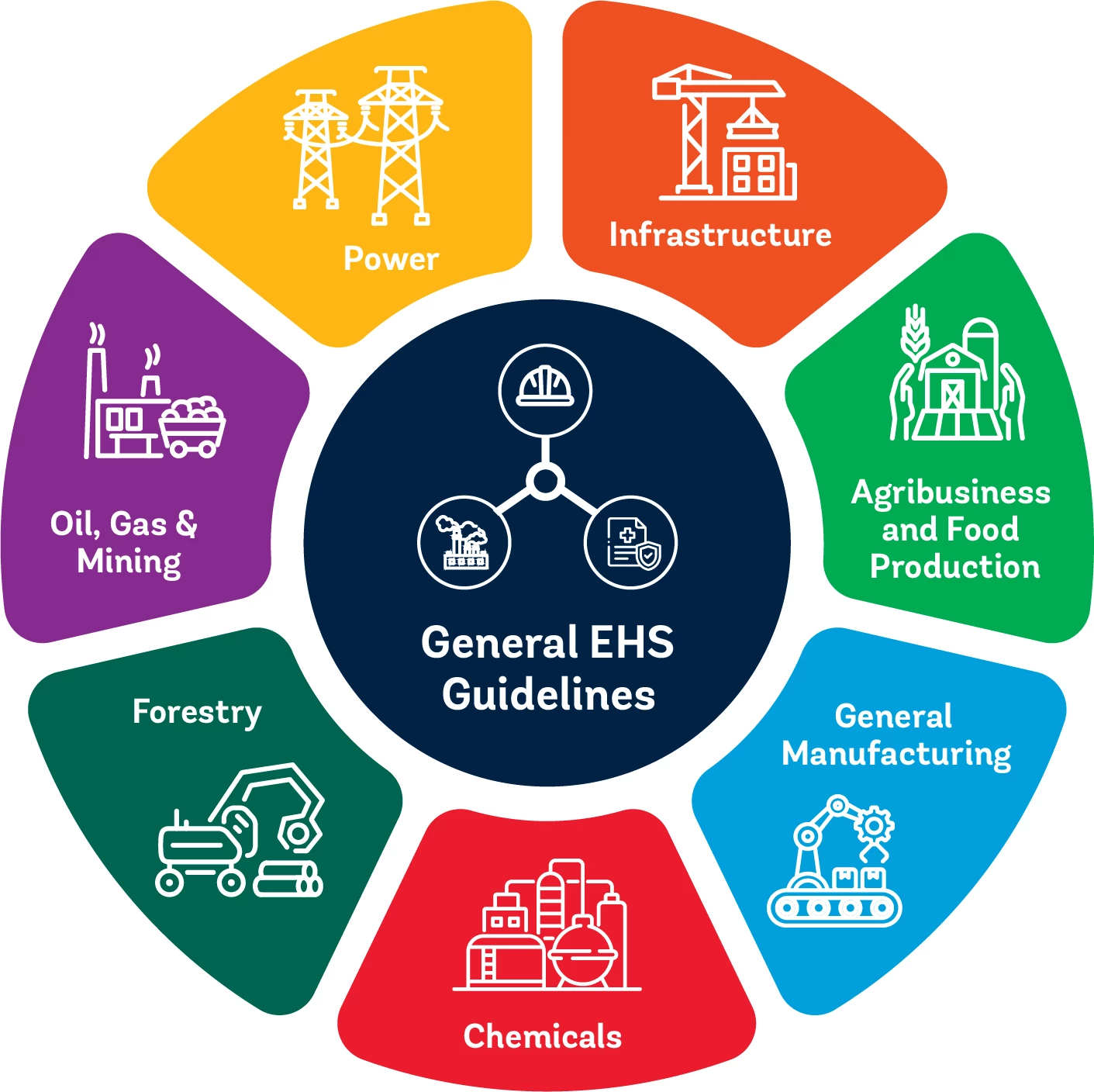
The General EHS Guidelines present information on common environmental, health, and safety (EHS) issues that potentially apply to and are relevant across industry sectors. This document should be used together with the relevant Industry-Sector EHS Guidelines.
Download General EHS Guidelines
The full document and individual sections of the General EHS Guidelines are presented below for download.
English | Français | Español | русский | 简体中文 | عربي | Tiếng Việt
2.1 General Facility Design and Operation
2.2 Communication and Training
2.3 Physical Hazards
2.4 Chemical Hazards
2.5 Biological Hazards
2.6 Radiological Hazards
2.7 Personal Protective Equipment (PPE)
2.8 Special Hazard Environments
2.9 Monitoring
3.1 Water Quality and Availability
3.2 Structural Safety of Project Infrastructure
3.3 Life and Fire Safety (L&FS)
3.4 Traffic Safety
3.5 Transport of Hazardous Materials
3.6 Disease Prevention
3.7 Emergency Preparedness and Response
Translations Disclaimer: The Environmental, Health, and Safety (EHS) Guidelines have been translated into other languages for your convenience. Reasonable efforts have been made to provide an accurate translation. The official text is the English version of the Guidelines. Any discrepancies or differences created in the translation are not binding and have no legal effect for compliance. If any questions arise related to the accuracy of the information contained in the translated Guidelines, please refer to the English version.
Industry-Sector EHS Guidelines
The Industry-Sector Guidelines are available for more than 60 industrial sectors and contain measures and performance levels expected to be met in each industry following GIIP. The Industry-Sector EHS Guidelines are designed to be used together with the General EHS Guidelines. For complex projects involving many assets, use of multiple Industry-Sector EHS Guidelines may be relevant.
An Overview of the Industry Sector Guidelines may be downloaded.
General and Industry-Sector Guidelines








Good International Industry Practice (GIIP) is defined as the professional skill, diligence, prudence, and foresight that would be reasonably expected from skilled and experienced professionals engaged in the same type of undertaking under the same or similar circumstances globally. The circumstances that skilled and experienced professionals may find when evaluating the range of prevention and control techniques available to a project may include, but are not limited to, varying levels of EHS capabilities and capacities, and financial and technical feasibility.
Last updated: December 2024