
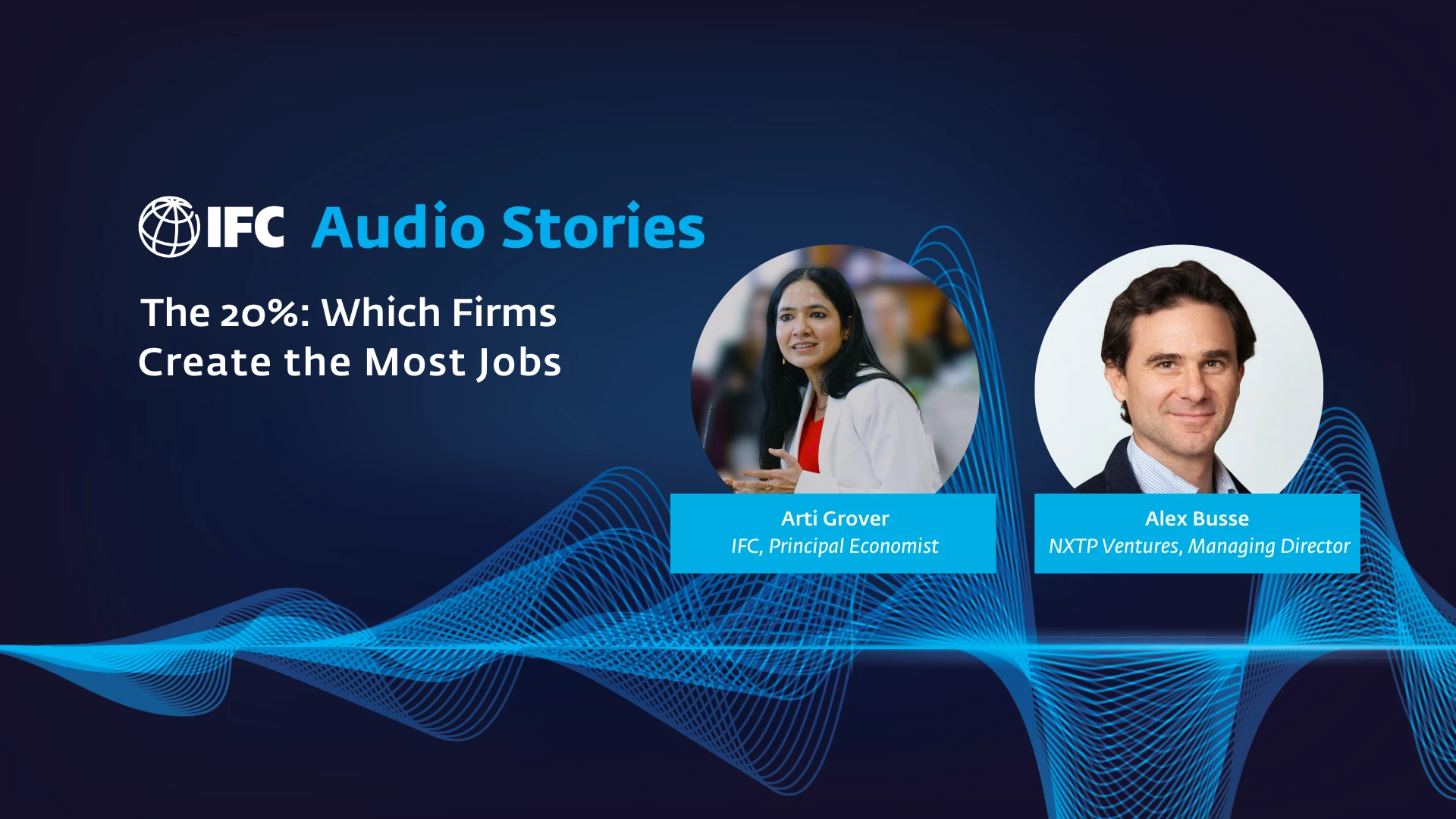
In this episode of IFC Audio Stories we explore why just a small share of firms, typically young, fast-growing businesses, are responsible for most job creation in emerging markets. IFC Principal Economist Dr. Arti Grover unpacks new research showing that age, networks, and capabilities - not size - are the best predictors of a firm’s job creation potential. Then, Alex Busse, Managing Director at NXTP Ventures, offers the venture capital perspective, sharing how early-stage investors identify and support the startups with the capacity to scale and hire. Click here for more on IFC’s insights on the firms that create jobs.
En este episodio de IFC Audio Stories analizamos por qué solo una pequeña proporción de empresas, generalmente jóvenes y de rápido crecimiento, son responsables de la mayor parte de la creación de puestos de trabajo en los mercados emergentes. La Dra. Arti Grover, economista principal de IFC, analiza una nueva investigación que revela que la cantidad de años de existencia, las redes y las capacidades, y no el tamaño, son los mejores indicadores del potencial de generación de empleo de una empresa. Posteriormente, Alex Busse, director gerente de NXTP Ventures, comparte la perspectiva del sector de capital de riesgo, y cuenta cómo los inversionistas en fase inicial identifican y apoyan a las empresas emergentes con capacidad para crecer y contratar personal. Haga clic aquí para conocer la perspectiva de IFC sobre las empresas que crean empleo.
Transcript - English
Lindy Mtongana: Welcome to IFC Audio Stories — where we explore private sector solutions to global development challenges. I’m Lindy Mtongana.
Today, we’re talking about jobs. Around the world the need for employment continues to grow but the firms driving job growth aren’t always the ones you expect. Infact a small share of firms, fewer than 20%, are responsible for most of the job creation. In this episode, we’ll look at why certain firms are so effective at creating jobs and how institutions like the World Bank Group can best support them.
We’ll start with insights from IFC Principal Economist, Arti Grover, who has been studying which firms create jobs, and why. Then we’ll hear from Alex Busse, Managing Director at NXTP Ventures, who brings the venture capital perspective, sharing how investors spot firms with the potential to grow, hire, and transform markets.
Lindy: Arti, welcome to the show.
Arti Grover: Thank you, Lindy.
Lindy: It's clear that creating more and better jobs is a key priority for the World Bank Group. So, what does your research tell us about the firms that in fact create the most jobs?
Arti: It's an important question because job creation is such a critical issue for economic development and for the World Bank Group.
So first, you know, the fact is, it is surprising. A small share of firms, called high growth firms, are responsible for a disproportionate share of new jobs. These firms represent fewer than one in five formal businesses, but they generate up to 60 to 65 % of new jobs. Yes, you heard that right. And they're not limited to one sector. You'll find them everywhere, from furniture makers in Ethiopia to textile mills in Brazil, computer electronics in Mexico and professional services in Hungary. But here is the catch, their growth spurts are episodic, which makes them harder to identify and support.
The second fact is that these firms tend to be dynamic. In countries like Brazil, Côte d'Ivoire, Hungary and Indonesia, a significant share of high growth firms are less than five years old. Young firms are more agile, they adopt new equipment, they update their processes faster and hire workers with stronger digital skills.
Third, location matters. Yes, even in the digital age, firms thrive in clusters or agglomerations where businesses, workers, and infrastructure come together. These clusters attract not only more, but also better firms, better workers, and better infrastructure.
The fourth fact is that firms plugged into value chains, whether multinationals, large firms or sophisticated suppliers accelerate job creation. In Viet Nam, foreign-owned factories drove employment growth as trade and investment expanded.
Finally, strong management and technology adoption are game changers. Better managerial practices boost productivity, expand firms, and improve working conditions. In Bangladesh, for example, better management promoted occupational safety and health compliance.
Lindy: There's such fascinating research, Arti. Based on what you’re saying, it's young firms that are playing a significant role in job creation. So what specific policies or interventions do you think are most effective in supporting these firms?
Arti : That's an excellent question. Supporting young firms requires answering two key questions. One is how do we generate more young firms? And second, how do we help the ones that have already entered the market scale up and thrive? So I propose four factors here.
First, let's talk about finance because access to funding is often the biggest hurdle for young firms. Seed capital, venture capital and mentorship programs like business accelerators can be transformative. For example, the World Bank Group has been investing in venture capital and private equity funds that focus on companies with high growth potential, exactly the kind of firms that drive job creation.
Second, the regulatory environment matters, a lot in fact. Streamlined registration and licensing procedures can lower entry barriers for productive young firms, while broader policies around labor, tax, property rights, and trade can ensure that resources flow to the most capable firms.
Third, young firms thrive when they're plugged into economic networks. Policies that connect young firms to local, regional, and global networks through supply chain financing, digital platforms, or partnerships with large firms can help them scale up.
Finally, programs that provide business training, mentorship, and access to productivity enhancing technologies can help firms grow and create jobs.
Lindy: Now one interesting thing that you mentioned a little earlier was that identifying high growth firms is challenging due to the episodic nature of their growth. So what tools or methodologies would you recommend for IFC in terms of being able to better screen and target those firms with high growth potential?
Arti: Identifying high growth firms is tricky. It's not just about finding the firms that are likely to grow. It's about identifying those firms that could grow but won't realize their potential without external support. This distinction is critical for designing effective public support interventions.
So how do we do this? Our research at the World Bank Group explores two practical approaches. The first is that we've developed a program readiness scorecard based on experimental data from several countries. It's simple. It's cost effective and easy to implement. It requires just a few targeted questions during the selection process.
The second approach that we are testing is to funnel high growth potential businesses in some countries. The idea here is that firms would start with low cost, low intensity programs, such as business training, advisory services, and only those firms that hit specific performance targets, such as revenue growth, operational improvements, job creation - they graduate to higher value program, which are more resource intensive and equip them with better skills.
Now this type of staged approach ensures that resources are allocated to firms with demonstrated growth potential while minimizing the risk of misallocating support.
Lindy: Arti, thank you so much. That was really informative.
Arti: Thank you.
Lindy: As Arti mentioned earlier access to funding is often the biggest hurdle for young firms. And its for this reason that venture capital can be transformative in the life of a business. Well IFC has a long standing partnership with NXTP Labs, an Argentina-based accelerator and early-stage seed fund. NXTP investments have helped companies grow and create jobs in a range of tech-enabled companies across Latin America.
To understand how NXTP identifies and supports the firms with the potential to scale and hire I spoke with the company’s Managing Director, Alex Busse.
Lindy: Alex, thank you so much for joining us on IFC Audio Stories.
Alex: It's a pleasure to be here. Thanks for having me.
Lindy: So, you meet early-stage founders all the time. What are the clues? I mean, what helps you spot a startup that could scale and eventually become a big employer?
Alex: So, in venture capital, we look to invest in businesses that we think can become what we typically say billion-dollar businesses. And what we typically see with that is that with that comes a lot of employment - pretty large teams that get built around the product and around the vision of these businesses.
And so broadly speaking, I would say there's like - if in order to our underwriting process - in order to see whether we think this could become a large employer or a large business, really, I would say three broad dimensions. One, the first one I would say is the team. The second one is the product and the third one is the market. And I would say really, the team is probably the most important and defining factor.
There's a plethora of characteristics that we look for. One of them really is, I would say, like the ambition of the founder: how unrelenting, how perseverant, how much of a fire do they have, you know, in their belly to really want to see this company and this product come alive.
The second one I would say is a good leading indicator for us is how, what we call, ‘customer centric’ they are. How much do they care about the problem that they're solving? How much time do they spend with their customers and their clients and really trying to create a tool that is solving a real pain point that they're seeing from their customers.
Then lastly, I would say they need to be pretty good salespeople. A founder of a tech startup is someone who sells to three different people, really three constituents. The first, they need to sell the vision of the business to investors. They need to sell the vision of the business to employees to attract the very best talent. And they need to sell the vision of the business to the customers that they're trying to sell the product to. So they're constantly telling the story about what it is that the company is doing. So that's a really, really core skill set that we see and that we look out for. And lastly, maybe just: can we see this person leading a very large business in five to 10 years?
Lindy: You take such a thoughtful approach to your investment decisions. It seems that it goes beyond what looks good on paper. Tell us more about how you support firms beyond the investment.
Alex: Ninety-nine percent really of what makes a company work has to do with the founders and the people that are day to day in the business. As venture capitalists, we try to nudge the business in the right direction where we can... where we can try and help these businesses. And I would say mentorship certainly is one of them. Being a founder is a profoundly emotional journey as well. So you get to create very strong bonds with the founders as they go through these roller coaster rides. One day you're on top of the world, the next day you feel like you're about to go out of business and this is something that routinely happens in startups. It's incredibly volatile and risky. And so that mentorship and that stewardship is something that we try to provide and we try to really create relationships with the founders that are built on trust. We have 100 plus businesses in our portfolio and we see multiple like three to 4,000 businesses every year, right? Just looking at business models. And so we try to share as much as we can with our portfolio founders to make their ride as smooth as possible.
Lindy: Could you share one example where all these puzzle pieces came together in terms of the team, the product, the market, the mentorship and you witnessed something pretty incredible in terms of a firm expanding and hiring and achieving great success.
Alex: Yeah, sure. There are a couple. I'll focus on one, which is, I would say from our Fund One portfolio. It's a company called NuvemShop. The best way to think about them is something like the Shopify for Latin America. So we funded them sometime probably around 2014. So the business has been around for over 10 years now. It was a team of four young engineers who had just come out of university. And we were the first to check into them and they started building the ‘Shopify for Latin America’ back then. This was something that was not as obvious as it is today, but this business has grown into an absolutely vital piece of infrastructure for Latin America because this is a business that is not only a very large employer [but] if you think about their effect, then again, the multiplier effect of a business like theirs, they are in turn basically providing all the technical infrastructure for, today, over a hundred thousand small businesses that are putting their businesses online so that they have the technological capabilities to sell online and to do it in a way that's easy for you to just create your online store. And so those are all small businesses and small merchants that today have a platform through which to sell. They in turn can hire more people. So I think it's a great story of a business that we saw from the very beginning to where they are today as a multi-billion-dollar business operating in Latin America.
Lindy: From your perspective where might you see opportunity for NXTP Ventures and development institutions like IFC to work together. What kind of backing do you think would really help firms grow and hire?
Alex: Just for context, IFC and NXTP have been partners for roughly 14 years now. So it's been a really, really long journey. And the IFC has really been absolutely key to NXTP's development. And so if you think about what it means for the IFC to fund a venture firm, so that the venture firm can then go out and find the very best businesses that then will then create those jobs. It really is like, it's kind of like a, I want to call it like a trickle-down effect cut funding venture firms, I think is a very, very important role that the IFC has played in the region. And I think with a lot of success. And then, you know, the second dimension is the IFC more on a business doing direct investing as well. And if you think about some of the perspectives that the IFC has by investing all over the world in emerging markets, they really have a lot of unique perspectives. A lot of the business models, a lot of the value propositions that we see are pretty similar across geographies. So the IFC's ability to also recognize certain patterns and recognize certain value propositions and businesses that have worked in other geographies and put those in touch and have founders create and be able to exchange ideas and learnings, I think is a really unique perspective that the IFC has. And again, the IFC has been an amazing partner to us over the years.
Lindy: Thank you so much Alex.
Alex: No, it's been a pleasure. Thanks so much for having me on.
Lindy: That brings us to the end of this episode of IFC Audio Stories. A big thank you to Arti Grover and Alex Busse for sharing their insights on the firms driving job creation. If you’d like to learn more about IFC’s research on job creation and high-growth firms, visit ifc.org.
I’m Lindy Mtongana. Thanks for listening
Transcripción - Español
Lindy Mtongana: Bienvenidos a un nuevo episodio de IFC Audio Stories, donde exploramos soluciones del sector privado a los desafíos del desarrollo mundial. Soy Lindy Mtongana.
Hoy hablaremos sobre el empleo. En todo el mundo, la necesidad de crear empleo sigue aumentando, pero las empresas que impulsan la generación de puestos de trabajo no siempre son las que uno espera. De hecho, una pequeña proporción de firmas, menos del 20 %, son responsables de la mayor parte de la creación de empleo. En este episodio, analizaremos por qué ciertas empresas son más eficaces a la hora de generar empleo y de qué manera instituciones como el Grupo Banco Mundial pueden brindarles un apoyo más adecuado.
Comenzaremos con Arti Grover, economista principal de IFC, que ha estudiado qué tipos de empresas son las que crean más empleo, y por qué. Luego escucharemos a Alex Busse, director gerente de NXTP Ventures, quien comparte la perspectiva del sector de capital de riesgo, y cuenta cómo los inversionistas encuentran empresas con potencial para crecer, contratar personal y transformar los mercados.
Lindy: Arti, bienvenida al programa.
Arti Grover: Gracias, Lindy.
Lindy: Está claro que la creación de más y mejores empleos es una prioridad clave del Grupo Banco Mundial. Entonces, ¿qué nos puedes contar sobre tu investigación de las empresas que generan la mayor cantidad de puestos de trabajo?
Arti: Es una pregunta importante porque la creación de empleo es un tema crítico para el desarrollo económico y para el Grupo Banco Mundial.
En primer lugar, resulta un hecho sorprendente. Una pequeña proporción de las empresas, denominadas empresas de alto crecimiento son responsables de un elevado porcentaje de los nuevos puestos de trabajo. Estas firmas representan menos de una de cada cinco empresas formales, pero generan entre el 60 % y el 65 % de los nuevos empleos. Sí, lo escuchaste bien. Y no se limitan a un solo sector. Se encuentran en todas partes: desde fabricantes de muebles en Etiopía hasta talleres textiles en Brasil, electrónica informática en México y servicios profesionales en Hungría. Pero aquí está el detalle: sus períodos de mayor crecimiento son episódicos, lo que las hace más difícil de identificar y apoyar.
El segundo dato es que estas empresas tienden a ser dinámicas. En países como Brasil, Costa de Marfil, Hungría e Indonesia, una proporción significativa de las firmas de alto crecimiento tienen menos de cinco años de antigüedad. Las empresas jóvenes son más ágiles, incorporan equipos modernos, actualizan sus procesos más rápidamente y contratan trabajadores con habilidades digitales más sólidas.
Tercero, la ubicación importa. Sí, incluso en la era digital, las firmas prosperan en grupos o agrupaciones donde confluyen los negocios, los trabajadores y la infraestructura. Estos grupos atraen no solo a más empresas, sino también a mejores empresas, mejores trabajadores y mejor infraestructura.
En cuarto dato es que las empresas integradas a las cadenas de valor ya sean multinacionales, grandes empresas o proveedores sofisticados, aceleran la creación de empleo. En Vietnam, las fábricas de propiedad extranjera impulsaron el crecimiento del empleo a medida que se expandía el comercio y la inversión.
Por último, una sólida gestión y la adopción de tecnologías son factores de cambio. Las mejores prácticas de gestión aumentan la productividad, permiten que las empresas crezcan y mejoran las condiciones laborales. En Bangladés, por ejemplo, una mejor gestión promovió el cumplimiento de las normas de seguridad y salud ocupacional.
Lindy: Se trata de una investigación fascinante, Arti. Según lo que planteas, las empresas jóvenes son las que están desempeñando un papel importante en la creación de empleo. Entonces, ¿qué políticas o intervenciones específicas crees que son más eficaces para apoyar a este tipo de empresas?
Arti: Es una excelente pregunta. Al abordar el apoyo a las empresas jóvenes hay que responder dos preguntas clave: la primera es cómo crear más nuevas empresas, y la segunda es cómo ayudamos a las que ya han están en el mercado a crecer y prosperar. De ahí que sugiero cuatro factores.
En primer lugar, hablemos del financiamiento, porque el acceso a los fondos suele ser el mayor obstáculo para las empresas jóvenes. El capital semilla, el capital de riesgo y los programas de tutoría como los aceleradores de negocios pueden ser transformadores. Por ejemplo, el Grupo Banco Mundial ha invertido en fondos de capital de riesgo y de capital privado que se centran en firmas con alto potencial de crecimiento, el tipo de empresas que impulsan la creación de empleo.
En segundo lugar, el entorno regulatorio importa, y mucho. Procedimientos simplificados de registro y obtención de licencias pueden reducir las barreras de entrada para las empresas jóvenes productivas, mientras que políticas más generales sobre el trabajo, impuestos, derechos de propiedad y comercio pueden garantizar que los recursos fluyan hacia las empresas con mayores capacidades.
En tercer lugar, las empresas jóvenes prosperan cuando están integradas a las redes económicas. Las políticas que vinculan a las empresas jóvenes con las redes locales, regionales y mundiales a través del financiamiento de la cadena de suministro, las plataformas digitales o las asociaciones con grandes compañías pueden serles útil para desarrollarse en mayor escala.
Por último, los programas que ofrecen capacitación empresarial, tutorías y acceso a tecnologías que mejoran la productividad pueden ayudar a las empresas a crecer y crear empleo.
Lindy: Ahora bien, algo interesante que dijiste hace un momento fue que identificar las empresas de alto crecimiento es difícil debido a que su crecimiento es episódico por naturaleza. Entonces, ¿qué herramientas o metodologías recomendarías a IFC para que pueda seleccionar y enfocarse más en aquellas empresas con un alto potencial de crecimiento?
Arti: Identificar las empresas de alto crecimiento es difícil. No se trata solo de encontrar empresas que tengan más probabilidades de crecer. Se trata de determinar qué empresas podrían crecer, pero que no alcanzarían su potencial si no reciben ayuda externa. Esta distinción es fundamental para diseñar intervenciones de apoyo público eficaces.
Entonces, ¿cómo hacemos esto? En nuestra investigación en el Grupo Banco Mundial exploramos dos enfoques prácticos. En el primero hemos elaborado una tarjeta del grado de preparación de los programas basada en datos experimentales de diversos países. Este enfoque es muy sencillo, eficaz en función de los costos y fácil de implementar. Solo se necesitan algunas preguntas específicas durante el proceso de selección.
En el segundo enfoque estamos tratando de encauzar empresas con alto potencial de crecimiento en algunos países. En este caso, la idea es que las empresas comiencen con programas de bajo costo y baja intensidad, como capacitación empresarial y servicios de asesoría, y solo aquellas que alcancen metas de desempeño específicas, tales como crecimiento de los ingresos, mejoras operativas y creación de empleo, pasan a programas de mayor valor, que requieren más recursos y les proporcionan mejores habilidades.
Este tipo de enfoque por etapas garantiza que los recursos se asignen a empresas con potencial de crecimiento demostrado, mientras se minimiza el riesgo de asignar apoyo de manera incorrecta.
Lindy: Arti, muchas gracias. Ha sido muy informativo.
Arti: Gracias.
Lindy: Como Arti mencionó anteriormente, el acceso al financiamiento suele ser el mayor obstáculo para las empresas jóvenes. Y es por esta razón que el capital de riesgo puede ser un factor transformador en la vida de un negocio. Pues bien, IFC tiene una alianza de larga data con NXTP Labs, un acelerador y fondo de capital semilla con sede en Argentina. Las inversiones de NXTP han ayudado a empresas a crecer y crear empleos en una amplia gama de compañías tecnológicas en toda América Latina.
Para entender cómo NXTP identifica y apoya a las empresas con potencial para crecer y contratar personal, conversé con el director gerente, Alex Busse.
Lindy: Alex, muchas gracias por acompañarnos en IFC Audio Stories.
Alex: Es un placer estar aquí. Gracias por invitarme.
Lindy: Tú te encuentras con fundadores de empresas en etapas iniciales todo el tiempo. ¿Cuáles son las pistas? Quiero decir, ¿qué les ayuda a detectar una empresa emergente que podría crecer y eventualmente convertirse en un gran empleador?
Alex: En el área del capital de riesgo, buscamos invertir en negocios que creemos se pueden convertir en lo que denominamos empresas de miles de millones de dólares. Habitualmente vemos que eso conlleva una gran cantidad de empleo: equipos bastante grandes que se construyen en torno al producto y la visión de estas empresas.
En términos generales, diría que, para nuestro proceso de evaluación, si queremos determinar si creemos que una empresa se podría transformar en un empleador importante o en un negocio a gran escala hay que abordar tres dimensiones generales. La primera es el equipo, la segunda es el producto y la tercera es el mercado. Pienso que el equipo es probablemente el factor más importante y definitorio.
En este sentido, buscamos una gran cantidad de características. Una de ellas se refiere al grado de ambición de los fundadores: cuán imparable, cuán perseverante son; cuánta pasión tienen para querer ver a su empresa y producto cobrar vida.
En segundo lugar, un buen indicador para nosotros es lo que llamamos “centrados en cliente”. Es decir, ¿cuánto les importa el problema que están resolviendo?; ¿cuánto tiempo dedican a sus clientes y usuarios, y qué tanto se esfuerzan por crear una herramienta que realmente solucione un problema concreto que han identificado en ellos?
Por último, diría que tienen que ser muy buenos vendedores. Un fundador de una empresa emergente tecnológica es alguien que vende a tres personas diferentes, en realidad a tres grupos. Necesitan vender la visión del negocio a los inversores, necesitan vender la visión del negocio a los empleados para atraer a los mejores talentos, y necesitan vender la visión del negocio a los clientes a los que están tratando de vender el producto. Así que están constantemente contando la historia sobre lo que está haciendo la empresa. Por lo tanto, es un conjunto de habilidades básicas que consideramos y que buscamos. Y, por último, quizás simplemente preguntarnos si podemos ver a esta persona dirigiendo una gran empresa dentro de cinco o 10 años.
Lindy: Ustedes adoptan un enfoque muy meditado en sus decisiones de inversión. Al parecer van más allá de lo que se ve bien en el papel. Puedes contarnos sobre cómo apoyan a las empresas, además de invertir en ellas.
Alex: El 99 % de lo que realmente hace que una empresa funcione tiene que ver con los fundadores y las personas que están en el día a día del negocio. Como capitalistas de riesgo, tratamos de orientar a las empresas en la dirección correcta donde podamos... donde podamos ayudar a estas empresas. Diría que la mentoría es, sin duda, una de esas áreas. Ser fundador de una empresa también es un camino profundamente emocional. Por lo que se pueden crear lazos muy fuertes con los fundadores a medida que atraviesan períodos de altibajos: un día están en la cima del mundo, al día siguiente sienten que están a punto de cerrar, y esto es algo que sucede comunmente en las empresas emergentes. Es increíblemente volátil y riesgoso. Y, por eso, tratamos de proporcionarles servicios de mentoría y dirección, y establecer relaciones con los fundadores basadas en la confianza. Tenemos más de 100 empresas en nuestra cartera, y consideramos muchas, entre tres y 4000 empresas anualmente, solo para analizar los modelos de negocio. Por este motivo, tratamos de compartir todo lo que podemos con los fundadores de las empresas que conforman nuestra cartera, para que su camino sea lo más fluido posible.
Lindy: ¿Podrías darnos un ejemplo en el que todas estas piezas del rompecabezas —el equipo, el producto, el mercado, la tutoría— se unieron, y fuiste testigo de algo increíble en términos de la expansión, la contratación y el gran éxito de una empresa?
Alex: Sí, claro. Hay un par de ejemplos. Me centraré en uno de ellos, que diría que viene de nuestro portafolio Fund One. Es una empresa llamada NuvemShop, que sería algo así como Shopify para América Latina. Le dimos financiamiento en algún momento, probablemente alrededor de 2014. Por tanto, el negocio existe desde hace más de 10 años. Era un equipo de cuatro jóvenes ingenieros que acababan de salir de la universidad. Fuimos los primeros en mostrar interés. Ellos comenzaron a crear el ‘Shopify para América Latina’. En ese entonces, esto no era tan obvio como lo es hoy en día. Pero este negocio se ha convertido en una pieza absolutamente vital de la infraestructura de América Latina, ya que no solo es un empleador muy importante, [sino que], si se piensa en su efecto, el efecto multiplicador de una empresa como la suya, básicamente están proporcionando toda la infraestructura técnica para más de 100 000 pequeñas empresas que están poniendo sus negocios en internet para poder vender en línea y hacerlo de una manera que sea fácil para crear una tienda virtual. Y así, esas pequeñas empresas y esos pequeños comerciantes tienen hoy una plataforma a través de la cual vender. Ellos, a su vez, pueden contratar a más personas. Se trata de una gran historia de un negocio que vimos desde el principio hasta el presente: una empresa de miles de millones de dólares que opera en América Latina.
Lindy: Desde tu perspectiva, ¿dónde ves oportunidades para que NXTP Ventures y las instituciones de desarrollo como IFC trabajen juntas? ¿Qué tipo de respaldo crees que ayudaría realmente a las empresas a crecer y contratar personal?
Alex: IFC y NXTP han sido socios durante aproximadamente 14 años, por lo que ha sido un camino muy, muy largo. IFC ha sido clave para el desarrollo de NXTP. Si pensamos en lo que significa para IFC financiar una empresa de capital de riesgo, que pueda luego encontrar los mejores negocios que más tarde generarán esos empleos, sería como un efecto de goteo, pero aplicado al financiamiento de empresas de riesgo. Creo que es un papel muy, muy importante que IFC ha desempeñado en la región, y lo ha hecho con mucho éxito.
La segunda dimensión es que IFC se centra en las empresas en las que realiza inversiones directas. Y si vemos algunas de las perspectivas de IFC al invertir en mercados emergentes de todo el mundo, encontramos que hay muchas perspectivas únicas. Muchos de los modelos de negocio, muchas de las propuestas de valor que vemos son bastante similares en todas las regiones geográficas. Por lo que la capacidad de IFC para reconocer ciertos patrones y ciertas propuestas de valor y de negocios que han funcionado en otras zonas geográficas, y ponerlos en contacto y hacer que los fundadores creen y sean capaces de intercambiar ideas y enseñanzas, pienso que es algo realmente único de IFC. Repito, IFC ha sido un socio increíble para nosotros a lo largo de los años.
Lindy: Muchas gracias, Alex.
Alex: Ha sido un placer. Muchas gracias por invitarme.
Lindy: De esta manera, finaliza este episodio de IFC Audio Stories. Agradecemos a Arti Grover y Alex Busse por compartir sus ideas sobre las empresas que impulsan la creación de empleo. Si desea obtener más información sobre la investigación de IFC relacionada con la generación de puestos de trabajo y las empresas de alto crecimiento, visite ifc.org.
Soy Lindy Mtongana. Gracias por escucharnos.