
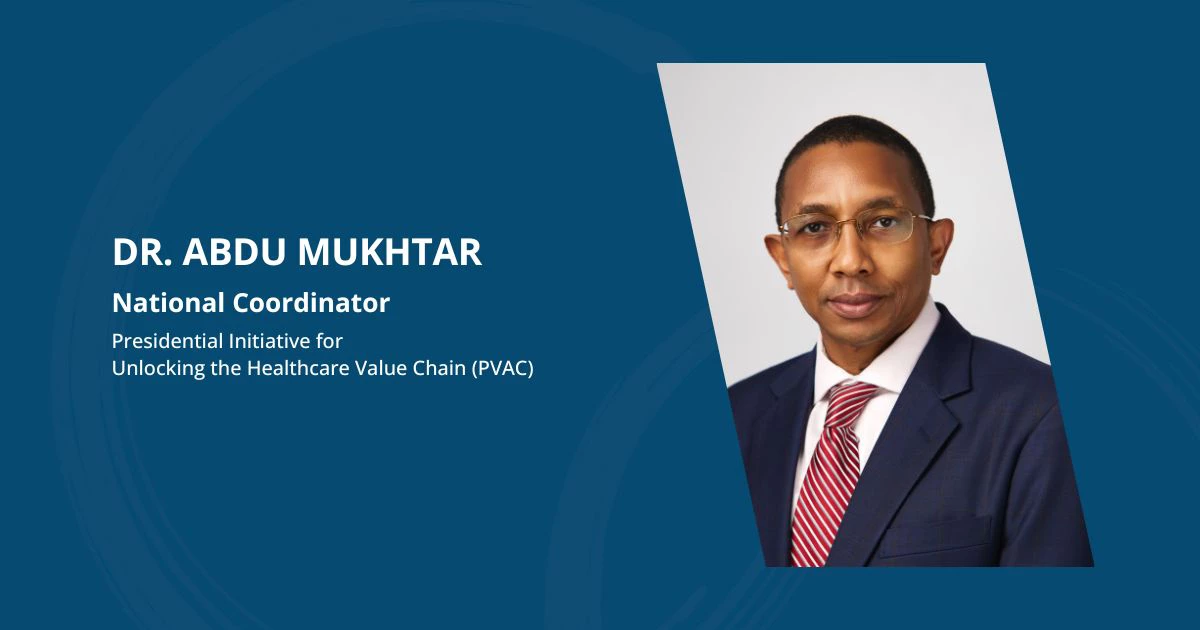
Q&A with Dr. Abdu Mukhtar, PVAC National Coordinator
The Nigerian government created the Presidential Initiative for Unlocking the Healthcare Value Chain (PVAC) to transform Nigeria’s healthcare ecosystem by boosting local manufacturing of pharmaceuticals, medical devices, and medical technologies. Dr. Abdu Mukhtar, PVAC’s National Coordinator, leads the country’s efforts to develop local production of health supplies. Here he explains why the private sector’s role in local pharmaceutical manufacturing is critical to Nigeria’s health and economic growth, how this can support job creation, and why pooled procurement is a “game-changer.”
Why was PVAC established?
Nigeria has 230 million people, and we don’t produce the majority of our health care products. We import 70 percent. How does that make sense? Our goal is to reverse those numbers and produce 70 percent of health care products locally by 2030. We should be at the forefront of manufacturing these items because this is Nigeria’s problem—and ultimately, our responsibility. PVAC was established to achieve this goal.
What motivates you to achieve this ambitious goal?
During Covid, I worked at the African Development Bank and led the response to the pandemic from a private perspective. There was no availability of masks or PPE [personal protective equipment], and we were running helter-skelter trying to get supplies. Even when we had the funding, there was nothing available. Then in other cases, we had to arrange delivery ourselves, and we faced so many logistical problems—for example, some deliveries coming from outside of Africa could only go as far as Ethiopia, and we had to arrange to get them from Ethiopia. Personally, I lost many relatives during Covid because there was a shortage of oxygen. The availability of oxygen serves as such a basic need for sick people. Why not just produce all of this in Nigeria?
Why do you believe the private sector can make a difference in local pharma manufacturing?
There are things government does well, but if you want to bring about growth, the private sector is necessary, too. The private sector is always driving innovation and creating impact—whether it’s with money, talent, or ideas. We have big ambitions in Nigeria, and at PVAC, the private sector offers us a lot of options for moving forward.
How does a government agency such as PVAC work with the private sector?
Our government officials meet with key industry [private sector] players. Some of their most common challenges include regulatory policies, infrastructure, access to finance and access to markets, capacity for research and development, and human capital—meaning there’s a shortage of people with the skills to do this work. Before, government agencies didn’t listen to these companies or weren’t responsive to their needs. Through platforms like our quarterly Pharma Consultative Forum, PVAC listens to them and explains what the government can do to help them. The private sector is capable [of doing a lot], so PVAC addresses their concerns and solves their challenges.
All of the challenges you mentioned above speak to the need for an enabling environment to attract talent and create jobs. Can this help keep talented professionals in Nigeria?
Brain drain is a problem. For talent to stay in one place, you must provide an enabling environment. The private sector can facilitate that enabling environment. We want to make doctors and professionals excited to work here by building the best facilities. By creating the right conditions for employment, such as fair compensation and the machinery, tools, and resources that allow doctors to help their patients, our home-grown talent will want to stay here.
What’s the role of technology transfer in creating a local pharma manufacturing sector?
Technology transfer needs to be unlocked so we can develop our own research and development capacity. PVAC is paying special attention to this and forging technology transfer agreements. This is an area that’s critical. One example of this might be with a company that’s looking to localize some products and raise funding from local partners. We can help make sure universities are part of the agreement so we can build centers of excellence at these research institutions. These become trusted local partners that promote growth.
What do you consider one of PVAC’s most impactful achievement so far?
We talked earlier about how a challenge for local manufacturers is access to markets. The market in Nigeria, as in other African nations, is very fragmented. We can help offer access to markets by shaping the market through pooling mechanisms, which allow for group purchasing of medicines at better prices. The President signed an executive order to incentivize the industry by creating a mandate for procurement with zero duties and long-term contracts. This laid the foundation for Medipool, a 20-year public private partnership arrangement. Medipool is a centralized platform that leverages the government's purchasing power for procuring and distributing medicines. It helps us negotiate prices with suppliers and improve access to quality pharmaceuticals. We now have the volume to help us negotiate the best prices, create distribution centers, and conduct quality assurance tests so there are no sub-standard drugs circulating. We feel that Medipool is a game-changer, not just for Nigeria but potentially throughout Africa. Procurement and quality control are problems throughout the continent, so we hope Medipool is a model for other countries.
Read more about how Africa is reshaping its healthcare ecosystem.