
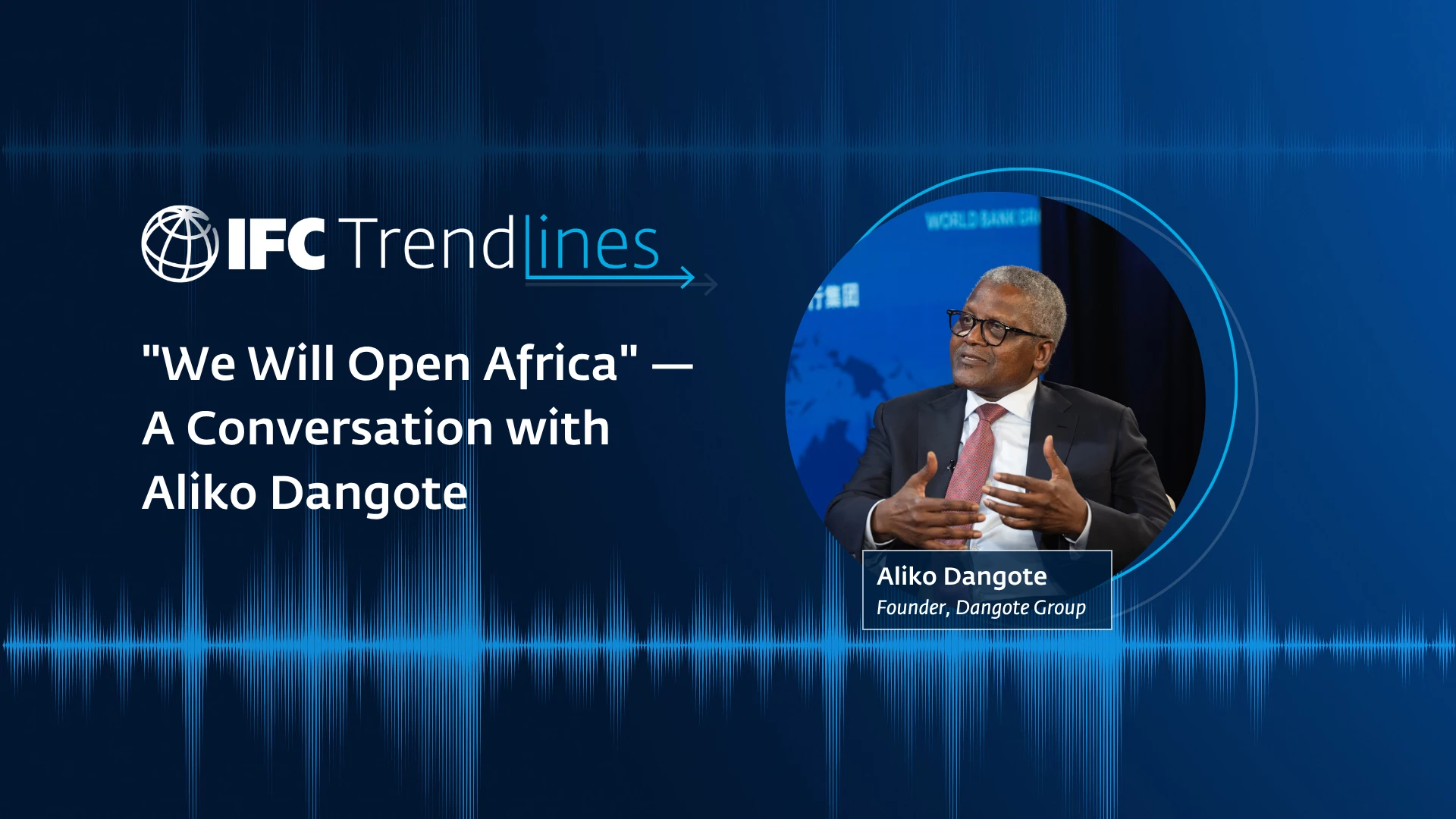
IFC Trendlines: Season 1, Episode 3
In this candid conversation, IFC Managing Director Makhtar Diop sits down with Aliko Dangote, Africa’s leading industrialist to explore the scale and urgency of building the continent’s economic future. Dangote reflects on his ambitions in energy, fertilizer, water and logistics, while making the case for African-led investment.
The discussion tackles persistent barriers like visa restrictions, costly intra-African trade, and fragmented markets, and the investments needed to overcome them. Dangote also shares his journey from early cement trading to building a global industrial powerhouse. With IFC’s support in focus, the conversation centers on turning ambition into results.
Transcript
Podcast Intro
Hello and welcome to IFC Trendlines: a podcast from the World Bank Group on private sector investment, mobilizing capital, and growth in emerging markets. I’m Lindy Mtongana.
In this special episode, we bring you a candid conversation between IFC Managing Director, Makhtar Diop and Aliko Dangote, Africa’s leading industrialist. From energy and fertilizer, to logistics, agriculture and water, Dangote lays out a vision rooted in African-led investment. With IFC’s partnership in focus, this is a conversation about the risks, decisions, investments, and leadership shaping Africa’s industrial future. Take a listen...
Makhtar Diop: Aliko, this is a huge pleasure to have you at IFC. I don't need to introduce Aliko Dangote, who is the largest investor in the continent, but not only in the continent, but one of the largest investor in the world and has been a transformative industrialist in the continent. We have been working with Aliko Dangote Group. But I want just today to have a conversation about your vision of Africa.
Last year, you set up a group called African Renaissance. Tell us, why did you put this group together?
Aliko Dangote: Well, thank you very much Makhtar, I must really thank you for doing a great job. My own vision of Africa - because I sat down one day and I said, okay, fine, everything is about potential, potential, potential. How do we get this potential into reality? How do you really, you know, make sure we translate for potential to real economic growth. And I said, let me get all the big guys in Africa who really care much about Africa, like-minds, and see how do we really sit down together and craft a vision for Africa.
Because when you look at it, every single thing you know is like, people are just putting roadblock for Africa to not escape our own cage, where we are. So we set up this group, which I'm very happy that you are accepted to be a member. You know, to say ok fine, you look at Africa today, um, you know, somebody like myself, I need 38 visas to move around. How do I now invest, if I'm not able to move around? I mean 38 visas? It doesn't make sense. Nobody has time to go and apply for a visa, take your passport and whatever. And most of them, they don't do visa on arrival. So we look at that one: free movement of people, free movement of goods and services. These are critical areas. Without this, there's no way we are going to have a very prosperous Africa, you know.
Because with this I cannot move my goods from Nigeria, from Lagos to Republic of Benin. And when you try to cross the border, you can be there for a week if you are lucky. If you are not lucky, you don't know anybody. You're going to be there for two weeks. There's no way you can do a trade with your neighbours like this.
Then we look at the sector of transportation. When you look at it, most of the people who own ships that move goods around, they are owned by other nationalities, not Africans. And it costs us, for example, to go from Lagos - I mean port - to Accra, more than coming from Spain to Lagos.
Then you talk about aviation. When you talk about aviation from Lomé to Accra, somebody will charge you $600. How do you move around? People cannot afford this kind of, you know, I mean, $600 is a lot of money.
Makhtar: Yeah but Aliko as usual, you are not taking a lot of credit for what you did. Let me push you a little bit on something. Yes, a lot of people have been talking about these ideas and there is a diagnostic. But the difference is that you're making it happen.
Aliko: That's true.
Makhtar: It's a different story. We all, in our professional careers, have seen a lot of discussion, diagnostics about the problems. But when we come to crossing the line and making it a reality.
Aliko: Delivery is an issue.
Makhtar: You go and did something which is quite amazing. Say, Nigeria now they need to use more value addition on something that it has in abundance, which is oil. And you build a refinery, I understand more than $20 billion. So, how did you this big idea came to you? And what were the steps? Because it was the first time you say that, people say, you know, Aliko is just dreaming, its not possible to do that. But you were persistent and did it. Why did you do it?
Aliko: Okay. You see, first of all, when you look at it, Nigeria, you’re right. We have a lot of oil. At one point, we were exporting 2.4 million barrels per day and not processing one barrel. Every single, you know product that we use, whether it's gas, oil, gasoline, jet fuel, everything is imported.
You know, Makhtar, to tell you the truth, Dangote Refinery was always on the agenda of discussion. Always.
And when you hear 650,000 barrels all the trading companies, all the big corporations, they always tell people openly ‘this refinery will never happen’. You know, at the end of the day, fast forward, Makhtar we as an African company, we've been able to deliver.
But let me tell you what will surprise you more, because, I mean, I must thank you for IFC taking also a risk on us because you are part of our pool of funding.
And to tell you the truth, at the time when I started this refinery, I have never, ever seen crude oil in my life. Never. Yes, never. I always avoid crude oil because for us in Nigeria, once you say that you are in oil, it's a dirty business. And I wanted to do a clean business, so I left the oil. It is just because I've seen my country suffering. I've seen that when I look at it, all African countries apart from Algeria and Libya, at that time, when we started - everybody was importing. Nobody had sufficiency in petroleum products. And I said, no, no, this cannot continue.
You know, we had to establish a company where we did the EPC, which is engineering, procurement and construction. Every single nut and bolts we bought - we shipped. Ordering of the equipments - we did. We put every single thing together to now achieve that. And now people have seen the benefit of it.
Today the refinery, we have tested the refinery up to 661,000 barrels per day. But we have been now stable for the last two months at 650,000 barrels per day, and every single department is working. So you can see that's what we have actually done. And when we look at it, Makhtar we say that okay, fine. You know, this thing now has removed fears in us. And we're saying that, you know, for Africa to develop, some of us, we must take that risk in terms of opening up Africa.
How do we open up Africa? We will open Africa by demonstrating that we believe in Africa, by investing our money in Africa. Because if I don't invest my own money, I can never go to any conference and convince people that Africa is a good place to come and invest. But right now, I have a voice. Right now I have a mouth to say, hey, come and invest in Africa because I have demonstrated that, look, these things are possible.
Makhtar: I see that you have been very deliberate in supporting African countries.
Aliko: You know, I feel much more satisfied as a human being to now take my continent out of trouble. How do I take my content out of trouble? Because we cannot continue. Every day we import food, we import whatever that we consume.
Okay, so we decided that, look, the best thing that for us to do is to look at what are the needs of Africa. And the needs of Africa is petroleum products, fertilizers. You know, today we are going to be - in about two and a half years - the largest fertilizer company in the world.
We are putting up 12 million tons of urea. We are opening up a mines of potash and phosphate in Congo-Brazzaville.
We are now going into power - 20,000MW. We are building the biggest deep sea port of 80m draft. Okay. We are doing LNG.
So why? Because we have now actually freed up our assets and we can actually raise more money. Our cash flow now is very, very strong. But what do you want to do with all this money. What we are trying to do is to now say, okay, fine. How can African countries and Africans most especially benefit from this?
Our own mission in Dangote is to look at critical needs of Africa and make sure that, yes, we make those critical areas a reality. Because if you don't do that, it's just like now you look at it, how can we in Africa be exporting 80% of the cocoa of the world? Every single cocoa is being shipped in beans. Simple. You process it. How much would it cost? And if you keep waiting for foreign investors; foreign investors are very smart. They are not going to come. They will only come when they see our own commitment. So that's why for us now. We have also changed because if you look at it, most of our companies we own super majority 89%, 90%, 92%, some 100%.
And we are saying that no, for us to grow up at scale, we need to make sure that we have partnership. We should also collectively get Africans to buy shares. Like now the refinery we are going to list. When we list, we are going to ask Africans to do... and we want to de-risk also their own capital. So when we are paying dividend, all our dividends will be in dollars.
And you can choose either you want naira or you want dollars or you want, uh, South African rand, whatever that you need, we will pay. But it is going to be calculated and paid for in dollars.
Makhtar: This point is very important for me because there is often, you know, some saying that all the private savings of the middle class is taken out of the continent and put in apartments in Europe or the United States. This is part of the story, we cannot deny it.
Aliko: But that's the truth
Makhtar: There is truth in it. But there is also the part of the story that people don't talk about a lot; its that when they have assets which are interesting and good quality assets people are investing in. If you take the West African Stock Exchange. Companies like Sonatel and so forth - Whenever they are issuing on the stock exchange people are oversubscribing. So, like you, I strongly believe that if you have quality assets on the continent where people can guarantee a return and with, uh, with a lot of stability, they will be investing in our assets.
What is your view about it?
Aliko: It is a great idea. Let me give you an idea. You know, let's say now, today we have a projection that our company based on the investments that we are going to make will end up having $100 billion of revenue, and a bidder will be minimum $30 to $35 billion. Let's say that, you know, the way that we always give a dividend, you know, at the company operational level, we have been giving very, very high dividend - sometimes we even give 90%.
But the parent company, which is Dangote Industries, we have never, ever given a dividend. I've never taken dividend, not one dime out of the company since when we started. Everything has been reinvested back into the business. That's why we were able to grow. So when you look at it, if we are now saying that at the end of the day, worst case scenario, we are going to give dividend of $20 billion.
Can you imagine if we have so let's say we will sell 25%. If you sell that 25% of this 20 - 25 billion, you are actually going to inject billions of dollars into the hands of all these Africans. Do you know what that can do? Its a life changing event. And that is why really we are now working with central Bank of Nigeria. We are working with the stock exchange, uh, of Nigeria. We're working with the Securities and Exchange Commission. And we are now trying to now make all these things happen while we, you know, Kenya, we put up like a vehicle and all the investment would be done there.
And now they will take the money into our company. When they want to sell down, you can always sell down because there is a certificate that you have. You can take your capital out at any time that you want, and majority of them too will.
Makhtar: Aliko this is something that we will really love to work with you. .
Aliko: I mean, you have more experience than us, so I'm sure this one IFC will definitely help to lead in this. You see, because if we open up something like this, I am telling you, we will end up paying maybe 20-25 billion of dividend to Africans. That is a lot of money.
Makhtar: It's a lot of money.
Aliko: It's a lot of money. So that is what we you know. So what are even for my own legacy really honestly, this one is a self satisfying event for me.
Makhtar: Another thing that you you have, you have been doing. And you came here and gives a keynote address on the water. So tell us, what are your project on in water?
Aliko: Our project in water. Now, what we are doing is actually like in agriculture. I keep saying that, you know, agriculture is not a poor man's business anymore. Uh, that is what can actually take our people out of poverty. So we became very, very interested in this, you know. And one time when you set off the financing for us, IFC led and put up, uh, you know, in 2005, you financed our first outing - $478 million.
Makhtar: I'm impressed with your memory. It was a while ago.
Aliko: Yes, it was while ago. And you took also risks on us. It was a seven year loan and we were able to pay it in 18 months.
Aliko: Okay, so when you look at that, when we finish - to keep telling you how important water is even to our own operation - normally in northern Nigeria, wherever you actually drill, you get water. But that area where we have the cement plant, there was no water at all. We were all hitting dry boreholes. Yes. Dry all over. And you cannot produce cement without water. I never knew.
Because the cooling of the equipments, all this one, you know it has to use water. So we had to go now and create earthen dam where luckily we are near by one river. And so we make it as a reservoir to reserve what we can have for two years, just in case that there is a drought. So with that, we were able to, you know, secure.
Today, my refinery cannot operate and produce good quality petroleum products without good treated water. In the refinery alone, we have 440,000,000l of treated water storage. We use a lot of water even though we recycle it.
So in the same vein, when you look at all the other businesses that we are doing - rice processing, rice mills - there must be water. If the quality of that water is not there. No production. The same thing with fertilizer.
Makhtar: You say that there are 400 mini dams in Nigeria - roughly, you told us. What will your plan for IFC and you and the world Bank Group as a whole, to work with you on these 400 dams? What do you envisage as big project or investment?
Aliko: I think what we need to do is actually - because some of them, they just need a bit of desilting and some of them, they need some repairs of the equipment, because they have not been put to use, all of them, the majority of them. So when we do this, what we are doing, all these people that are around the dams will actually totally transform their lives.
Once the dams are working, people will go now, they will farm. There is water. They can do irrigation when the irrigation is there, people can actually have a livelihood throughout the year.
So this one will empower people. It will take out poverty. It will create prosperity and all most of all these conflicts we are having especially in the Sahel. They will go away. Because why do you think that people want to go now and risk their lives and be notorious in killing people? It's because they have no jobs.
So these are one area which I believe ourselves as a private sector, IFC and the world Bank Group we should get together to find a solution.
Makhtar: It's quite interesting because, you know, you are working in various sectors from cement to, to oil and yes, refinery ...
Makhtar: How many people are in the group?
Aliko: Total direct and also through contractors we have about 51,800. But you know, the number is going to grow massively by the time that we open up the agricultural side.
To create more jobs and prosperity is to do agriculture. With agriculture, we'll get to maybe 200,000 jobs. And that's what will really give me self-satisfaction.
Makhtar: That's a really a common goal that a president Ajay Banga has. He has centred the whole of the World Bank Group around the objective of creating jobs.
You know something that I am passionate about. And I think that there is opportunity to work with your foundation and so forth, is to help at a much lower level the family business. The typical journey where someone who's a trader; he created his company, become wealthy, become a manufacturer, and now they go to the to the transmission of wealth to the children, who should be able to carry it to the next generation.
That journey for me would be essential in Africa. And what we start doing - that's why we created this local champion initiative - which includes supporting you - which is the top of the pyramid. But also thinking about the local level and what we learn is that they value the money that you are giving them, but they value even more the advice and the experience.
Aliko: You know, what you have described, you describe exactly Aliko Dangote. Because I started, when I finished school. I started with just selling, trading, selling four trucks of cement everyday. My uncle was giving me allocation of cement. I was taking the cement to, you know, sell. There was difficulty in getting cement at that time in Nigeria, so, the 500,000 naira, which was then $500,000, you know, I didn't use the money.
Three months later, I returned the money to my grandfather, who actually gave me the this, you know, But my uncle was in cement business. He was importing under the government license. And, I was getting four trucks everyday, automatic, you know, from him. People would come and pay me my money, uh, and say, okay, I'm going to come back in six months to collect my, you know, cement.
So I had too much cash. I return his cash. By that time, I was a bit risk averse, so I wanted to stick to my cement. It was only in 1981 that I started importation of, uh, you know, sugar. 5000 tons was the first license that I got to go and import sugar. So when you look at this, when you look back and say, okay, fine. You know, that's where I came from, selling of four trucks a day. And these are the kind of people, now that you are talking about, because I was there.
Makhtar: But I wanted people to hear those these stories. I know they heard part of these stories, but I think that the vision that we have for the content, I want you to to reiterate to everybody and clearly and unequivocally that we are fully supporting what you are doing.
Aliko: No. Thank you.
Makhtar: And for us, uh, the industrialization of Africa, we require people to take risks, to invest in it. And if institutions like ours are not here to support that, it will not happen. It will not happen. We need to take risks. We need to believe in the industrialization of the continent. And we need also to bring everybody around the table policymakers, industrialists and private sector like us, institutions like ours to try to do together. You have the full commitment of the World Bank Group in that
Aliko: We really appreciate that. And we recognize that. And honestly, what you said, you know, um, Makhtar you are really very right. We also realize that, uh, you know, one thing that you did, which I did, you mentioned to you that really touched not only me, the entire Dangote Group is the one we now call all our, you know, lenders.
And we say we are paying everybody off, IFC insist that no, they are not going to take their money. Their money must be put into Dangote Fertilizer, which is I mean for us, we say yes. You know, if the if the interest that you have shown that you want us to work together to transform Africa is not only also about money. What you get from IFC is also the advice. Because the pool of experience that you have, the pool of people that have been dealing for donkey years, that you have all this experience.
You give us advice in areas where we are not doing well, like in social and environmental issues you make sure that yes, we you know, we behave very well. So we are really very, very appreciative. I mean, we couldn't have asked for a better time with World Bank. You are my brother. You're my personal friend. Ajay Banga, yes, we've been friends for a very long time. And when he became, president of the World Bank we’re actually even closer now. So, uh, our work with world Bank and IFC will continue to grow. We need your support and we will make the lives of Africans better.
Makhtar: Aliko. It's a huge pleasure. Thank you so much to receive you here in a in a in IFC. Thank you. And we will continue working with in the Africa Renaissance Group, with your personal business. And, uh, we, we keep the eye on the prize which is to make Africa to really grow. And people getting jobs and proud of being who they are and being, you know, uh, moving in the right direction. So thank you once again very much for your time.
Aliko: Thank you. Thank you so much. It's great to be here. And I promise you, the relationship will now go into a new phase.
Makhtar: Thanks.
Aliko: So thank you. Thank you. Thank you.