
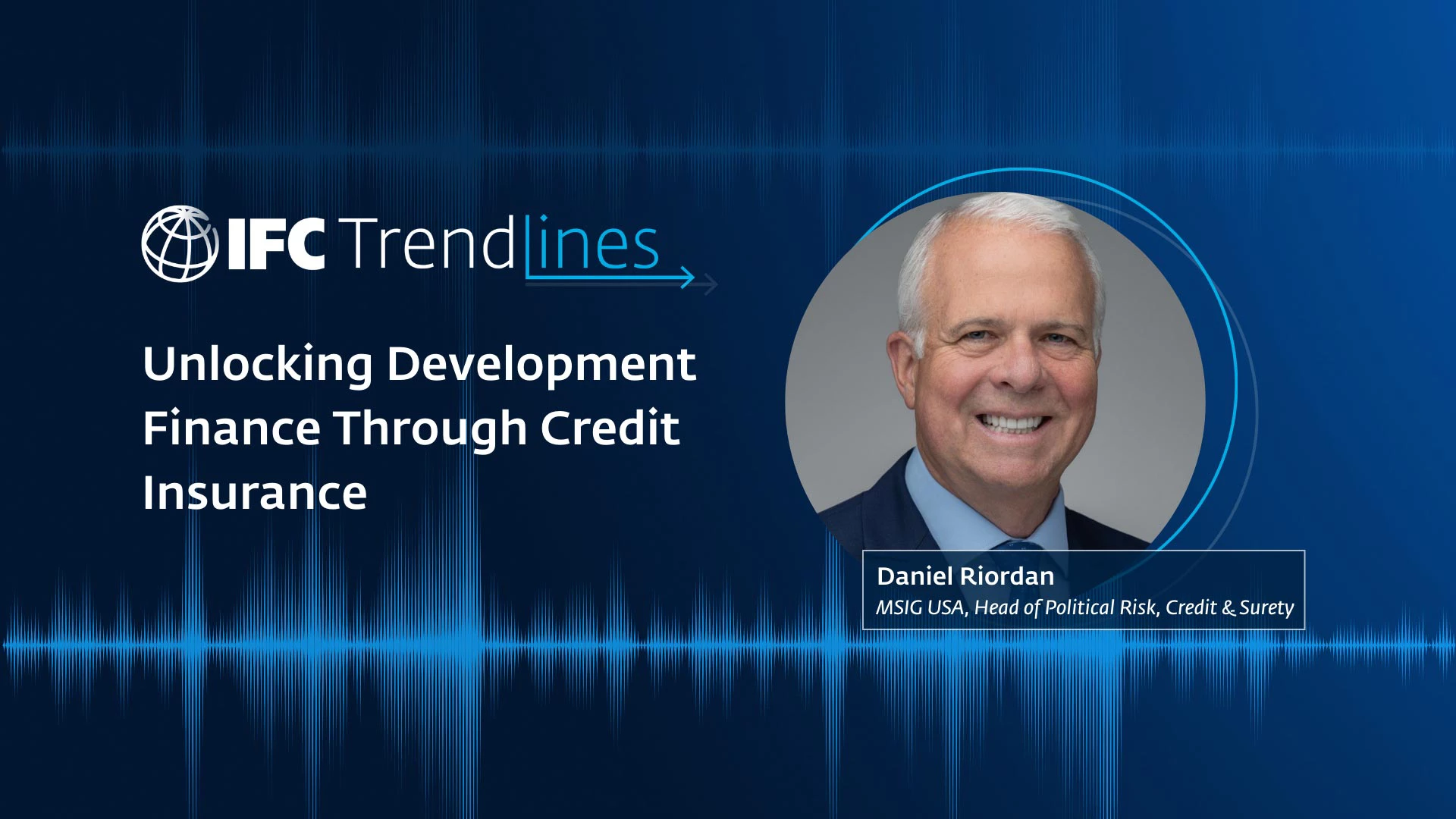
IFC Trendlines: Season 1, Episode 2
Risk is often what stands between small businesses in emerging markets and the capital they need to grow. In this episode of IFC Trendlines, Mahfuza Afroz, IFC's Global Head of Credit Insurance, Syndicated Loans and Mobilization, sits down with Daniel Riordan, Head of Political Risk, Credit & Surety at MSIG USA — one of the world's largest insurance groups - to explore how credit insurance is reshaping development finance.
IFC's latest Managed Co-Lending Portfolio Program (MCPP) for credit insurers is a $6 billion facility backed by 19 global insurers. Daniel shares what drew MSIG USA to the program as a first-time participant, and how such partnerships facilitate capital flows to small businesses in emerging markets.
Transcript
Intro VO: This is a podcast of the International Finance Corporation
Opening Quote
Daniel Riordan: Collaboration works best when the partners look to each other as long term strategic partners and not opportunistic partners. And I do think that's really what separates those private insurers who really have an interest in this area from others.
Mahfuza Afroz: Welcome to IFC Trendlines. I'm your host. Mahfuza Afroz, IFC's Global Head of Credit Insurance, Syndicated Loans and Mobilization.
There's no shortage of capital in global markets, but access to it remains uneven. In emerging markets many businesses, especially smaller ones, still struggle to get financing. And one major reason is risk.
So, what if that risk could be shared differently? Over the past several years IFC has partnered with global insurers to do exactly that; sharing risk across diversified portfolios through credit insurance. The result? Commercial returns for insurers, greater lending capacity for IFC, and more financing reaching businesses in emerging markets.
When we first began exploring this model, it was very much a test: whether insurers would move beyond individual transactions into portfolio risk-sharing as a primary insurer. Seeing it evolve into a multi-billion-dollar platform, has been encouraging. The global insurance industry holds enormous underwriting capacity. When that capacity is deployed strategically alongside strong origination, structuring and partnership, it really can unlock meaningful opportunity in emerging markets.
And joining me today is one of the partners behind this effort. Daniel Riordan has decades of experience in political risk and credit insurance, having held senior leadership roles across the industry. Currently he is head of political risk and credit at MSIG USA, where he leads the growth of the firm's portfolio. Dan, welcome to Trendlines.
Daniel Riordan: Thank you. Thank you for having me.
Mahfuza: Dan, there are a lot of people listening out there who don't necessarily understand what a risk sharing facility like this is. So can you explain, in your own words, what the latest MCPP facility that IFC has offered and that you have participated in, is all about?
Daniel: Certainly. As a private insurer, we know there are other private insurers who will be interested in the MCPP particularly the facility that we've just supported. Why? Because it opens up great opportunities to participate in international lending with very important financial institutions and emerging markets. Really an opportunity to for us as an insurer, to have an impact on development. And I do think there will be further interest. I know there already is quite a bit of interest. There'll be further interest among different insurers to participate, particularly when you think of the ability to for us to have an impact on small and medium sized enterprises. Again, very important for MSIG USA to have that development impact. We look for that opportunity, but very hard for us, on a case by case, individual basis, to be able to accomplish that. The portfolio you've created and really the focus on those financial institutions provides us with a unique capability.
Mahfuza: So there's a lot of alignment of interest right between what IFC wants to do and the World Bank Group largely wants to do and what insurance partners also seemingly want to do. This is MSIG’s first participation in the MCPP series. I'm wondering, what was the motivation behind stepping into this program now, and what does it say for other private insurers who might be looking at this space?
Daniel Riordan: So we know the IFC, and I've had the opportunity of working with the IFC over the years in our careers, many of us at MSIG, so it was an easy fit for us. We followed the development of the MCPP program. We were delighted with really the level of technical expertise, the leadership that the IFC has presented in this very unique portfolio of credits that have been amassed through the MCPP. We also think very highly of the underwriting standards that are used at the IFC. We look at really the IFC’s ability to manage risk, as in the risk management capabilities. And then, of course, we also importantly look at the development impact of the of the IFC, and our ability to have an opportunity there. Because a very important thing within MSIG USA is the basic tenet to have a source in the secure sound future of the planet. That is a mainstay of the development mandate of our insurance company.
Mahfuza: That's fantastic. So, it's familiarity with us from your previous experiences, the underwriting quality of IFC, and really the kind of opportunities we present in terms of the future, right? You touched upon SMEs, you know small and medium enterprises. Can you explain how this actually helps them? Especially since there's such a dearth of capital available for such, you know, SMEs in the emerging markets.
Daniel: So, I mean, I do think it helps them, because I think for those SMEs to benefit, they definitely need an organization like the IFC. The IFC has impressed me over the years with its commitment to development in various emerging markets, and the fact that you have staff on the ground. That gives us a lot of comfort as a private insurer, to know about that depth of understanding, depth of knowledge, and the collaborative nature you have with those SMEs in the different markets. And I think that's a real credit to the IFC and how it's been able to identify those opportunities for investment.
Mahfuza: I love how you're able to describe what IFC does, like literally. So, you know, you've been a pioneer in this industry for quite a while, and I'm wondering how you've seen risk sharing evolve over the years and decades.
Daniel: Certainly, certainly. With over 30 years of experience in the private sector now in the industry as a whole, I first worked in government and then moved to the private sector, I've been able to see and help in developing some of the instruments that we now find rather commonplace in terms of the collaboration. It didn't always exist. I would say in the last 15 years, it is a phenomenal increase, and it's and it's benefiting the countries that we operate in. It's benefiting the communities that I think we can support together. But that's quite a bit of effort to try to pull that together. And now it's not unusual, you know where you see a press release, for example, on announcing a new facility. Ten or fifteen years ago, it was almost unheard of. You just didn't see as much of that. Now it's really grown significantly, and I think to everyone's benefit.
Mahfuza: That's fantastic. So the partnership itself has evolved, right? It's not just insurance, it's MDBs that have a lot more to offer. You are willing to lean in a lot more. So from your perspective, I'm wondering, what kind of advice would you give to a development institution like IFC or other MDBs out there as to how we should be partnering with you and what kind of innovation we should be considering with insurance companies.
Daniel: So, I think that the IFC can serve as a role model for other development finance institutions. I do think many of them are starting to move in the direction of away from just one-off type of transactions where we are often providing them with facultative reinsurance to more portfolio concept. It does, it does provide further diversification, which is very, very important for insurance companies to have a well-diversified portfolio. And your efforts to MCPP bring that diversified portfolio, along with risk management, along with the technical expertise that I do think a lot of the other DFIs can learn from.
Mahfuza: So, if I flip the question a bit now, let's look at it from an insurer’s perspective. For those private you know, insurers who are considering working with MDBs, what piece of advice would you have for them?
Daniel: Yeah, so my advice is to really get to know your partners, always. In business that's a basic concept. But I think the collaboration does require the private sector to learn what's the drivers to study their partners, to see how they assess risk, how they manage their aggregations, how they manage their business, to further the understanding, which I think has increased quite a bit over the years. So, I think that collaboration works best when the partners look to each other as long term strategic partners and not opportunistic partners. And I do think that's really what separates those private insurers who really have an interest in this area from others.
Mahfuza: And that's a great point. I think the long term partnership has to be kept in mind. You can't just be in and out right. So we're almost at the end of this. I'm wondering if you have some final words of wisdom, whether it's on credit insurance, risk sharing, or development finance in general?
Daniel: I mean, I would think kind of speaking to the private insurance markets too. I would, I would say there often is concern about emerging markets. They're often concerned about volatility in emerging markets. One specific way to really start a relationship, and to look for those opportunities is to partner with DFIs, with multilaterals, who actually have long term experience. I do think that that is not something to be afraid of. That's something to embrace. And I think there's a lot of good business for them in in that in that instance.
Mahfuza: Fantastic, so don't be afraid. Don't be afraid. Engage. Okay. Dan, thank you so much for the conversation.
Dan: Thank you for having me.
Mahfuza: What began as a $1 billion facility with two insurers under our Managed Co-Lending Portfolio Program, or MCPP, as it's more widely known, has grown into IFC’s largest private capital mobilization under a single agreement with the signing of this latest facility. It's a mammoth $6 billion credit insurance facility backed by 19 global insurers helping unlock lending to banks and financial institutions that serve small and medium sized businesses across emerging markets.
To stay ahead of the trends shaping emerging markets and private investment. Subscribe to the IFC Trendlines newsletter and podcast. I'm Mahfuza Afroz. Thanks for listening.