
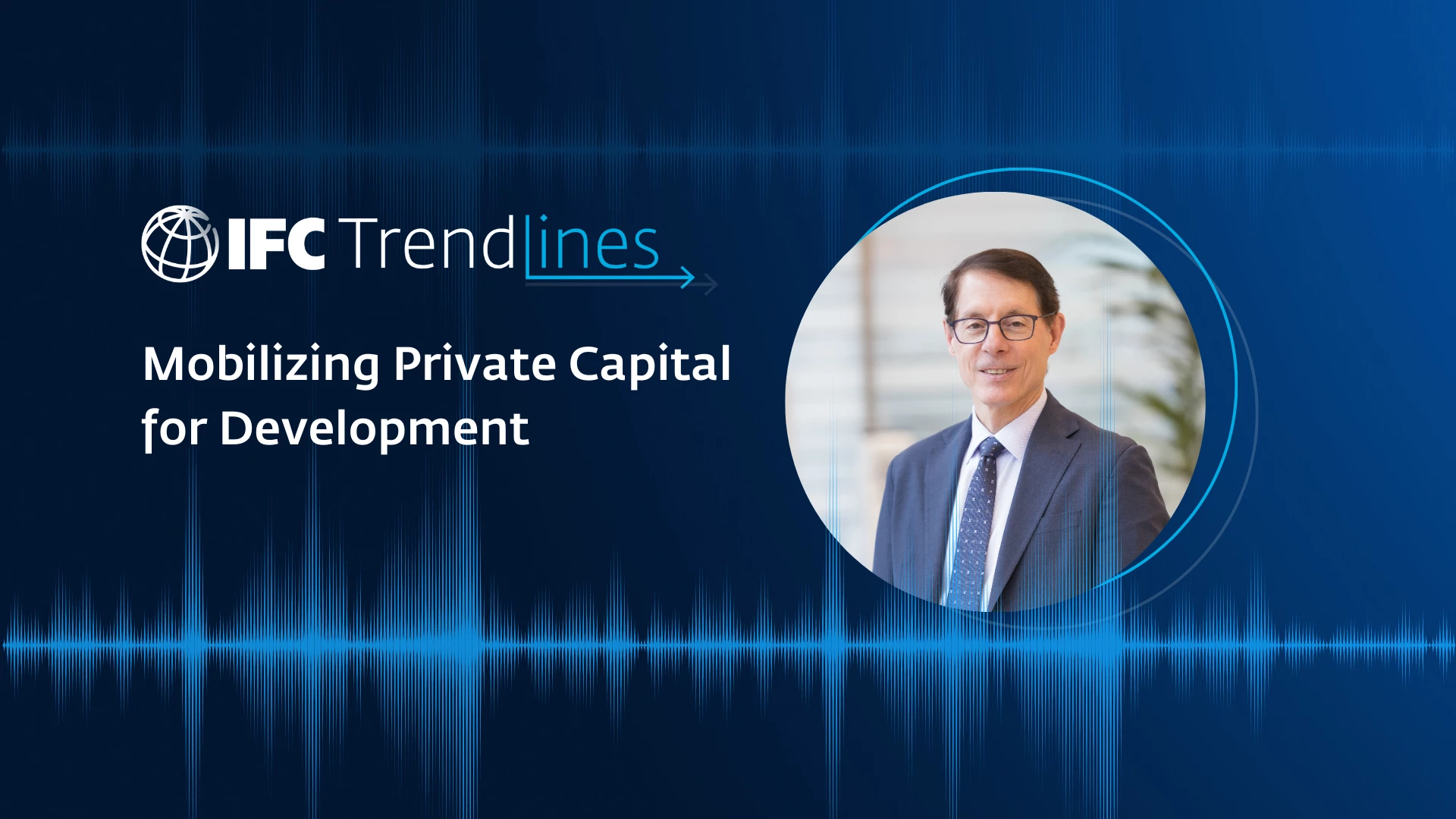
IFC Trendlines: Season 1, Episode 1
Attracting private investment into developing countries is crucial for their development. In this first episode of IFC Trendlines, IFC Vice President and Chief Financial Officer John Gandolfo joins host Daisy Serem to discuss what this means for investors, how IFC – a member of the World Bank Group - helps manage risk in emerging markets, and the financial instruments being used to mobilize more private capital. The episode also explores where investment opportunities are emerging and which sectors are driving jobs and growth across developing economies.
Transcript
Daisy Serem: Hello, and welcome to IFC Trendlines - a monthly podcast from the International Finance Corporation – a member of the World Bank Group -, and the audio companion to the IFC Trendlines Newsletter. I’m Daisy Serem, and I’m pleased to host our very first episode.
Today, we’re talking about private capital mobilization - why it matters, what investors are looking for, and how institutions like IFC are responding.
Joining me to discuss this is John Gandolfo, IFC’s Vice President and Chief Financial Officer. John oversees IFC’s debt and equity capital mobilization, blended finance and global investor relations as well as IFC’s financial strategy and reporting. He spends much of his time speaking directly with private investors about how they assess risk, opportunity and impact in emerging markets. John, welcome to IFC Trendlines. Thank you so much for joining us on this very first episode.
John Gandolfo: Thank you very much, Daisy.
Daisy: As you look across emerging markets, what are your priority areas that you believe will create the most meaningful opportunities for investors and deliver strong development impact,
John: Our main focus is to create more jobs, and creating jobs is the best way to lift people out of poverty, creating jobs that allow them to earn an income that brings them out of poverty and creates new opportunities for them. We think that focusing on high impact sectors where there's the greatest opportunity to create jobs is the best way for us to do that, and that includes focusing on infrastructure and energy, agribusiness, healthcare, tourism and value added, manufacturing. These sectors employ large numbers of people and also unlock broader economic opportunities. So, we think there's a lot of value of focusing on these sectors as a way to create jobs. And let me give you two examples of initiatives that we have going on within the World Bank Group. One is that one that we call Mission 300, and Mission 300 is an incredible initiative that really aims to expand electricity access to 300 million people living in Sub Saharan Africa by 2030. Reliable energy is key to creating jobs and growth and opportunities. Also, by doing that, we can create opportunities for institutional investors to invest in providing and developing reliable energy in in Sub Saharan Africa. Another initiative is one that is designed to connect farmers to better markets and finance opportunities so that they can become commercially sustainable. So those are two examples of initiatives that we have underway that we think fundamentally will help to create jobs, promote livelihoods, and ultimately lift people out of poverty.
Daisy: Private capital has become increasingly important to development financing over the years. How did we get here, and why is this central to the World Bank Group strategy?
John: Today's global economy faces a profound imbalance. Capital continues to pool in developed markets, while human capital potential and growth opportunities are very significant in emerging markets. At current trends, the number of young people that will be entering the workforce in the coming years is far in excess of the jobs that are available. So, it’s clear that public funds, and from governments in emerging markets, and development finance is insufficient to close the development finance gap. And it's over the last couple of years, leaders of the G20 and other stakeholders of multilateral development banks have been asking all of us in the multilateral development bank community to attract more private capital to invest in emerging markets and to help close that development finance gap. And in response to that, we are focusing all of our attention on private capital mobilization, and that means creating interesting, bankable investment opportunities, as well as finding ways to de-risk projects and create opportunities that meet the investment and risk-return preferences of institutional investors. And I would just say that if we can attract just a fraction of the hundreds of trillions of capital that's available in institutional investors, asset managers, asset owners - that will go a long way to helping to close the development finance gap.
Daisy: So, when we look at this focus of attracting private capital, what would you say is the value proposition for global investors who are looking to invest alongside IFC and other multilateral development banks? What are the opportunities in emerging markets?
John: When investors invest alongside multilateral development banks, they have the opportunity to earn attractive financial returns while at the same time supporting the long-term development of emerging markets. And investing alongside multilateral development banks gives institutional investors access to investment opportunities and sectors that they may not have access to because it's difficult to enter alone. They also benefit from the extensive experience over many decades that multilateral development banks have been investing in emerging market, they benefit from that experience and knowledge that has been developed over many years. Similarly, the multilateral development banks do significant due diligence, including financial, legal, environmental and social, that helps to mitigate the risks associated with investing in emerging markets and when challenging situations arise, we're there to help work out the situation and retain value. Also, studies have shown, after looking at very extensive histories of the risk characteristics of multilateral development bank originated investments in emerging markets, that the risk profile is also better, and that means that the default rates are lower and the recoveries are higher than otherwise one would have been expected. And finally, when you invest alongside a multilateral development bank like IFC, you also have the benefits of diversification across the entire emerging market universe.
Daisy: So, you obviously are spending a lot of time engaging with investors, and maybe you can give us an inside scoop on what you're hearing from them. Why do you think they are hesitant to invest in emerging markets?
John: There's a relatively long list of reasons why institutional investors are slow to move to emerging markets, and some of those start with: it could be political risk, i's the regulatory and policy environment, it's the availability of quality investment opportunities. There's financial risks like foreign exchange risk that that is there because of, in some cases, underdeveloped local capital markets and maybe even the investment products and tools to access emerging markets. So we know the list of impediments to attracting institutional investors to invest in emerging markets.
Daisy: How can multilateral development banks, particularly IFC, help address these concerns?
John: We can help to address those concerns, those barriers to investing in emerging markets by supporting governments to strengthen their local regulatory and policy environments, to create the right enabling environment for investors to invest, by helping to develop the local capital markets, also by providing risk mitigation tools, like, for example, through the World Bank Group Guarantee Platform, giving access to political risk insurance or credit guarantees that mitigate the risks of investing in emerging markets, and developing products that investors are both familiar with and allow, let's say, the tranching of the risk of the of the investments to create the kinds of risk characteristics that are acceptable to institutional investors.
Daisy: And I think that's a good way to segue into our next question, which is around some of the range of financial instruments that the World Bank Group offers to meet different investor needs. And one example is the new Emerging Market Securitization Program. Can you talk about the thinking behind this program?
John: So this Emerging Market Securitization Program has been in development for the last couple of years, and really we wanted to create a product that makes it easier for investors such as pension funds, insurance companies and asset managers to invest in emerging markets, in the risk and return characteristics that they're comfortable with. So this program pools IFC originated assets into a vehicle, a standardized investment vehicle, that institutional investors fully recognize. We created a $510 million program and we launched it last summer and closed it in September. This vehicle is tranched into a AAA tranche, which we sold off to institutional investors and we listed that tranche on the London Stock Exchange, a mezzanine tranche and an equity tranche. IFC and the UK Mobilist were the equity owners, and by being the equity owners in this structure, it means that we are de-risking the investors that come into the higher levels in the in the capital stack of the transaction. And I think the program really shows that we can put together packages of emerging market assets. We can tranche them into different risk characteristics, and we can place them with institutional investors in ways that meet their investment preferences. And you know, our long term vision for this is to continue to issue at a regular cadence and to eventually develop an asset class of emerging market securitized assets that is attractive to institutional investors.
Daisy: Well, it sounds like there's a lot of work underway that is keeping your team very busy, and you've talked a little bit about your long term vision looking ahead. What should investors be watching from IFC and the World Bank Group in the near term.
John: We will be developing new products, new instruments and new pathways for institutional investors to be able to invest in emerging markets. And in order to develop these pathways, we are spending a lot of time, again, engaging with institutional investors, but also through our originate to distribute initiative in the World Bank Group and through the Private Sector Investment Lab. Both were initiated by our president, Ajay Banga. We are also creating an online tool that will allow us to match the investor risk-return interests and our pipeline so as to be able to seamlessly put together and match these. And in that way, we can show the kinds of investment opportunities to institutional investors that they're looking for.
Daisy: Well, thank you so much, John, for sharing your insights. I really enjoyed this conversation on IFC Trendlines. Thank you.
John: Thank you very much, Daisy.
Daisy: Here are a few highlights from this month’s IFC Trendlines Newsletter.
At the World Economic Forum in Davos, our Managing Director, Makhtar Diop, joined a panel discussion on how emerging markets are shaping the global economy. We also take a close look at the latest Global Economic Prospects report, with insights on the global outlook for investors. And we share a new story on how digital finance is expanding access and inclusion in rural Europe. To explore these insights and more, subscribe to the newsletter. You’ll find subscription links and full details in the podcast show notes.
Daisy: That brings us to the end of our first episode of IFC Trendlines.
The big takeaway from today’s conversation is that private capital now sits at the center of development finance. Investors are looking for familiar structures that mitigate risk and deliver impact and returns. And that’s where institutions like IFC are stepping in - to build solutions that can scale across emerging markets.
To stay ahead of the trends shaping emerging markets and private investment, subscribe to the IFC Trendlines newsletter and podcast.
Thanks for listening to IFC Trendlines.