
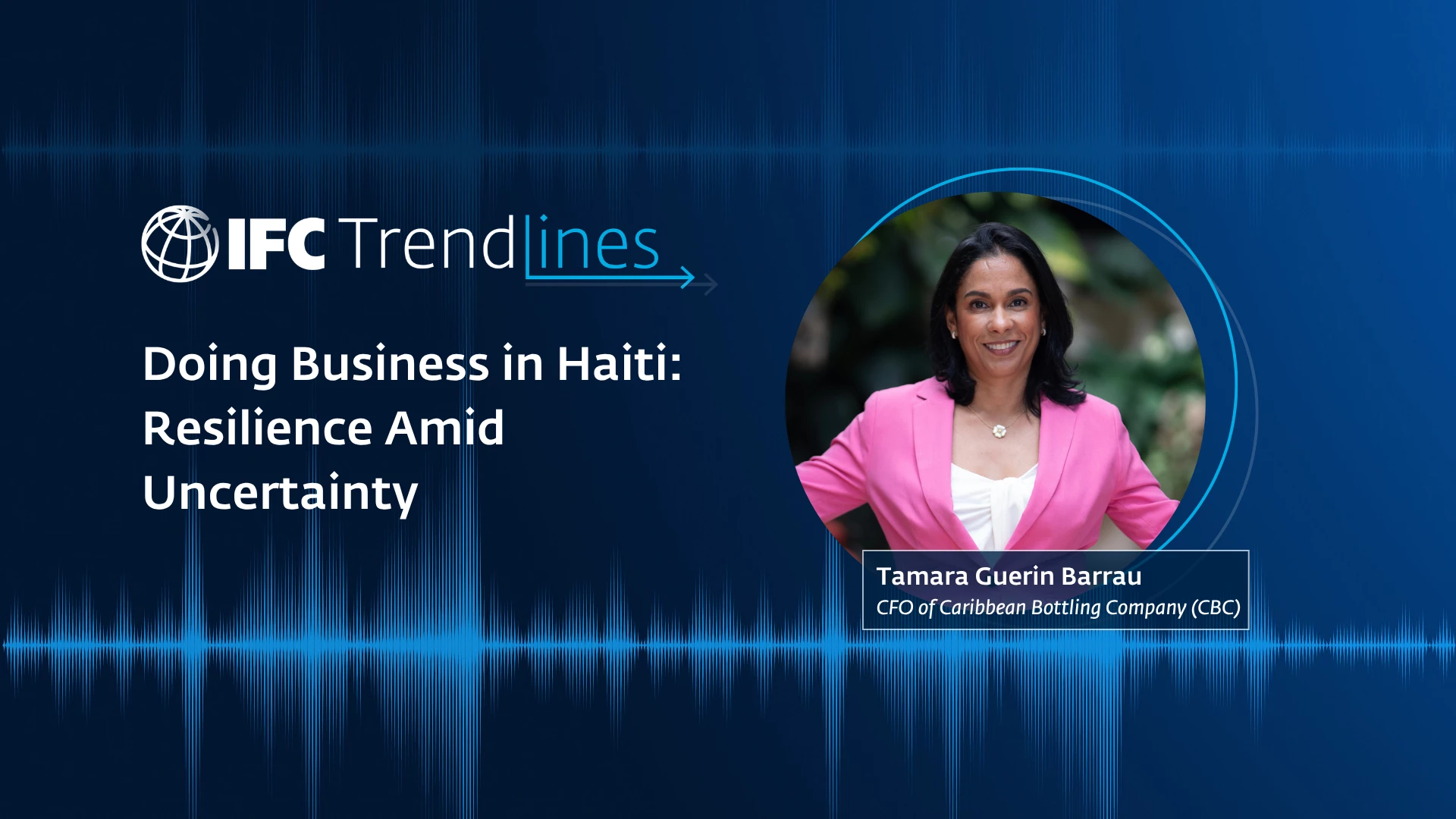
IFC Trendlines: Season 1, Episode 4
In this episode of IFC Trendlines, Ivy Kuperberg, IFC Country Officer for Haiti and the Bahamas, speaks with Tamara Guerin Barrau, CFO and Vice President of Caribbean Bottling Company, one of Haiti’s largest employers. They discuss what it means to operate, invest, and create jobs in a country facing overlapping crises and why a resilient private sector remains essential to Haiti’s future.
Transcript
Opening Quote: The first thing I would say to any potential investor is don't look at Haiti as a traditional investment. It's not only about the numbers, it's not only about the returns, it's about the impact that you're having and Haiti is a country where you have the most opportunity of having an impact right now. There are ways to be able to align your well-being, your company's well-being, and the community's well-being, and reach success.
Ivy: Welcome to IFC Trendlines, where we explore how private investment is shaping growth, jobs, and opportunity across emerging markets. I'm Ivy Kuperberg, IFC country officer for Haiti and the Bahamas.
Around the world, more than half of people living in extreme poverty are in countries affected by fragility, conflict, and violence. Keeping a business alive in these environments takes persistence, creativity, and long-term investment.
Our guest today knows this reality firsthand. Tamara Guerin Barrau is the Chief Financial Officer and Vice President of Caribbean Bottling Company, one of Haiti's largest employers and most recognized businesses. For more than 50 years, CBC has produced bottled water and beverages while employing hundreds of Haitians and serving communities across the country. Over the past decade, Haiti has faced overlapping crises that have tested every institution in the country. Yet CBC has continued operating, investing, and creating jobs.
Tamara, welcome to Trendlines
Tamara: Thank you so much, Ivy. Thank you to the IFC team for giving me this opportunity to share a little bit about CBC.
Ivy: Thank you. Now, for people who might not know, you or CBC, can you tell us a little bit about the company?
Tamara: Sure, sure. So, CBC, Caribbean Bottling Company, was founded in 1973 It was a family business at the time called Sada and Debrosse Esa, and they were the representatives of the Culligan Brand, which is a world-renowned water company. And so they represented Culligan in Haiti, and they started selling bottled water and filtration systems in Haiti. And in 2005 the company was going through bankruptcy, basically, and a group of dynamic investors invested in the company and bought the majority shares of the company, and I joined the team in 2006 as CFO.
We had several challenges at the time, and we ended up restructuring the company. And adding different products to our portfolio of products. We not only bottle water, we added a line of juices, we added iced tea, which has a very typical Haitian mango flavour to the portfolio, and our last product line that we added is an isotonic beverage called Active, and it's very popular with the youth and the sportive community in Haiti.
So we have a wonderful team of 600 employees. We are ISO 9001 certified, and we're working on ISO 22 certification. So we are just a nice family team. I want to say it's the CBC family, and we're very grateful for the opportunities that Haiti provides us. We have been operating in a difficult context, but we have this just magical energy within this company, and it's a blessing to be working there, and I'm very grateful to be doing this at this moment.
Ivy: And it's amazing. I would say CBC is ubiquitous in Haiti. You can find it both at the larger grocery stores, you can also find it in the tiny kiosks, in the MSMEs, and so you know it's so available that sometimes we forget all the hard work that goes on behind the scenes. Myself, I came to Haiti for the first time following the 2010 earthquake, which was a period of extreme upheaval, but from what you're saying, there has been multiple times where there's been uncertainty, difficulty, maybe limited knowledge about what the next weeks, months might bring. So, how do you, as CFO, as you know, one of the leaders of this company, really manage running this type of business in a period of uncertainty and fragility?
Tamara: Absolutely, we've had many challenges. I think the first big challenge was reversing the trend of the bankrupt company back when we entered the business, and so turning the company around with a limited capital base was definitely one of the big hurdles that we had to overcome from the get go.
Another very challenging period was during the earthquake. After the earthquake, we had sustained damages to our infrastructure and our equipment. Thankfully we were up and running in less than three days, providing the market with water in very difficult circumstances. And during that time the market was inundated with free water that was coming in from abroad, so we had to navigate around that. We had also employees that were grieving, that had lost family members. It was just a very, very challenging time that we had to overcome together as a company. And I would say the past seven years have been quite challenging.
Since 2018 Haiti has been experiencing negative GDP growth, so in fact the contraction of GDP. And with the rising insecurity, we've had a lot of challenges where we've had at times to stop operations, because either we could not get fuel to the plant or we had interruptions in getting our raw material to the plant. We've had to have days where we had to stop production because there was upheaval or gang violence in our area or in areas leading to the plant. And we found ways to become more resilient. We've found ways to communicate better, so that we know what areas to avoid and what areas we can function in.
Ivy: What was also interesting to me is having lived in Haiti, CBC is often, you know, the benchmark by which people decide whether the economy is functioning. I remember shortly following Peyi Lok and the gas was blocked. We got an alert that CBC was going to have to stop operations, and that immediately at the personal level, at the schools, the hospitals, that sends a signal to the economy, uh, oh, something's really wrong. And then three days later, when production restarted, everybody just had that collective, okay, we know if CBC is working right, that's the first step that we need to make sure that everything starts producing again.
Tamara: Overall the reason why we've been able to overcome all these challenges is that we've never lost our focus on our vision, and our vision is really is to spread this world of wellness that we've been able to create within CBC, but to spread that around, and we stay true to our values and our customer satisfaction, listening to our customers. We stick to our values of integrity and our values of responsibility.
And we have a responsibility towards the community. So we're engaged in different activities to be able to support the community that is also going through a tough time. So we're very mindful of the impact of our operations on the environment, and so it's that sense of responsibility that keeps us moving forward throughout the different difficult periods.
Ivy: What's been amazing to me is that since 2018 when Peyi Lok started, we've heard a lot about what you mentioned, the economy contracting, we've heard about manufacturing productive sectors losing 10s of 1000s of jobs, and yet in the same period, CBC was creating jobs. So, how is it that even in those difficult times, CBC was creating temporary jobs, long-term jobs? How do you see employment as part of what CBC does?
Tamara: So thankfully we have a strong demand for our products. And so that has allowed us to be able to answer to that demand to create new positions, to expand our operational teams, to expand our operations, to hire more drivers and delivery members. So that has really fueled our growth.
I think also innovation in different product products and coming out with different product lines, which are responding to consumer’s needs and desires, have allowed us to grow and to hire more people. And right now we're looking at again another expansion product project, and we're looking at expanding geographically also, and not necessarily being concentrated in the Port au Prince metropolitan area, and that will allow us to hire some more people to join the team.
That being said, I have to say that when we look at Haiti, only 5% of jobs are being generated by the formal private sector. We have another 5% of jobs being generated by the public sector, and you have between 10 and 11% of jobs being generated by the informal private sector, and you have a very high percentage, over 75% of jobs that are created by the completely informal sector. So it's very difficult for the type of job growth that we need in Haiti right now to change, to uplift the country out of poverty we need to be creating at least 100,000 jobs per year for the next 20 years. So right now it's very difficult to lean only on the private sector in Haiti to be able to create those types of jobs. So we need to be able to attract foreign investments, investments from the diaspora. And we need to be able to have policymakers that are able to formulate policies that encourage an ecosystem that allows the possibility for SMSEs to grow and to expand and to move from the informal sector to the formal sector, to eventually enlargen the tax base.
So, yes, we're doing great work, but we need thousands of CBCs doing this work in Haiti, and we need to be able to accompany youth, so that they can get the proper training, so that they are able to open their small or micro enterprise, and they are able to create jobs, so that we can have that effect that we want to see to lift our country out of poverty.
Ivy: Hait’s very hot right now. The country is in the World Cup. We've seen a lot of events, both inside and out of Haiti, with diaspora, with domestic private sector, with people really now focused on Haiti's recovery, and how the country can get to that next level and build that stability that then allows the country to really take off and flourish. For you, as CBC, what do you think is important for people who want to invest their own funds, for development financial institutions like IFC, for private investors - for them to know about what makes an investment work in Haiti, maybe sometimes what those challenges can be, and then what helps you get over them.
Tamara: The first thing I would say to any potential investor is don't look at Haiti as traditional investment where you're looking at risk and returns it's not only about the numbers, it's not only about the returns, it's about the impact that you're having, and Haiti is a country where you have the most opportunity of having an impact right now, and for me this is where the real opportunity lies.
And so don't think of coming into Haiti and doing business as usual, you have to be able to be flexible, you have to be able to listen to the people that you are serving, you have to be able to listen to your clientele and understand what their needs are, what their wants are, and you have to be able to do that in a manner where quality is assured, where the dignity of people is respected, so you, you really have to come into Haiti knowing that you're coming into a complex environment, and there is also the opportunity of getting financial returns and financial gains. I'm not saying that you're coming to Haiti and just for the benefit of the community, there are ways to be able to align your well-being, your company's well-being, and the community's well-being, and reach success.
People should have a shift from having a transactional engagement in Haiti to really coming in with a mindset of doing long term work and long term development in Haiti through their investments. T hey must do it with empathy, they must do it with discipline, and they must make these investments, keeping in mind the alignment of their well-being and the community's well-being.
Ivy: I think that you touch on the inclusiveness of the Haitian business community; you know, that old saying of, ‘if you want to go quickly, go alone, but if you want to go far, go together’. And I really like all of those considerations that really have led CBC to becoming the success it is, not only as a successful business, but as a company really bringing together the business community and showcasing what's possible within the country.
Thank you for joining us Tamara.