
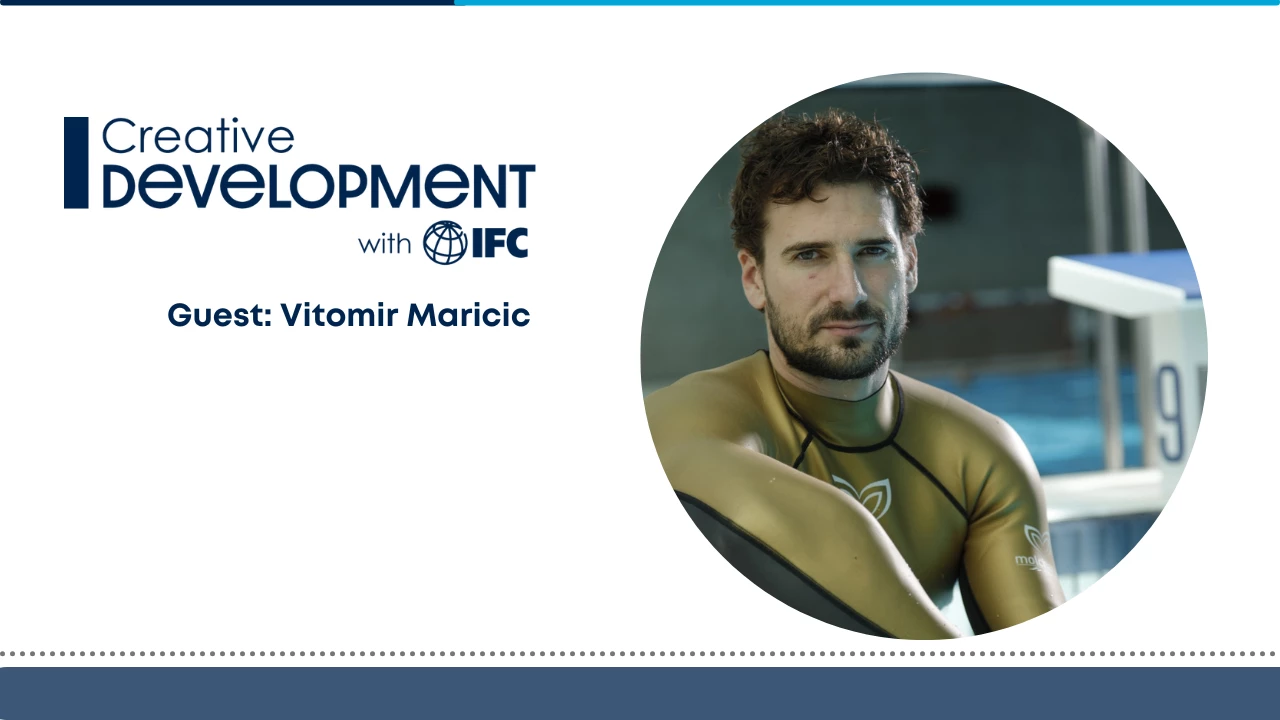
Season 6 | Episode 4
In this episode, Makhtar Diop sits down with world champion freediver Vitomir Maričić, a man who pushes the limits of human endurance - including setting the Guinness World Record for the longest breath-hold at an astonishing 29 minutes and 3 seconds.
Freediving is one of the world’s most extreme sports. With no oxygen tanks and no room for error, athletes descend hundreds of feet below the ocean’s surface on a single breath. Vitomir shares what it takes, physically and mentally, to survive and excel in such a high-stakes environment, and how that discipline shapes his approach to life and business.
The conversation also explores Vitomir’s deep commitment to ocean conservation and the urgent need for responsible action to protect marine ecosystems.
Saison 6 | Épisode 4
Dans cet épisode de Creative Development with IFC, Makhtar Diop reçoit le champion du monde d’apnée Vitomir Maričić, un athlète qui repousse les limites de l’endurance humaine — jusqu’à établir le record du monde du plus long temps d’apnée, homologué par le Guinness World Records, avec un impressionnant 29 minutes et 3 secondes. L’apnée compte parmi les disciplines les plus extrêmes au monde. Sans bouteille d’oxygène et sans droit à l’erreur, les athlètes plongent à des centaines de mètres sous la surface, en une seule respiration. Vitomir raconte ce qu’exige une telle pratique, sur le plan physique comme mental, pour tenir et garder le contrôle dans un environnement à haut risque — et comment cette rigueur façonne sa manière d’aborder la vie et les affaires. La conversation met également en lumière son engagement profond en faveur de la protection des océans et l’urgence d’agir de façon responsable pour préserver les écosystèmes marins.
Transcript in English
Makhtar Diop: Hello and welcome to Creative Development with IFC. I’m Makhtar Diop, Managing Director of the International Finance Corporation. Today, I’m joined by Vitomir Maričić - an athlete who pushes the boundaries of human capability. He is a world champion freediver and holds numerous records including the Guinness Record for the longest breath-hold - an astonishing 29 minutes and 3 seconds. Beyond sports Vitomir is actively engaged in education, sustainable tourism, and ocean conservation. Vitomir, welcome to the show.
Makhtar Diop: So let me congratulate you. You have been involved in all type of free diving. You are holding the record of walking with one breath under water. And you run for 100 meters underwater without breathing. Tell me little bit. You started nine years, 10 years ago. How did you get to that?
Vitomir Maricic: My first competitions were 2017, and by 2018 I already was fully into it professionally. It was by chance, actually there. I've always been very fond of the underwater world and breath-hold and apnea diving. However, because the sport was not really developed when I was young, I didn't pursue it as a competitive career. I was a professional in different sports. And then at one point I got to assist a world record. It was like a little bit more extreme, a world record on the ice. And I wanted to try for myself as well. So on that first try, I actually did the world record. I expected it. I was very confident that I will do it, because I know from an early age approximately what I can do underwater, and I have always been kind of training things that are beneficial for breath-hold. And then after that, I had an injury, during my training in a circus, and I was about to have a recovery of about one year. I did recover much faster in the end, in a couple of months. But I decided that maybe it would be good to pursue free diving and learn a little bit more about it and compete in freediving, because it's a very low impact sport that has basically no injuries, and you can, you can do it until you die. Basically there is no age restriction for freediving. So I said I'm going to take this as a break, but in the end, it became my career, and now most of the things that I do are somehow connected to freediving.
Makhtar: You say that, you know, you were a pro in another sport before, and it's not obvious to move from a pro sports to another pro sport like this. Was it a sport which was related to swimming? Were you a swimmer? Were you a basketball player, like many Croatians?
Vitomir: I did many sports from an early age. I was playing basketball at a time, but that was not my last sport. I was more into free climbing, weightlifting, a little bit of triathlon before that. And the switch was kind of organic. I would say it was very natural because freediving is something that I was doing since I was about four or five years old, so it wasn't something that was completely new. And also immediately I understood that I'm at a very high level and that I could have much better results in this globally than in other sports.
And with that also came the financial side supporting it. So in sports its also important that you have a way that you can sustain your life, that you have an income, whether it's from sports or from other businesses. And in previous sports, I was never at a world level. I was national champion in some sports, but this was very, very recreational, just covering the expenses of training. And in freediving, it's a very specific sport that has a sport side to it, but it's also attached with a recreational industry, just like scuba diving is, for example. So through this industry, the athletes in this sport have a chance to earn and be professionals in this industrial part of it as well. And this was very appealing for me, because it was, at the same time something that I love doing and training, and at the same time something that could have extra revenue for me.
Makhtar: I was in Croatia recently. And you know, when you think about Croatia, it produced so many top athletes from a country which is relatively small. That is impressive. There is something we say that its either in the DNA of the Croatian, or in the system of education, which brings so many top athletes. What is the system in Croatia, which allows you to produce so many top athletes like you?
Vitomir: I think it's very easy to get into sports, and sports are relatively highly appreciated. So young generations, they can have some heroes in sports, and it's easy to have some role models through sports. Also, I think that the nation is traditionally very competitive, and some regions of Croatia are amongst the tallest people in the world, on average. So that also helps having that kind of background.
And also the methodology is pretty good. It's a good mix of old school, Russian-Bulgarian methods that were very present in Yugoslavia, but also Western European and American modern methodologies. So who[ever] wants to educate themselves, there's, there's good schools in sport. There is good medical institutions, and there is a lot of clubs. A lot of young people are just there into sports. We consider it as an important part of general education. So sport is present throughout high school, university, elementary school. Even in kindergarten you will have sport classes and there's even special ‘sports kindergartens’. So I think it's just accessible, and even without that, you'll always find kids playing in the streets. It's kind of a traditional thing here. I'm not sure if it's still like that. I believe it is. But when I was a kid, that was the only thing that we were thinking about. It was just maybe doing homework, going to school and then spending the whole afternoon in sports activities.
Makhtar: For those who are not familiar with free diving, what is the day of a professional free diver?
Vitomir: That would greatly depend on a free diver and on the disciplines that he is training but let's say, generally, at my peak, I will be training three to four times a day, usually combining pool training, gym training and then some other technique or mental training, or stretching or something like that, to supplement or to recover faster as an active recovery. But my approach was always with very high volume and very much sport-performance oriented. I wouldn't say that's the average in freediving. It's a very small sport still. So there's many approaches, and many people are not going to spend so much time in training, or they're going to focus, for example, exclusively on depth preparation. For me, I think when I entered the sport, coming from a sport background, as a professional sport coach and as a professional athlete, I changed a little bit this approach, with introducing a lot of gym training and different periods for different things. This is very known in modern sport, but in freediving, it wasn't so evident. So I think now more and more freedivers are going to switch into this type of training, and all the best ones already now are kind of doing the same pattern.
Makhtar: Your new target, I understand, is 160 meter deep diving?
Vitomir: I'm hoping, yeah, for between 160 and 170 meters. I'm going to enter this new discipline, which is unsanctioned for competition, only for records. It's going to be a variable weight dive. And hopefully this dive will bring a lot of attention to first, the human potential and then how we can use this attention to create awareness on some important topics around the world.
Makhtar: When you talk about what you are doing, mental is at the heart of it – the foundation of it. How do you train mentally to be so focused? When we read about your last attempt, your record, you were talking at some point, you said that your body was aching very much, but you said that after 20 minutes, you are in a different zone and you are able to continue. So can you talk a little bit about the mental side of it?
Vitomir: Well, it's definitely extremely important, and it's maybe in this sport more evident than in some other sports or activities. However, this mental component is really crucial for everything that you do at a higher level. Any high performing athlete like 100 meter runner or a marathon runner or a swimmer, they need to master this mental approach in order to peak their performance and to give the best of themselves at any given time at a competition. This is an extremely complex skill, and it's maybe not so evident when you're thinking about running. You think, I just come there and run the best I can. But it's not so simple. This is something that's been trained for years. And they also do a lot of mental preparation in order to do so.
And it's important to understand that mental preparation can only yield results if it's connected to training, because this is complementary, and this is developed together. So your physical adaptation and your physical development must be assisted by your mental approach. You will never get so far if your mental approach is not cooperating.
Also, this will then create different physiological processes that are going to connect your mental state with your physical output. And this is something that needs to be integrated all together, and needs to grow together. And then, of course, you have this mental component that can be trained on top of that. There's different mental tools, different exercises that shape your attention and where you learn to cure your brain to have a specific type of attention on specific things that can give you results in a way that you want.
Now, it can be very, very different depending on activity. For example, an elite swimmer needs to be really focused on his reaction time and start, and then providing the best of the organism in terms of sharpness, alertness, awakeness and aggression. In freediving, it's completely different. We need to be completely stable and calm and emotionally disconnected from what we're doing, because it's not easy to handle that type of suffering for a sustained period of time. The body wants to go away from that, the body always wants to go where comfort is, but it's always possible to do different. And this is the willpower that we have, especially as humans. We are an animal that has an incredible willpower, and we can almost do anything with our mind. But in order to be able to do this, the physical preparation is necessary, and then the integration with the physiological connection of those two is something that's built for years.
Makhtar: That's fantastic. As you were talking, I was thinking about how you are now also having your own business. You are developing your own business in parallel with your career as a professional athlete. Tell us about your business and tell us about how the skills that you built in sports are helping you now in your business.
Vitomir: My business is very versatile. I am constantly juggling different areas of business, and some of them are created and related to medical research, and working with the medical departments on finding new protocols and discovering new stuff, making research papers from it. Some part of it is going to be related to sport and sport performance. And a big part of it is a coaching platform where we coach different athletes in different skills through a group of coaches, which is then done online and remotely. Part of it is live, one-to-one education practice, or group education practice with training camps for specific sports or specific skills. And this is relatively important because it helps grow the industry. It's something that opens new workspaces, and basically, people start understanding that anyone can become sport professional or instructor in freediving, and this opens a possibility for him to work independently, remotely or anywhere. So that's one part of the business. There is also investment in prototypes and developments around the world, on gear, on material, on developing new safety standards and protocols for the sport and so on. So there is many of these aspects.
But what I would say that benefits me most there is being able to handle a lot of things at the same time by prioritizing what needs to be done, by learning how to put them into specific boxes, delegate some boxes and assert enough attention to some while removing some attention from other.
Also through sport, you learn the importance of recovery and the importance of pacing. So you learn that if you're constantly working on something, you're not going to be successful. You need to have periods of intensive work, of less intensive work, and periods of break and recovery. And it's very easy to get overwhelmed by work, by not following a schedule or targets or something that looks towards your success. And people, especially private entrepreneurs, they will get lost in just working more and working more and working more and going more into a niche. What freediving as a sport, and generally sports helps you with mentally, it gives you tools to take a step back and have a wider perspective on what is important for something that you're doing. So for your success in anything, there is never just one single factor. It's a multi-factorial equation, and you need to balance these factors. In sport, a good plan and a good design of training will help you give enough adequate attention to each of these factors at a very specific time so that in the end, you could be successful at what you're doing. And this is very easy to understand when we're speaking about something simple as sports. But then when you learn it there and understand it there, then you can translate it to business much easier.
Also some very practical things that I learned is that in many times, emotional detachment from something that we're doing creates much better results, and this is very important in sports, because it's so easy to get stressed or to want something too much or to be hurt by something that didn't play out the way you want it. Through this, we build different types of expectations and healthy expectations in sport, just like in business, just like in life or relationship, is that you're not always going to win, and it's not always going to be fair. Sometimes you're going to invest a lot and get nothing back. But if you understand that in the big picture and in the process of what you're doing, this is to be expected, and this is something that will happen, then you're less stressed and less traumatized about it, and you understand that consistent investing of a time on a specific plan is going to give results a little bit after that. So I think these overall, general, let's say, life lessons and experience are very useful to bring from sports to a business environment, for example.
Makhtar: I fully agree with you, and I think that this is something that is need to be practiced daily to be able to master, because it's so easy to get emotional and to lose a little bit that distance that is required to make the right decision in the long term. What you say makes a lot of sense,
Vitomir: Absolutely. To accept failure for people in the beginning is very stressful, and they they don't understand the learning that can be done from failure, and then they start developing fear of failure. And if you have a fear of failure, you have a pressure to make decisions. And with that kind of pressure, you're not creating good decisions. If we switch that perspective around, which is necessary in sport, and accept failure as just one of the possible outcomes, that's definitely going to happen at happen some point and it's fine to accept it, then the pressure is a little bit off, and we understand that this is a part of the process. And I many times say to people only when you're ready to accept failure, you're ready to succeed truly.
Makhtar: But let me turn to Sea Shepherd. You are an ambassador for Sea Shepherd. Tell us a little bit about that organization.
Vitomir: For me, that's an organization that I decided to put my trust in and collaborate with them on their projects, because I like their approach of being an action taking organization. And this means that they are really fighting for the causes they believe, physically in the ocean and politically, trying to change the laws and trying to get a better legislative framework for what needs to be done. And I believe that these things are a high priority for people and everyone on Earth, because the sea seems to be the most endangered part, even though it seems that it's indestructible and huge and vast, but it's a very fragile ecosystem, and the overfishing that's happening constantly in all the seas now, even the High Seas is something that can damage that ecosystem very easily. And small changes in that ecosystem create huge changes in the atmosphere, which affects everyone. And this is not going to be something that's going to be easy to reverse. So we need to act preventively, and we need to fight to conserve and protect the ocean and all its habitants.
Makhtar: Absolutely, this is a reason why, you know, at IFC and the World Bank Group, we have been doing a lot of work on trying to find incentive for company to invest and protect the marine ecosystem. Another important thing which for us is related to the sea, is tourism. We believe that tourism is a huge job creator, and Croatia is a good example of it. It needs to be done in a sustainable way, because we need to make sure that the resources are protected in the long run. So we are very much in the same space, because it's also something which is related to people condition, jobs, living and sustainability. And I am personally very sensitive to that. I'm coming from a country which is very coastal, and we know what overfishing can also do to poor people who end up, you know, migrating to other places because they cannot make a living out of fishery like they used to do in the past.
Vitomir: This last record that that I did was intended to create a news that will go around the world and generate attention on exactly this. And I intend to do another record which will surpass 30 minutes, hopefully again, to have the same effect and to just create an avalanche of news and pushing the things that are important to push in the first place.
Makhtar: So if you want to leave us with a last word about ocean marine protection, what do you think is currently the biggest threat? Is it marine plastic? Is it coastal erosion?
Vitomir: Fishing -100%. there is no sustainable fishing anymore that needs to be clear for everyone. And there is very, very few protected zones that are truly protected. And plastic is not good of course, coastal erosion is not good, but overfishing is something that can create massive damage within 10 years. So if we continue to overfish sharks, for example, we will lose an apex predator, which will completely disrupt the ecosystem, and we will not have fish, so we will not have anything. The movement of the sea will stop. The algae will be different. The production of oxygen will be different. The carbon footprint is not going to go into the ocean anymore. So we have a huge, huge ecological problem for the atmosphere. So this is something that I see as the most immediate threat. On the other hand, it's also something that's the easiest to solve. We only need a few protected pools that are highly protected because we have seen in many studies, just like we have seen, how easy is to disrupt this ecosystem, it's so easy for the sea to rebuild itself, but it needs to be left alone. It needs to be protected. Over a period of four to five years, it's incredible how much these areas can blossom and overflow into everything around them. So the fishermen and all the industry living from this will actually prosper from protection. It will not damage anyone. But they need to understand that this is an investment and this is a process, and they need to respect these restrictions and limitations.
So we need to find a way to communicate this, to create this awareness and to create strict laws and rules and limits on what is protected and what is not, so that we can save the whole ocean and the whole sea, but somehow we're failing to create this. And I really think this is the most eminent threat.
Makhtar: Vitomir, thanks so very much for taking the time. And good luck for the next attempt. And I'm sure that you're going to beat the record.
Vitomir: Thank you, and I wish you a successful continuation of this podcast and everything that you do, I think it's a it's a very good thing to get people involved in topics like this and to spread topics like this that are helping build a better world.
Transcription française
Makhtar Diop : Bonjour et bienvenue dans Creative Development with IFC. Je suis Makhtar Diop, directeur général de la Société financière internationale (IFC). Aujourd’hui, j’ai le plaisir d’accueillir Vitomir Maričić, un athlète qui repousse les limites des capacités humaines. Champion du monde d’apnée, il détient de nombreux records, dont un record Guinness pour la plus longue apnée jamais réalisée : un incroyable 29 minutes et 3 secondes. Au-delà de la performance sportive, Vitomir s’engage activement dans l’éducation, le tourisme durable et la protection des océans. Vitomir, bienvenue dans notre podcast.
Makhtar Diop : Permettez-moi d’abord de vous féliciter. Vous avez exploré toutes les disciplines de l’apnée. Vous détenez notamment le record de marche sous l’eau en une seule inspiration, et vous avez parcouru 100 mètres en courant sous l’eau, sans respirer. Racontez-nous un peu : vous avez commencé il y a neuf ou dix ans. Comment en êtes-vous arrivé là ?
Vitomir Maricic : Mes premières compétitions remontent à 2017 et, dès 2018, je m’y consacrais déjà à plein temps, de manière professionnelle. En réalité, tout est arrivé un peu par hasard. J’ai toujours été passionné par le monde sous-marin, par l’apnée et la plongée en immersion libre. Mais quand j’étais jeune, ce sport n’était pas vraiment développé, donc je ne l’ai pas envisagé comme carrière compétitive. J’étais professionnel dans d’autres disciplines sportives. Puis, un jour, j’ai eu l’occasion d’assister à une tentative de record du monde — quelque chose d’assez extrême, un record réalisé sous la glace. Cela m’a donné envie d’essayer. Lors de ma première tentative, j’ai battu le record du monde. Je m’y attendais, d’ailleurs. J’étais très confiant, car depuis l’enfance je savais à peu près ce dont j’étais capable sous l’eau, et j’ai toujours pratiqué des activités bénéfiques pour le travail en apnée. Ensuite, je me suis blessé lors d’un entraînement dans un cirque, et l’on m’annonçait près d’un an de récupération. Finalement, je me suis remis en quelques mois. C’est à ce moment-là que je me suis dit que ce serait peut-être l’occasion de me consacrer davantage à l’apnée, d’approfondir ma pratique et de commencer à concourir sérieusement. C’est un sport à très faible impact, qui entraîne très peu de blessures, et que l’on peut pratiquer toute sa vie. Il n’y a pratiquement pas de limite d’âge en apnée. Au départ, je voyais cela comme une parenthèse. Mais cette parenthèse est devenue une carrière. Aujourd’hui, la plupart de mes activités sont, d’une manière ou d’une autre, liées à l’apnée.
Makhtar : Vous expliquez que vous étiez déjà sportif professionnel dans une autre discipline — et ce n’est pas évident de passer d’un sport de haut niveau à un autre. S’agissait-il d’un sport lié à la natation ? Étiez-vous nageur ? Ou peut-être basketteur, comme beaucoup de Croates ?
Vitomir : J’ai pratiqué de nombreux sports dès mon plus jeune âge. J’ai joué au basket pendant un temps, mais ce n’était pas ma dernière discipline. Je me suis davantage consacré à l’escalade libre, à l’haltérophilie, et j’ai fait un peu de triathlon. La transition s’est faite assez naturellement, presque organiquement. L’apnée, je la pratiquais depuis l’âge de quatre ou cinq ans — ce n’était donc pas quelque chose de totalement nouveau pour moi. Très vite, j’ai compris que j’évoluais déjà à un niveau très élevé et que je pouvais obtenir des résultats bien plus importants à l’échelle internationale en apnée que dans les autres sports.
Il y avait aussi la dimension financière. Dans le sport, il est essentiel de pouvoir subvenir à ses besoins — disposer d’un revenu, qu’il provienne de la pratique sportive elle-même ou d’autres activités. Dans mes disciplines précédentes, je n’ai jamais évolué au niveau mondial. J’ai été champion national dans certains sports, mais cela restait très amateur et couvrait à peine les frais d’entraînement. L’apnée, en revanche, est un sport particulier : il comporte un volet compétitif, mais il est aussi étroitement lié à une industrie de loisir, un peu comme la plongée sous-marine. Cet écosystème offre aux athlètes la possibilité de gagner leur vie et de se professionnaliser dans une dimension plus « industrielle » du sport. Cela m’a beaucoup séduit, car c’était à la fois une passion — quelque chose que j’aimais profondément pratiquer — et une source de revenus complémentaires.
Makhtar : J’étais récemment en Croatie. Et quand on pense à ce pays, on se rend compte qu’il a produit un nombre impressionnant d’athlètes de très haut niveau, alors que c’est un pays relativement petit. C’est remarquable. On dit que cette réussite sportive tient soit à l’ADN des Croates, soit au système éducatif. Selon vous, qu’est-ce qui, en Croatie, permet de former autant de champions — des athlètes comme vous ?
Vitomir : Je pense qu’en Croatie, l’accès au sport est très simple et qu’il y est particulièrement valorisé. Les jeunes peuvent facilement s’identifier à des modèles à travers le sport. Le pays a aussi une culture profondément compétitive. Par ailleurs, certaines régions figurent parmi les populations les plus grandes au monde en moyenne — un avantage indéniable dans de nombreuses disciplines.
Il y a aussi la qualité des méthodes d’entraînement, qui combinent l’héritage d’inspiration russo-bulgare — très présent à l’époque de la Yougoslavie — et des approches plus modernes venues d’Europe occidentale et des États-Unis. Ceux qui souhaitent se former disposent de bonnes écoles de sport, d’institutions médicales solides et de nombreux clubs. Beaucoup de jeunes pratiquent un sport. Chez nous, le sport fait véritablement partie de l’éducation générale. Il est présent tout au long de la scolarité — à l’école primaire, au lycée, à l’université. Même à la maternelle, il y a des cours de sport, et certaines structures sont même des « jardins d’enfants sportifs ». Au fond, le sport est partout et très accessible. Et même en dehors des structures officielles, on trouve toujours des enfants qui jouent dans la rue. C’est presque une tradition. Je ne sais pas si c’est encore exactement comme ça aujourd’hui, mais je le crois. Quand j’étais enfant, en tout cas, c’était notre quotidien : faire ses devoirs, aller à l’école… puis passer tout le reste de l’après-midi à pratiquer un sport.
Makhtar : Pour ceux qui ne connaissent pas bien l’apnée, à quoi ressemble la journée d’un apnéiste professionnel ?
Vitomir : Cela dépend beaucoup de l’apnéiste et des disciplines qu’il pratique, mais de manière générale, à mon apogée, je m’entraînais trois à quatre fois par jour, en combinant généralement des séances en piscine, de la musculation, ainsi que des séances techniques, mentales ou d’étirements, afin de compléter l’entraînement et d’optimiser la récupération. J’ai toujours privilégié un entraînement intensif, centré sur la performance sportive. Je ne dirais pas que c’est la norme en apnée. C’est un sport encore très minoritaire, et chacun adopte sa propre méthode : certains ne passent pas autant de temps à s’entraîner, ou se concentrent exclusivement sur la préparation en profondeur. Pour ma part, venant d’un parcours sportif professionnel — à la fois comme athlète et comme coach — j’ai adapté ma méthode en ajoutant beaucoup de musculation et en planifiant des périodes spécifiques pour chaque type d’entraînement. C’est une approche très connue dans le sport moderne, mais qui n’était pas encore évidente dans l’apnée. Aujourd’hui, de plus en plus d’apnéistes adoptent ce type de préparation, et tous les meilleurs suivent un schéma similaire.
Makhtar : Si je comprends bien, votre nouveau but est d’atteindre 160 mètres de profondeur ?
Vitomir : Je souhaite atteindre entre 160 et 170 mètres. Je vais me lancer dans une nouvelle discipline, qui n’est pas reconnue en compétition officielle, mais uniquement pour les records. Ce sera une plongée en poids variable. Et j’espère que cette performance suscitera beaucoup d’attention, d’abord sur le potentiel humain, puis permettra de sensibiliser à des enjeux majeurs à travers le monde.
Makhtar : En vous écoutant, on comprend que l’aspect mental est au cœur de votre pratique. Comment vous entraînez-vous pour rester aussi concentré ? Lors de votre dernière tentative, vous disiez que votre corps souffrait énormément, mais qu’au bout de vingt minutes, vous étiez dans une autre dimension et pouviez continuer. Pouvez-vous nous parler un peu de l’aspect mental de votre discipline ?
Vitomir : Oui, c’est absolument essentiel — et peut-être encore dans ce sport que dans d’autres disciplines. Cela dit, la dimension mentale est déterminante dès lors qu’on évolue à haut niveau, quel que soit la discipline. Un athlète de haut niveau — qu’il s’agisse d’un sprinteur sur 100 mètres, d’un marathonien ou d’un nageur — doit maîtriser l’approche mentale pour atteindre son pic de performance et donner le meilleur de lui-même en compétition. C’est une compétence complexe, ce n’est pas évident. Quand on pense à la course à pied, on pourrait croire qu’il suffit de se présenter et de courir aussi vite que possible. Mais ce n’est pas si simple. Cette capacité se construit sur la durée, grâce à des années d’entraînement et une préparation mentale rigoureuse, essentielle pour performer au plus haut niveau.
Il est essentiel de comprendre que la préparation mentale ne porte ses fruits que si elle est intimement liée à l’entraînement. Les deux sont complémentaires et se développent ensemble. L’adaptation et le développement physiques doivent être soutenus par l’approche mentale. Sans cela, on n’ira jamais très loin. Cette interaction déclenche des processus physiologiques qui relient l’état mental à la performance physique. Tout doit être intégré, évoluer de concert. À cela s’ajoute, bien sûr, un travail mental spécifique. Il existe différents outils et exercices qui permettent de façonner l’attention, d’entraîner le cerveau à se concentrer précisément sur certains éléments afin d’obtenir les résultats recherchés.
Cela peut varier énormément selon la discipline. Par exemple, un nageur d’élite doit être extrêmement concentré sur son temps de réaction et son départ, puis mobiliser toute sa réactivité, sa vigilance et même une forme d’agressivité. En apnée, c’est tout l’inverse. Il faut être parfaitement stable, calme, presque détaché émotionnellement de ce que l’on vit. Car endurer une telle intensité sur la durée n’a rien de facile. Le corps cherche naturellement à fuir cette sensation ; il tend toujours vers le confort. Mais nous pouvons décider autrement. C’est là que la volonté entre en jeu — une force mentale propre à l’être humain. Nous avons une capacité de dépassement extraordinaire, capable de nous mener très loin. Mais pour y parvenir, la préparation physique est indispensable. La synergie entre le mental et le corps se bâtit avec les années d’entraînement.
Makhtar : C’est passionnant. Cela m’amène à un autre aspect de votre parcours : l’entrepreneuriat, que vous développez en parallèle de votre carrière d’athlète professionnel. Pouvez-vous nous en dire plus sur votre activité ? Et comment les compétences acquises dans le sport vous aident-elles à faire grandir votre entreprise ?
Vitomir : Mon activité est très diversifiée. Je jongle en permanence entre plusieurs domaines. Une partie est liée à la recherche médicale : je collabore avec des équipes et des départements médicaux pour élaborer de nouveaux protocoles, explorer de nouvelles pistes et publier des travaux de recherche. Une autre concerne le sport et la performance sportive. Une part importante repose sur une plateforme de coaching : avec une équipe d’entraîneurs, nous accompagnons des athlètes dans différentes disciplines, principalement en ligne, mais aussi en présentiel — en individuel ou en groupe — à travers des stages et des camps d’entraînement ciblés. Cela contribue à structurer et à faire évoluer le secteur, en créant de nouvelles opportunités professionnelles et en montrant qu’il est possible de devenir athlète professionnel ou instructeur en apnée, tout en travaillant de manière indépendante, à distance ou partout dans le monde. Nous investissons également dans des prototypes et des projets de développement à l’international : équipements, matériaux, amélioration des standards de sécurité et des protocoles du sport, etc. En somme, mon activité englobe plusieurs volets complémentaires.
Mais ce qui me sert le plus, c’est d’apprendre à gérer plusieurs choses à la fois : prioriser, organiser chaque tâche dans des « cases » spécifiques, déléguer certaines responsabilités, et savoir porter mon attention sur certaines tâches plutôt que sur d’autres.
Le sport vous apprend aussi l’importance de la récupération et du rythme. On comprend rapidement que si l’on travaille sans interruption, on n’ira pas loin. Il faut alterner périodes de travail intensif, périodes moins intenses et phases de repos et de récupération. Il est très facile de se laisser submerger par le travail, de ne pas suivre un plan ou des objectifs précis, et de perdre de vue ce qui mène réellement au succès. Les entrepreneurs, en particulier, risquent de se noyer dans le « toujours plus » : travailler toujours plus, se spécialiser encore davantage. L’apnée, comme le sport en général, offre des outils mentaux précieux : elle apprend à prendre du recul et à voir plus clairement ce qui compte vraiment dans ce que l’on entreprend. Pour réussir dans n’importe quel domaine, il n’y a jamais un seul facteur décisif : c’est une équation multi-factorielle qu’il faut savoir équilibrer. Dans le sport, une bonne planification et un entraînement structuré permettent de donner à chaque facteur l’attention qu’il mérite, au moment le plus opportun, pour maximiser les chances de réussite. C’est simple à appréhender dans le sport, et une fois cette méthode assimilée, elle se transpose facilement au monde des affaires.
Une autre leçon très pratique que j’ai apprise, c’est que prendre du recul émotionnel par rapport à ce que l’on fait permet souvent d’obtenir de bien meilleurs résultats. C’est particulièrement important dans le sport, car il est très facile de se laisser submerger par le stress, de vouloir quelque chose trop fort ou de se sentir frustré quand les choses ne se passent pas comme on l’espérait. Avoir des attentes saines, que ce soit dans le sport, les affaires, la vie ou une relation, c’est comprendre qu’on ne gagne pas toujours et que tout n’est pas toujours juste. Parfois, on investit beaucoup sans rien recevoir en retour. Mais si l’on garde en tête la vision d’ensemble et la logique du processus, on comprend que cela fait partie du parcours et on l’accepte. Dès lors, on est moins stressé, moins affecté. On sait qu’un engagement constant et du temps investi avec discipline dans un plan précis finissent toujours par porter ses fruits, même si les résultats ne sont pas immédiats. Ces leçons de vie, tirées de l’expérience sportive, sont très utiles à transposer dans un environnement professionnel, notamment dans les affaires.
Makhtar : Je suis tout à fait d’accord avec vous, et je pense que c’est quelque chose qui doit se pratiquer au quotidien pour pouvoir le maîtriser, car il est si facile de se laisser emporter par ses émotions et de perdre le recul nécessaire pour prendre la bonne décision sur le long terme. Ce que vous dites a beaucoup de sens.
Vitomir : Absolument. Accepter l’échec est très stressant au départ, et beaucoup ne voient pas ce qu’on peut apprendre de ses erreurs. Rapidement, la peur de l’échec s’installe. Or, quand on a peur d’échouer, chaque décision devient une pression, et sous la pression, on ne prend pas de bonnes décisions. Si l’on change de perspective — comme c’est nécessaire dans le sport — et que l’on considère l’échec comme un résultat possible, quelque chose qui arrivera forcément et qu’il est normal d’accepter, alors la pression diminue. On comprend que l’échec fait partie du processus. Je le dis souvent : c’est seulement lorsqu’on est prêt à accepter l’échec qu’on est vraiment prêt à réussir.
Makhtar : Parlons maintenant de Sea Shepherd. Vous en êtes ambassadeur. Pouvez-vous nous en dire un peu plus ?
Vitomir : Sea Shepherd est une organisation en laquelle j’ai décidé de placer ma confiance et avec laquelle je collabore sur différents projets, car j’apprécie leur approche concrète et engagée. Ils ne se contentent pas de paroles : ils agissent réellement sur le terrain pour les causes qu’ils défendent, dans les océans, mais aussi sur le plan politique, en essayant de faire évoluer les lois et de créer un cadre législatif plus adapté. Je pense que ces actions sont une priorité absolue, car les océans sont probablement la partie la plus menacée de notre planète. Même s’ils paraissent immenses et indestructibles, ils forment un écosystème très fragile. La surpêche, qui touche désormais toutes les mers, y compris les Hautes Mers, peut rapidement fragiliser cet équilibre. Et de petits déséquilibres dans cet écosystème entraînent d’énormes conséquences sur l’atmosphère, qui nous affectent tous. Ces dommages seront difficiles à inverser, d’où l’importance d’agir de manière préventive. Il est essentiel de se battre pour conserver et protéger les océans et tous leurs habitants.
Makhtar : Absolument. C’est aussi pour cela qu’IFC et le Groupe de la Banque mondiale cherchent à encourager les entreprises à investir dans la protection des écosystèmes marins. Un autre sujet important, lié à la mer, est le tourisme. Nous considérons que le tourisme est un immense créateur d’emplois, et la Croatie en est un bon exemple. Mais il doit être pratiqué de manière durable pour préserver les ressources sur le long terme. Nous travaillons donc sur des enjeux très proches, car il s’agit aussi de conditions de vie, d’emplois et de durabilité pour les populations. C’est un sujet qui me tient particulièrement à cœur : je viens d’un pays côtier, et nous savons ce que la surpêche peut provoquer, surtout pour ceux qui, ne pouvant plus vivre de la pêche comme autrefois, sont contraints de migrer ailleurs.
Vitomir : Ce dernier record que j’ai réalisé avait pour but de créer un véritable buzz mondial et de focaliser l’attention sur ce point précis. Je compte en réaliser un autre, qui dépassera les 30 minutes, pour provoquer à nouveau un fort retentissement médiatique et mettre en avant ce qui doit l’être.
Makhtar : Pour conclure sur la protection des océans, selon vous, quelle est aujourd’hui la menace la plus urgente ? Le plastique dans les océans ? L’érosion des côtes ?
Vitomir : La pêche — à 100 %. Il n’existe pratiquement plus de pêche durable, c’est évident. Très peu de zones protégées le sont vraiment. Bien sûr, le plastique et l’érosion côtière posent aussi problème, mais la surpêche peut provoquer des dégâts massifs en moins de dix ans. Si nous continuons à surexploiter, par exemple, les requins, nous perdrons un prédateur clé et l’écosystème sera complètement bouleversé. Plus de poissons, plus rien. Les courants changeront, les algues seront différentes, la production d’oxygène aussi, et l’océan ne pourra plus absorber le carbone comme aujourd’hui. C’est un problème écologique énorme, avec un impact direct sur l’atmosphère. C’est selon moi la menace la plus immédiate. Mais paradoxalement, c’est aussi la plus facile à résoudre. Il suffirait de créer quelques zones protégées strictes. Les études le confirment, et nous l’avons vu : fragiliser cet écosystème est facile. Mais il peut tout aussi bien se régénérer rapidement. À condition de le laisser tranquille. A condition de le protéger. En l’espace de quatre ou cinq ans, on voit ces zones se régénérer, se développer et bénéficier à tout l’écosystème. La protection des océans ne pénalise pas les pêcheurs, au contraire : elle leur permet de prospérer sur le long terme. Mais cela demande de la patience, une vision d’investissement, et surtout le respect strict des règles établies.
Nous devons donc trouver un moyen de mieux communiquer sur ces enjeux, de créer une véritable prise de conscience. Nous devons instaurer des règles claires et strictes sur ce qui est protégé et ce qui ne l’est pas afin de préserver l’océan dans son ensemble. Or, pour l’instant, nous échouons — et c’est, selon moi, la menace la plus urgente.
Makhtar : Vitomir, merci infiniment d’avoir pris le temps d’être avec nous. Et bonne chance pour votre prochaine tentative. Je suis certain que vous battrez le record.
Vitomir : Merci beaucoup. Je vous souhaite plein succès pour la suite de ce podcast et pour tous vos projets. Je pense que c’est essentiel d’impliquer les gens dans des sujets comme ceux-ci et de les diffuser largement, car ils contribuent à construire un monde meilleur.