
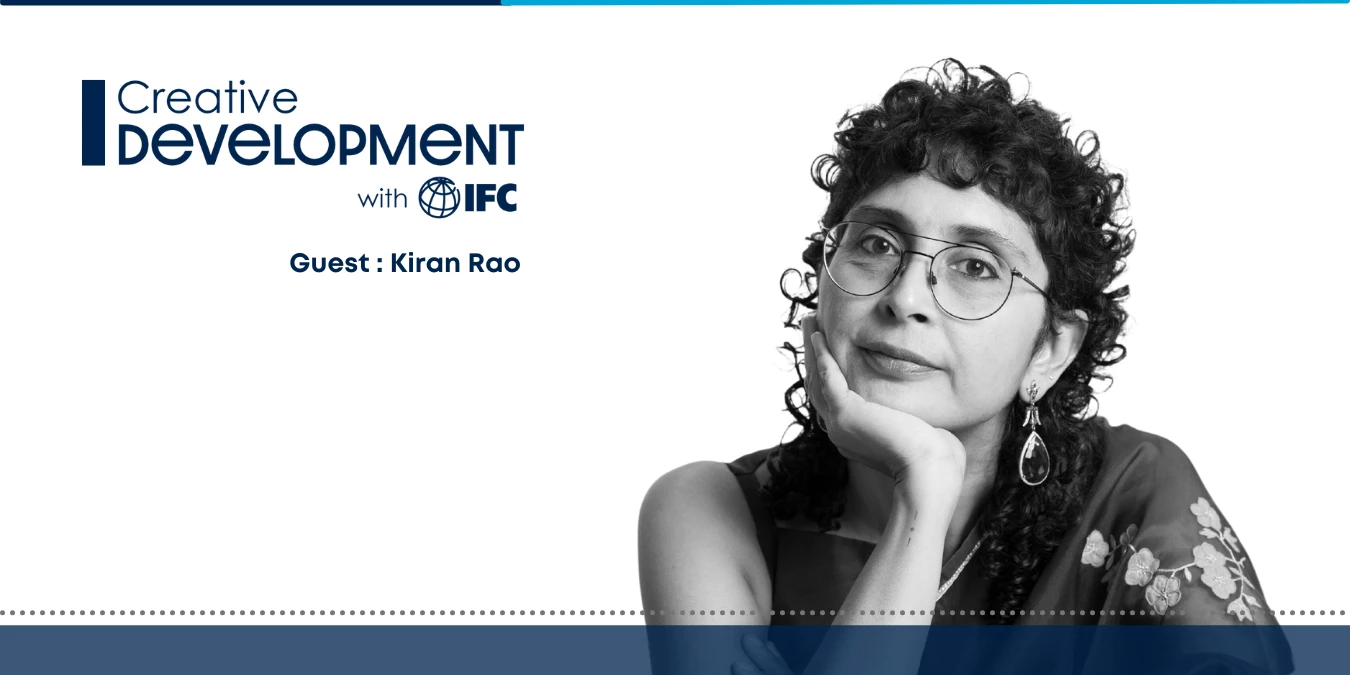
Season 6 | Episode 1
In this episode of Creative Development with IFC, Makhtar Diop speaks with visionary filmmaker Kiran Rao about the evolution of Indian cinema, the rise of independent voices, and why bold, local storytelling matters. They also discuss Rao’s award-winning film Laapataa Ladies - a witty tale that shines a light on the struggle against patriarchy, and her new project Humans in the Loop, a thought-provoking film on artificial intelligence and our shared future.
______________________________________________________________________________________
Saison 6 | Épisode 1
Dans cet épisode du podcast Creative Development with IFC, Makhtar Diop s’entretient avec la réalisatrice engagée Kiran Rao autour de l’évolution du cinéma indien, de l’essor des voix indépendantes et de l’importance de récits audacieux, ancrés dans les réalités locales. Ils reviennent également sur Laapataa Ladies, une comédie primée à la fois drôle et percutante qui met en lumière la lutte contre le patriarcat, ainsi que sur son nouveau projet, Humans in the Loop, qui explore les enjeux de l’intelligence artificielle et notre avenir commun.
Transcript in English
This is a podcast of the International Finance Corporation
Makhtar Diop: Hello, I’m Makhtar Diop, Managing Director of the International Finance Corporation. Welcome to Creative Development with IFC. Today, I’m very happy to welcome a visionary filmmaker and storyteller, Kiran Rao. For more than 20 years, Kiran has made a strong mark in Indian cinema. Her films are known for powerful stories that connect with many people. She has challenged conventions, given a voice to the unheard and touched art in India and around the world. Now, as Indian films are winning global recognition, her work shows the future of filmmaking, both as art and as business. So Kiran, it's such a pleasure to have you in our discussion on art, on Creative Industries. Tell us this virus of filmmaking. Where did it come from?
Kiran Rao: Well, I've been interested in the arts since I was little. I used to love to act in school. I loved literature and poetry and music. But I didn't really realize that all these different art forms actually find a very beautiful common playground in film making. And I only discovered that when I went to do my masters in mass communication. I actually did my bachelor's in economics, and I wanted to do developmental economics. And somehow, after my Bachelor's, I realized that I wouldn't be entirely happy if I didn't work through the arts in doing anything that I do. So I wasn't sure what, and I was lucky enough to get into one of the most prestigious sort of universities teaching mass communication in Delhi, called Jamia Millia Islamia and the school is called Mass Communication Research Center. And in the two years of my masters, I had the opportunities to, sort of to learn photography and sound, and, of course, shooting on film and also research and, kind of trying to understand where in this world of filmmaking I was most comfortable and happy. And it sort of led me towards direction, though I was very, very interested in cinematography, but I ended up wanting to be a director. So it took many, many years after school to even realize that what I wanted to do was work in film.
Makhtar: But as a director you're a serious person, but you have a lot of humor in your movies. You treat very serious topics in a funny way to make it lighter as you introduce it, you know. So tell us a little bit about your personality and this duality between seriousness and lightness.
Kiran: There's not that much seriousness. Honestly in class I used to be the clown, and, the teachers would ask me to stand on stage and entertain people, because I was very talkative as a child. Loved to act, loved to play the fool and mimic people and things like that. And I think I just enjoyed seeing people's response when I would act the fool. And so I think while film school, sort of gave me the more artistic sort of understanding of cinema, I think instinctively, I was always drawn to the kind of film that, you could enter more lightly in in a more inclusive way, rather than a very intellectual way, you know. So while my first film is its is a very traditional first film, it tries to sort of through a very personal lens, look at a subject. I was very influenced by some of the artists that I saw in film school, and that comes through in my first film. But my second film, I think I was much more confident to try something lighter and speak about all the things that I'm very passionate about, but through humor and through the idea of satire and trying to take this very complex society of ours and maybe, show people a slightly different perspective through humor,
Makhtar: Interesting, you know, I think of people like Spike Lee, who also have this way of treating very complex social issues with humour. And I just watched his last movie.
Kiran: Highest 2 Lowest
Makhtar: Exactly, it is just interesting to see some complexity and that lightness also is something which makes it up.
Kiran: I think humor is a great way to actually address some of the more difficult subjects or challenges that we face as a society. Because 've always felt that when people are laughing, they're at their most vulnerable, their most open, their most in some way accepting of new ideas. Because when you're laughing say at yourself. You're still thinking about it you can, you can see someone just like you and laugh at him. But you're also thinking about the ideas of the filmmaker, while you're enjoying the moment, which is what happens, I hope, in my film, [Laapataa Ladies] where, lots of things are sort of critiqued, but they're critiqued in a funny way, so that while you're laughing, the knife goes in, and you feel it yourself as well.
Makhtar: You bring a dimension of the other real life in India. Trains are something so important in the culture. People are chatting, preparing the meal at home in the train. They made friends by meeting every day at the same time at a train station. So you talk about rural world, you talk about women, you talk about train. So how did you connect all these?
Kiran: You know,[Laapataa Ladies] the original idea was written by a writer called Biplab Goswami, and it was originally written pretty much like this, where these two young brides who are in veil are going to their husbands homes by train. And it's set about 20 plus years ago before the connectivity that we have now with the internet. And because of the very similar veils, the girls get swapped and actually the railway station forms a very important part of the story, because one of the girls gets left behind at the station. And I think trains are very emblematic, somehow, of India and the great sort of Heartland and the rural landscapes of the country. I think we have had now a very, robust rail service for almost 100 years, and honestly, you meet the most incredible diverse mix of people, both on the train and on the platforms. So it was really fun for me, because I come from a very middle class family. I've grown up taking trains all my life as a child while visiting my grandparents, and even for school trips. And it was an opportunity for me to show the beauty of the Indian rural countryside, the people that you meet who have very little, but are so full of warmth and generosity and as one of the characters in the film says, people are never quite what they seem. Don't judge a person by the way they look. They could be quite different when you actually get to know them. And, I think that's so true of India, you find a lot of openness and generosity where you least expect it. And I wanted to include that because it was in the film anyway. But the writer of this screen play, Sneha Desai changed a lot of the characters on the railway station. And I think that became something that is very important to me, and absolutely loved, doing that - the railway station set.
Makhtar: The railway has been in a lot of movie genre. The railway is always present when we are growing up watching Western. But you personally, what was the thing strikes you more , that takes you more from your journeys in the train.
Kiran: You actually said it when you said, you take food from home. I traveled at a time when second class trains had the people walking up and down the train serving food. You would stop at various stations to buy the local delicacy on the on the platform, but often you would go for long distances without the train stopping, and so you would carry food that you hoped would not spoil over 36 hours. So I remember my mother preparing for a train journey, because our journeys from Calcutta to those days, Madras and then Bangalore would take 36 and sometimes, if the train was delayed, could take 40 hours or 48 hours. And you could never, in those days, be very certain of the food that you could buy on the station. And my mother was worried that we might be sick, so she would pack the food and I always remember how, she would as it was taken out for us across the course of that journey, it would be the food that would spoil first, that would be taken out first, and by the end of the journey, we were eating the really dry, dry meals, you know? But it's very emotional for me. Actually, I had some of my happiest times traveling by train. Now, actually, it is quite different, because India is so developed. But back then, you see so much of the country as you pass. You know, you would pass rivers and hills and empty, beautiful fields, little villages dotting the countryside, not much light at night. You could tell far away, that there was a village. I mean, I know it sounds romantic, but and it was quite could be quite difficult, because we would carry our bed rolls, and often, because it was so crowded, I would sleep on the ground between the seats. And my mom, when I was little, would sleep with me on the bunk. But sometimes I would sleep down there, and there would be cockroaches. And, it had its share of, challenges, but it built us as even now I'm quite happy to rough it out and the train, the train toilets were quite, quite difficult. So, we grew up well prepared for life, I'd like to say. And of course, as soon as the journey starts, your neighbors start opening up their food, and then it's a it's a picnic on the train, and the whole bogie is just full of like the fragrances of India. Someone's Gujarati, someone's from the south, someone's from Bengal, you start having conversations. Really it was not enough that I had a very short bit in the train. But I think a lot of it comes through on the platform, where you see the kinds of people who come to eat at Manju Maai, this lady's stall. So yeah, it was wonderful for me to be able to capture some of that.
Makhtar: So, food, train, different side of India brought you to something which is, what is the role of women and the way women are treated in the society? Tell me a little bit about how you brought all that to focus on that topic. But also, how do you see that conversation, not only in India, but outside India? Because you travel a lot.
Kiran: I do, and I find it quite interesting how, despite, different countries having different degrees of development, different sorts of approaches to cultural issues, to religion, etc. I still feel that most women across the world have felt in some way a resonance with my film, wherever I have shown it, for instance, in Japan, where it ran for a very, very long time, almost for a year the film was running, I had incredible conversations with people there who felt that the patriarchy that's depicted in the film is not very different on some level, even if the cultural traditions are different. So I do think that women have fairly similar experiences in many, many parts of the world, regardless of even social status. The question is that women have been for too long, conditioned to know their place, to speak when spoken to, to accept certain sorts of expectations of them in terms of their behavior, in terms of their own hopes and dreams and that actually is fairly culturally agnostic. I think patriarchy has sort of transcended culture and found itself embedded almost everywhere. Of course, many, many, many countries have worked consistently, have had very, very radical and, important women's movements, and have made that those strides in, ensuring that women have a place on an equal stage. But I don't think it's quite there for a vast majority of women across the world. And that's what I've found, also traveling with my film, is that whether I've shown it in the US or in Shanghai, in China, I've of course, shown it all across the country. Here, I've met people who've seen it on Netflix from all over the world. They all feel a certain connection with the ideas that the story kind of tries to address and that I think is for me, very, very rewarding, because the idea really was to say that we need to be inclusive in our idea of equality. We need to include men in this conversation, very importantly, and we need women to be given the right to choose what they feel is the way they would like to live their lives, and that's actually - choice, is what the film most sort of, assertively kind of offers as a way forward.
Makhtar: So let's move on to a totally different world – AI. Tell us what is your take on AI and creative industry in general.
Kiran: So interestingly, I'm actually executive producer on a film called Humans in the Loop, made by a first time director called Aranya Sahai. And it was a film actually that came out of a fund by an initiative called Museum of imagined futures, and the idea was to try and look at the intersection of technology and society and responsible tech. And this film actually dives into what actually AI industries are doing across the world in terms of the disruption, of course, is, as we know it, in many forms of, sort of work processes, and we in our film industry are seeing how it is affecting every level and layer of work. But this film looks at a woman who is a tribal woman in a in a state called Jharkhand, in one of our eastern states, and she's a Adivasi or a tribal woman, and so you would never associate AI with, technically, with, tribal areas or tribals. But here is a woman who is working at a data labeling Center, which is what actually tech companies have set up in many parts of the world where labor is cheap as well. So it's really looking also at the labor that goes into creating these systems, but also how in a place like Jharkhand, which has some of the most ancient tribes with very, very complex and deep knowledge systems about the world around them are now labeling or tagging the world for an artificial intelligence. So the film really draws a parallel between she is a mother. She is a young mother. This woman in the film, but draws a parallel between parenting any new intelligence and what that new intelligence will grow up to be, so AI is at that stage, in my opinion, we are all sort of taking to it almost without really realizing. What kind of impact it's going to have on us and on, the world economy at large. But quite apart from that, to take a step back, actually, really the film encourages us to look at how AI is being built, especially in terms of equitability and in terms of representation of the Global South, because a lot of AI companies, as we know are, set up by companies from developed countries and and in that sense, the needs that this technology is fulfilling, is that of a company, say, set somewhere in California, and does that algorithm, that machine learning methodology, really include people who are diverse, and will it actually carry the same sorts of prejudices and biases that the people creating it have and that, I think, is a huge ethical argument and a discussion that we should be having worldwide, because it's going to impact and as we know, all of this just becomes a sort of a ripple effect, and before We know it, these systems exist in everything that we use, and we feel somehow that technology is, is God like or more fair? Because it it is a machine, and therefore it does not have the biases of humans. But what if it has exactly the same biases as humans, because it's being created with those biases. So I have an interest in understanding what AI is going to do, of course, to us in terms of disrupting how we create in our industry. And I'm really interested to see whether we can work with tech innovators to see that it is more ethical, more fair, more equitable, more representative of, the diversity of the world, rather than just a Western perspective.
Makhtar: Now you're perfectly right. I think that this is something that concerns a lot of people. The fact that larger learning models are trained with data which are largely from from the west and which are not as diverse as you mentioned. But do you envisage in your in your upcoming movies to use some AI?
Kiran: Yes, unfortunately, we can't now deny its incredible efficiency in performing certain tasks for us. I do think it's going to be a while away before it's entire scripts are written by AI, or we start using, AI to say, edit our films, or anything like that. But it, I don't think it's that far away, especially because there's this certain not just efficiency, but it's been designed to sort of provoke interesting, sort of ideas from creators, and that's what we like about it. It's like it positions it in a certain way for you, which helps you go forward, whereas when you're working alone, it often you reach a creative dead end. And this can spark a new idea. So I do think especially in things like, for instance, dubbing an actor entirely in a new language, I mean things like that that are just simply time efficient. I think those kind of functions will quite easily be taken up by AI and already are subtitling, dubbing, VFX, of course, is quickly catching up, but I do think it'll be a while before we can have entirely AI completely from scratch created actors, for instance, because the consistency, the depth, the little things, the subtleties that go into performance, let us say, which makes us human, is what I don't know if AI will be able to do so quickly.
Makhtar: Let’s come to the Bollywood industry. What do you see as being the main challenge? I know a lot of you are now on Netflix. But what do you think about the industry? What do you think is a challenge? Is it financing? Is an organization?
Kiran: So I think the film industries of India, because we have many of them have many challenges. I think some of the industries in our country have managed to circumvent them because they are slightly smaller. But the Hindi film industry, which was the more gargantuan, more country wide industry, has always had multiple issues because of its size and also because of the fact that it was recognized as an industry not more than 10 or 15 years ago. It was just entrepreneurial. It was an industry, but it was never given the benefits of an industry never looked at as an industry or developed as such. And so I think organization even policy around filmmaking, which would encourage a more sort of long view on what the industry can build in terms of culture, in terms of just film infrastructure for a new generation of filmmakers is completely lacking. We have filmmakers or producers or studios that are entirely dependent on themselves and their own wherewithal to create or to make profits and then plow that back into cinema. And what that does when you have the short view of recouping on an investment is that you're not really looking to develop an industry for the long term, for risk taking, for new types of storytelling. You're looking at what would work so that you could recoup your investment and I think that has been the biggest challenge, and I know a lot a lot of people are always complaining about the quality of storytelling and the fact that they're not newer stories, or the Hindi Film Industry is not taking enough risks. And as a producer, I know that comes from the fact that nobody has your back it's so what ends up happening is everybody's sort of working in their silos, and it's not creating a good ecosystem that's healthy that encourages new voices, that allows for n ew kinds of storytelling, that also rewards good storytelling. So I feel it's a big it's quite a long conversation. It's something I feel that needs an overhaul. It needs all the stakeholders to come together to understand where we are going wrong and how we could set it right. And having the government look at the different film industries of India as a soft power, as a cultural ambassador for the country. Investing in these industries more actively, and I do think that the because of streaming, for instance, as you said, the film industry for a moment, felt like, Okay, we. Can sidestep the kind of stranglehold that exhibitions and exhibitors and distribution have on our films getting to an audience, and we can create films and series for OTT but, but that's also in the short run has proved to be a bottleneck, because there's only that much content that even a streamer can actually acquire or commission.
Makhtar: Do you think that there is enough patient capital going to the movies industry?
Kiran: No, not enough capital. No, I think it's people are essentially the people who've invested in films. Either are investing in films because they want to be part of a glamor industry, or they think that there is great. Upsides, if you tick certain boxes, it's a big action film. It has three heroes. It has various one hero from the north, one from the south. And you feel like you've got a pan India film. And unfortunately, none of those formulae really work. So the patient capital that you need that is in there for the long run. That's in there with a vision to look to where storytelling is going in this new world where everybody's attention is actually what we're all fighting over. We're fighting over it not just from other industries, film industries in the world, we are actually competing with social media, with gaming, with restaurants, with live music, with comedy shows. People have many things to do with their time and we are just one of them. Unlike maybe five or 10 years ago, when going to a movie was a habit. People enjoyed watching films together as a group. It's a time of reckoning. And honestly we're all sort of finding our way, and it would be great if we could find our way together with a view to how to make the industry overall more healthy.
Makhtar: So let me go back to the first topic, gender. Is there a gender issue in the cinema industry In India?
Kiran: there's been significant change. I'd like to say it. Like all industries in our country, women are underrepresented, absolutely, there's no doubt in my mind. In fact, there's quite a few studies to show how women, both off screen and on screen, are quite underrepresented, both in terms of being part of the crew, especially in decision making, roles like director, producer, cinematographer, writer. But quite apart from being under underrepresented, what I've felt is that in the last 20 years, 25 years that I've worked in film, there's a there's been a significant uptick in women joining the industry, not just as actors, and I can take pride in that I as someone who came into the industry with no background in film, no one I knew at all, was very warmly welcomed. Worked with people who treated me exactly the same barring, you know, you find misogynistic people everywhere. It's not just in the film industry. So there have been occasions when I've had run ins with a particular cinematographer who didn't like to be told by a young slip of a girl what to do, because she was the first ad, and he didn't think first ad's were anything. So there have been, of course, instances like that, but by and large, I have to say that the industry has been incredibly welcoming of women, and I think what we need more than anything is to encourage women. It's hard for anyone. It's not just women. Anyone coming into the industry has to fight to get their story heard, to find the right producer, the right actor to back their story. It's regardless of your gender. So we want to encourage women to be confident and follow their passion, fight for the stories that they believe in. And they'll eventually find a director or a producer, or backing for their story.
Makhtar: I can talk to you for four hours. It is beautiful. And I and I look forward to seeing your new movie. Also, yes on AI Yes, because what you say - raising a kid while you have a certain technology, which is growing like a kid is a nice parallel to think about, and the way you're looking at it is quite exciting.
Kiran: Thank you
Transcription française
Makhtar Diop : Bonjour, je suis Makhtar Diop, directeur général de la Société financière internationale [IFC]. Bienvenue dans Creative Development with IFC. Aujourd’hui, j’ai le grand plaisir d’accueillir une réalisatrice et conteuse visionnaire, Kiran Rao. Depuis plus de vingt ans, Kiran laisse une empreinte forte dans le cinéma indien. Ses films se distinguent par des récits puissants qui touchent un large public. Elle a bousculé les conventions, donné une voix à celles et ceux que l’on n’entend pas, et marqué l’art, en Inde comme dans le monde entier. Aujourd’hui, alors que le cinéma indien reçoit une reconnaissance mondiale, son travail montre ce que l’avenir du cinéma peut être, à la fois comme art et comme industrie. Kiran, c’est un vrai plaisir de vous avoir avec nous pour discuter d’art et d’industries créatives. Dites-nous d’où vient cette passion pour le cinéma ?
Kiran Rao : Eh bien, je nourris un intérêt pour les arts depuis l’enfance. À l’école, j’adorais faire du théâtre. J’aimais la littérature, la poésie et la musique. Mais je n’avais pas vraiment réalisé que toutes ces formes artistiques trouvaient en fait un terrain d’expression commun dans le cinéma. Je ne l’ai découvert qu’en faisant un master en communication et médias. J’avais d’abord fait une licence d’économie et je voulais me lancer dans l’économie du développement. Mais après ma licence, j’ai compris que je ne pourrais m’épanouir qu’en travaillant dans le domaine artistique. Je ne savais pas trop comment, et j’ai eu la chance d’intégrer l’une des universités les plus prestigieuses de Delhi dans le domaine de la communication, la Jamia Millia Islamia, et plus particulièrement son Mass Communication Research Center. Pendant mes deux années de master, j’ai pu apprendre la photographie, le son, tourner sur pellicule, faire de la recherche… et surtout découvrir dans quel domaine du cinéma je me sentais le mieux. Cela m’a progressivement orientée vers la réalisation, même si la direction de la photographie m’attirait énormément. J’ai fini par vouloir être réalisatrice. Il m’a fallu de nombreuses années pour vraiment comprendre que ce que je voulais faire, c’était travailler dans le cinéma.
Makhtar : Vous abordez votre travail de réalisatrice avec une grande rigueur, mais vos films débordent d’humour. Vous traitez de sujets très sérieux avec une tonalité légère, ce qui en quelque sorte les rend plus accessibles. Pourriez-vous nous parler de votre personnalité et de cette dualité entre gravité et légèreté ?
Kiran : Je ne suis pas si sérieuse que ça ! À l’école, j’étais plutôt le clown de la classe. Les professeurs me faisaient monter sur scène pour divertir les autres, car j’étais une enfant très bavarde. J’adorais jouer, faire le pitre, imiter les gens... Et je crois que j’aimais surtout voir leur réaction quand je faisais le clown. Si les études m’ont en quelque sorte apporté une compréhension plus artistique du cinéma, j’ai toujours été attirée, instinctivement, par des films dans lesquels on entre avec légèreté et en se sentant inclus, plutôt que par une approche intellectuelle. Mon premier film, quoique traditionnel, tente d’aborder un sujet à travers une perspective très personnelle. J’ai été très influencée par des artistes que j'ai découverts au cours de mes études, et cela se ressent dans ce premier film. Pour mon deuxième film, je me sentais beaucoup plus confiante pour essayer quelque chose de plus léger et traiter de tout ce qui me passionne par le biais de l’humour et de la satire. Je voulais saisir la complexité de notre société et essayer d’en offrir une perspective un peu différente grâce à l’humour.
Makhtar : C’est intéressant, cela me fait penser à des réalisateurs comme Spike Lee, qui traitent eux aussi de questions sociales complexes avec humour. Je viens d’ailleurs de voir son dernier film.
Kiran : Highest 2 Lowest.
Makhtar : Tout à fait. Ce qui frappe, c'est cette complexité et, en même temps, cette légèreté qui arrive en contrepoint.
Kiran : Je pense que l’humour est un excellent moyen d’aborder les sujets ou les problèmes les plus difficiles que connaît notre société. J'ai toujours senti que, lorsqu’on rit, on est à la fois vulnérable et ouvert, et d’une certaine manière, le plus réceptif aux idées nouvelles. C'est d'autant plus vrai quand on rit de soi, on peut se reconnaître dans l’autre et en rire. Mais on se laisse imprégner par le propos du cinéaste, tout en passant un moment divertissant. C'est ce que j’espère provoquer dans mon film Laapataa Ladies. Beaucoup de choses sont pointées du doigt, mais à travers l’humour. De sorte que, tout en riant, la critique sociale frappe juste et nous atteint personnellement.
Makhtar : Vous apportez une dimension très ancrée dans la réalité indienne. Le train occupe une place essentielle dans la culture. Les gens bavardent, mangent le repas qu'ils ont préparé. Des amitiés naissent à force de se croiser chaque jour, à la même heure, sur un quai de gare. Vous parlez du monde rural, des femmes, des trains... Comment avez-vous relié tous ces fils ?
Kiran : Vous savez, l’idée originale de Laapataa Ladies vient de l'auteur Biplab Goswami, et, à l’origine, l’histoire était déjà à peu près celle-ci : deux jeunes mariées, voilées, rejoignent en train le village de leur mari. L’histoire se déroule il y a un peu plus de vingt ans, avant que nous ayons la connectivité qu’offre aujourd’hui Internet. Et à cause de voiles très similaires, les deux jeunes femmes se retrouvent échangées. La gare joue alors un rôle central dans le récit, car l’une d’elles se retrouve abandonnée sur le quai. Pour moi, le train est un élément très emblématique de l’Inde, du cœur du pays et de ses paysages ruraux. Nous avons un réseau ferroviaire très robuste depuis près d’un siècle, et honnêtement, on y croise une incroyable diversité de personnes, aussi bien dans les trains que sur les quais. Ça a été un vrai plaisir pour moi, car j’ai grandi dans une famille de la classe moyenne, et j’ai pris le train toute mon enfance, pour rendre visite à mes grands-parents ou même lors de voyages scolaires. C’était donc une belle occasion de montrer la beauté de la campagne indienne, ces gens que l’on rencontre — qui ont peu de choses, mais qui débordent de chaleur et de générosité. Comme le dit l’un des personnages du film : on ne peut jamais juger quelqu’un à son apparence, les gens sont souvent très différents quand on apprend à les connaître. Je crois que c’est profondément vrai en Inde : on y trouve souvent beaucoup d’ouverture et de générosité là où on s’y attend le moins. Je tenais à intégrer cela dans le film. Par ailleurs, la scénariste Sneha Desai a beaucoup retravaillé les personnages de la gare dans le scénario, et cet aspect est devenu très important pour moi. J’ai adoré filmer les scènes de gare.
Makhtar : Le train traverse beaucoup de genres au cinéma. Il est omniprésent dans les westerns que nous regardions en grandissant. Mais vous, personnellement, que vous inspirent vos voyages en train, qu'est-ce qui vous a le plus marquée ?
Kiran : Vous l’avez dit vous-même, quand vous parliez d’emporter votre nourriture. Moi, j’ai voyagé à une époque où, en seconde classe, des vendeurs parcouraient les wagons pour servir à manger. On s’arrêtait dans différentes gares pour acheter la spécialité locale sur le quai, mais souvent, il y avait de longues distances sans arrêt, et il fallait donc emporter de la nourriture que l’on espérait ne pas voir se gâter pendant 36 heures. Je me souviens de ma mère qui préparait nos repas pour les trajets, car nos voyages de Calcutta à Madras puis Bangalore duraient alors 36 heures, voire — si le train avait du retard — de 40 à 48 heures. Et on ne pouvait jamais être vraiment sûrs de la qualité de ce qu’on achèterait en gare. Ma mère craignait que nous tombions malades, alors elle emballait tout. Je me rappelle encore comment, au fil du voyage, les plats les plus périssables étaient servis en premier, et à la fin, nous mangions les repas les plus secs. Tout cela est très chargé d’émotion. J’ai vécu certains de mes moments les plus heureux en train. Aujourd’hui, c’est très différent parce que l’Inde s’est extrêmement développée. Mais à l’époque, on voyait défiler le pays défiler sous nos yeux : des rivières, des collines, des champs déserts et magnifiques, des petits villages épars dans la campagne, très peu de lumières la nuit. De loin, on devinait qu’il y avait un village. Je sais que cela peut sembler romanesque, mais en réalité, c'était dur. Nous transportions nos tapis de couchage et, comme les wagons étaient souvent bondés, je m’allongeais entre les sièges. Enfant, je partageais la couchette de ma mère. Parfois, je devais dormir par terre, au milieu des cafards... Alors, oui, c'était difficile, mais ce manque de confort nous a endurcis. Et je ne parle pas des toilettes... Disons que nous avons grandi bien préparés pour la vie. Et bien sûr, dès le début du voyage, chacun déballait ses provisions : c’était le pique‑nique dans le train, et tout le compartiment embaumait les parfums de l’Inde. Quelqu’un venait du Gujarat, un autre du Sud, une autre du Bengale, et la conversation s’engageait. La séquence dans le train est trop brève pour vraiment rendre compte de tout ça. Mais on ressent beaucoup de cette atmosphère sur le quai, en regardant les gens qui viennent manger à l'échoppe de Manju Maai. Donc oui, c’était merveilleux pour moi de pouvoir en saisir un fragment.
Makhtar : En partant de la nourriture, des trajets en train et des différentes facettes de l’Inde, vous questionnez finalement la place des femmes et leur traitement dans la société. Comment en êtes-vous venue à mettre ce sujet au centre ? Et comment percevez-vous ce débat, en Inde mais aussi ailleurs, vous qui voyagez beaucoup ?
Kiran : En effet, et ce qui m’interpelle, c’est que, malgré des niveaux de développement et des rapports aux questions culturelles ou religieuses très différents selon les pays, la plupart des femmes à travers le monde se projettent d’une manière ou d’une autre dans mon film, où qu’il soit projeté. Au Japon, par exemple, où il est resté à l’affiche près d’un an et où j’ai eu des discussions passionnantes avec le public, beaucoup m’ont dit que le patriarcat montré dans le film leur paraissait familier, même si les traditions culturelles sont différentes. De fait, je crois que les expériences des femmes se ressemblent dans bien des endroits, indépendamment même de leur statut social. Le fait est qu’on les a trop longtemps conditionnées à rester à leur place, à ne parler que quand on les y invite, à se plier aux attentes des autres sur leurs comportements, leurs aspirations et leurs rêves, et que cette réalité ne connaît pas de frontière culturelle. Je pense que le patriarcat dépasse les cultures et s’est ancré presque partout. Bien sûr, de nombreux pays ont mené des mouvements féministes importants et radicaux, en obtenant des avancées majeures pour garantir aux femmes une place égale dans la société. Mais c’est encore loin d'être le cas pour la grande majorité des femmes dans le monde. C’est ce que j’ai constaté en voyageant avec mon film, que ce soit aux États‑Unis, à Shanghai en Chine, ou ailleurs dans le pays. J’ai rencontré des gens du monde entier qui l’ont vu sur Netflix. Tous ressentent un lien avec le sujet abordé. C’est vraiment très gratifiant pour moi, car mon intention était justement de souligner la nécessité d’une vision inclusive de l’égalité. Il faut associer les hommes à la conversation, c’est vraiment essentiel. Et il faut reconnaître aux femmes le droit de choisir la manière dont elles souhaitent vivre leur vie. Ce choix, c'est réellement ce que le film revendique d'une certaine façon, c'est la voie tracée pour aller de l'avant.
Makhtar : Passons maintenant à un tout autre univers, celui de l’IA. Dites-nous ce que vous pensez de l’IA et, plus généralement, des industries créatives.
Kiran : Je suis la productrice exécutive d’un premier film intitulé Humans in the Loop, réalisé par un jeune réalisateur, Aranya Sahai. Ce film a été soutenu par une initiative baptisée le Museum of Imagined Futures. L’idée était d’explorer l’intersection entre technologie et société, et la question de la tech responsable. Ce film plonge au cœur de ce que font réellement les industries de l’IA, partout dans le monde, et des bouleversements qui touchent, on le sait, sous de multiples formes, les processus de travail. Dans notre secteur, le cinéma, on voit combien chaque niveau et chaque maillon sont affectés. Le film a la particularité de s’attacher à une femme Adivasi dans l’État du Jharkhand, à l’est du pays. De prime abord, on n’associe pas l’IA aux territoires ou aux populations tribales. Or, cette femme travaille dans un centre d’annotation des données. Il s'agit de structures installées par des entreprises technologiques dans diverses régions du monde où la main-d’œuvre est bon marché. Le film s’intéresse au travail humain nécessaire pour fabriquer ces systèmes. Il montre, comment, dans un endroit comme le Jharkhand — où vivent certaines des communautés tribales les plus anciennes, porteuses de savoirs très riches et complexes sur le monde qui les entoure — ces populations se retrouvent à « étiqueter » le monde au profit d’une intelligence artificielle. Le film établit un parallèle entre cette femme, qui est elle-même une jeune mère, et le fait « d’éduquer » une nouvelle intelligence, dont on ne sait pas ce qu'elle va devenir en grandissant. À mes yeux, l’IA en est là : nous l’adoptons tous sans mesurer réellement l’impact qu’elle aura sur nous et sur l’économie mondiale. Mais, si l’on prend un peu de recul, le film nous pousse à réfléchir à la manière dont l’IA est conçue, notamment en termes d’équité et de représentation du Sud global. Comme on le sait, beaucoup d’entreprises d’IA sont créées par des sociétés établies dans des pays développés. La technologie qu’elles développent répond donc surtout à leurs besoins — par exemple ceux d’une entreprise basée en Californie. Mais cet algorithme, cette méthode d’apprentissage automatique prend-il vraiment en compte la diversité des populations ? Ou reproduira-t-il les mêmes préjugés et biais que ses concepteurs ? C’est, selon moi, un enjeu éthique majeur et un débat à mener à l’échelle mondiale, car l’impact sera général. Par effet de ricochet, avant même que nous en ayons pleinement conscience, ces systèmes se retrouvent dans tout ce que nous utilisons. Et nous avons le sentiment que la technologie est « divine » ou plus juste, parce que c’est une machine, donc censée être exempte des biais humains. Et si, au contraire, elle reproduisait exactement nos préjugés, précisément parce qu’elle est conçue sur la base de ces biais ? Je m’intéresse à l’impact de l’IA sur nos modes de création dans l’industrie cinématographique. Et je suis très curieuse de voir comment nous pouvons travailler avec les innovateurs de la tech pour qu’elle soit plus éthique, plus juste, plus équitable, et qu’elle reflète davantage la diversité du monde — plutôt que de n’offrir qu’un point de vue occidental.
Makhtar : Vous avez tout à fait raison. Je pense que c’est un sujet qui préoccupe beaucoup de monde, le fait que les grands modèles d’apprentissage sont entraînés sur des données majoritairement issues de l’Occident et qu’il y a un manque de diversité, comme vous l’avez souligné. Mais envisagez-vous vous-même d’utiliser de l’IA dans vos prochains films ?
Kiran : Oui, hélas, on ne peut plus nier l’incroyable efficacité de l’IA pour accomplir certaines tâches à notre place. Je pense qu’on n’en est pas encore au stade où l’IA permettra d’écrire des scénarios de A à Z ou de monter des films. Cela dit, on n’en est sans doute plus très loin. D'abord, bien sûr, en raison des gains d’efficacité, mais pas seulement. Ces outils sont conçus pour susciter des idées, pour stimuler d'une certaine manière l’imagination des créateurs, et c’est précisément ce qui nous séduit. L’IA pose un cadre en quelque sorte, qui aide à avancer, alors qu’en travaillant seul, on se heurte souvent à une impasse créative. Et cela peut déclencher une nouvelle idée. Je pense que pour une tâche comme le doublage des acteurs dans une autre langue, par exemple, les gains de temps et d'efficacité seront tels que ces fonctions seront assez facilement prises en charge par l’IA. Elles le sont déjà d'ailleurs, qu’il s'agisse du sous-titrage, du doublage et même des effets visuels. Mais je pense qu’il faudra encore du temps avant d’avoir des acteurs entièrement générés par une IA. La cohérence, la profondeur, tous les détails, les subtilités qui composent une interprétation et qui font de nous des humains, je ne suis pas sûre que l’IA les maîtrise si rapidement.
Makhtar : Venons‑en à l’industrie de Bollywood. Quel est, selon vous, le principal défi aujourd’hui ? Je sais que beaucoup d’entre vous sont désormais sur Netflix. Mais comment voyez-vous l’état du secteur ? Quel est, d’après vous, le vrai défi ? Est-ce le financement ? Ou un problème d’organisation ?
Kiran : Je pense que les industries du cinéma en Inde, car il y en a plusieurs, font face à de nombreux défis. Certaines d’entre elles ont réussi à les contourner parce qu’elles sont un peu plus petites. Mais l’industrie du film en hindi, qui est la plus massive et étendue à l’échelle nationale, a toujours cumulé les problèmes, à la fois en raison de sa taille et du fait qu’elle n’a été reconnue comme une véritable industrie que depuis 10 ou 15 ans. C'était purement entrepreneurial. C’était une industrie de fait, mais jamais reconnue, ni considérée, ni développée comme telle. Je pense par conséquent qu’il manque une vraie structuration et des politiques pour le cinéma qui encourageraient une vision à long terme de ce que l’industrie peut construire, culturellement parlant et en matière d’infrastructures, pour une nouvelle génération de cinéastes. Aujourd’hui, de nombreux réalisateurs, producteurs ou studios dépendent uniquement de leurs propres moyens pour créer, générer des bénéfices, puis les réinvestir dans le cinéma. Mais lorsqu’on adopte une vision à court terme, centrée sur le retour sur investissement, on ne cherche pas vraiment à construire une industrie durable, à encourager la prise de risques ou à faire émerger de nouvelles formes de narration. On se concentre sur « ce qui marchera » pour rentrer dans ses frais. C'est, selon moi, le principal défi. Beaucoup critiquent la qualité des histoires, l’absence d’innovation ou le fait que le cinéma hindi soit trop timoré. En tant que productrice, je sais que cela vient de l'absence totale de soutien. Le résultat, c’est que chacun travaille dans son coin, et que l’écosystème n’est pas sain, alors qu’il devrait encourager les nouvelles voix et de nouveaux modes de narration, et récompenser les bons récits. Je pense que cela appelle une réforme en profondeur du système. Toutes les parties prenantes doivent se rassembler pour identifier ce qui ne fonctionne pas et trouver des solutions. Il faudrait aussi que les pouvoirs publics considèrent nos industries du cinéma comme un instrument d’influence, comme un ambassadeur culturel du pays, et qu’ils y investissent plus activement. Je crois que, avec l’essor du streaming, l’industrie du cinéma a eu, pendant un temps, le sentiment de pouvoir contourner l’emprise des circuits traditionnels — les salles, les exploitants, la distribution — pour atteindre le public, en créant des films et des séries directement adaptées aux plateformes. Mais cela s’est aussi avéré un goulot d’étranglement, car même un diffuseur en ligne ne peut acquérir ou produire qu’un volume limité de contenus.
Makhtar : Pensez-vous qu’il y ait suffisamment de capital patient dans l’industrie cinématographique ?
Kiran : Non, il n’y a pas assez de capitaux. Je pense que, pour l’essentiel, les gens qui investissent dans les films le font soit pour appartenir à une industrie glamour, soit parce qu’ils imaginent des gains considérables si certaines cases sont cochées. C’est un grand film d’action, par exemple. Ou c’est un film avec trois héros. Il y a un héros du Nord, et un autre du Sud, et on se dit qu’on tient un film qui touche l’ensemble du pays. Malheureusement, aucune de ces formules ne fonctionne vraiment. Le capital patient, celui qui s’inscrit dans la durée, avec une vision pour anticiper l’évolution de la narration dans un monde où l’attention de chacun est devenue la vraie bataille, est encore trop rare. Nous ne subissons pas seulement la concurrence des autres industries cinématographiques dans le monde, mais aussi celle des réseaux sociaux, des jeux vidéo, des restaurants, des concerts, des spectacles comiques... Les gens ont mille façons de passer leur temps, et le cinéma n’en est qu’une. C’est un moment de remise en question. Et pour être honnête, nous tâtonnons tous un peu. Ce serait formidable si nous pouvions trouver une voie commune, avec l’ambition de rendre l’ensemble du secteur plus sain.
Makhtar : Retournons à notre sujet initial : les femmes. Y a‑t‑il un problème de genre dans l’industrie du cinéma en Inde ?
Kiran : Je dirais d'abord qu’il y a eu des changements significatifs. Mais, comme dans tous les secteurs de notre pays, les femmes sont sous‑représentées, cela ne fait aucun doute. Il existe d’ailleurs plusieurs études montrant à quel point les femmes, à l’écran et hors champ, sont sous‑représentées, au sein des équipes et surtout aux postes décisionnels, comme la réalisation, la production, la direction de la photographie, l'écriture de scénarios... Mais au‑delà de cette sous‑représentation, ce que j’ai observé en 20-25 ans de carrière, c’est une nette augmentation de la participation des femmes dans le cinéma, et pas seulement en tant qu’actrices. Et je m'en félicite. Moi qui suis arrivée dans ce secteur sans aucun bagage ni réseau, j’ai été très bien accueillie, j’ai travaillé avec des gens qui m’ont traitée sans faire de différence. Même si, bien sûr, il y a des misogynes partout. Ce n’est pas propre à l’industrie du film. Il m’est arrivé d’avoir des accrochages, par exemple avec un chef opérateur qui supportait mal qu’une « gamine » lui donne des consignes. À ses yeux, une première assistante-réalisatrice ne valait pas grand-chose. Donc oui, il y a eu des incidents de ce genre. Mais dans l’ensemble, je dois dire que notre secteur a été incroyablement accueillant envers les femmes. Et je pense que, plus que tout, nous devons encourager les femmes. Cela dit, c’est difficile pour tout le monde, pas seulement pour les femmes. Dans le cinéma, vous devez vous battre pour faire entendre votre histoire, que vous soyez un homme ou une femme, trouver le bon producteur et le bon acteur pour la porter. C’est pourquoi nous voulons encourager les femmes à avoir confiance en elles, à suivre leur passion et à se battre pour ce en quoi elles croient. Et, avec le temps, elles finiront par trouver un réalisateur, un producteur, ou le soutien nécessaire pour porter leur projet.
Makhtar : Je pourrais discuter avec vous des heures, c’est vraiment passionnant. J’ai hâte de découvrir ce prochain film sur l'IA que vous avez évoqué. Cette idée de développer une technologie qui grandit comme un enfant est une piste très intéressante, et votre regard est passionnant.
Kiran : Je vous remercie.