
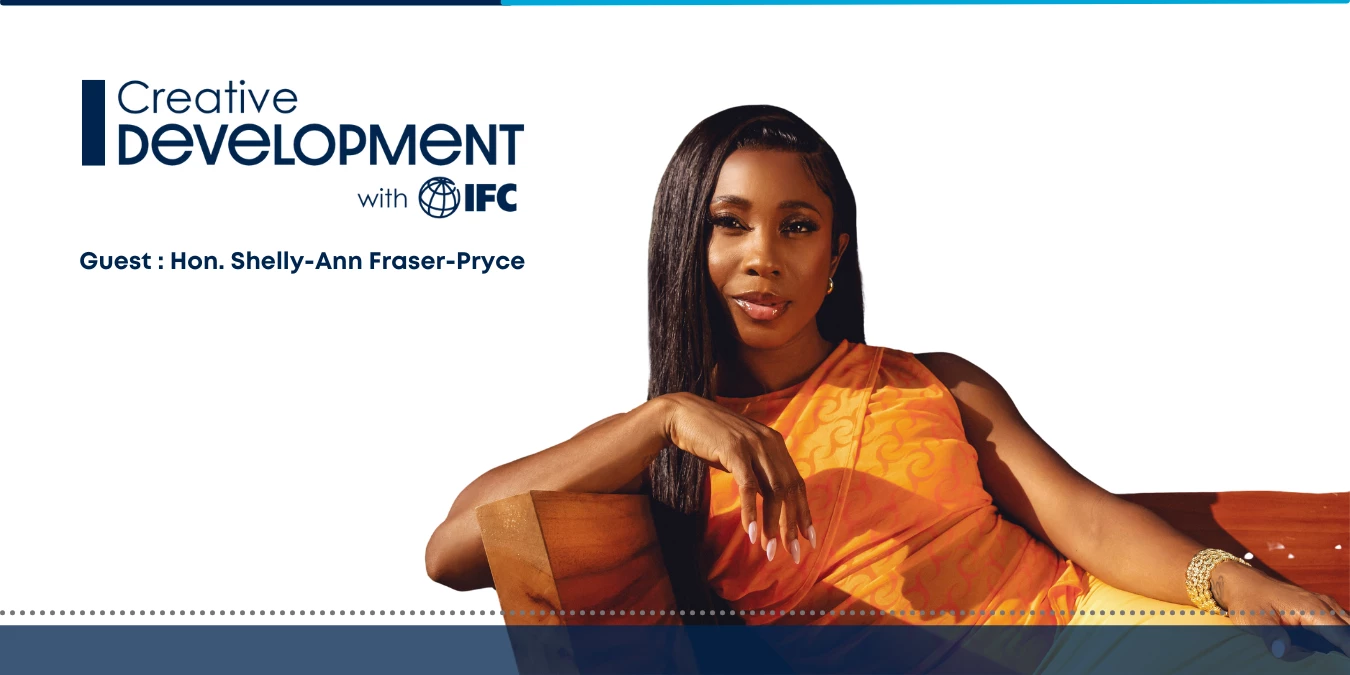
Season 6 | Episode 2
In this episode of Creative Development with IFC, the most decorated 100-meter sprinter of all time, Shelly-Ann Fraser-Pryce, joins Makhtar Diop for a powerful conversation on speed, purpose, and legacy. Reflecting on an extraordinary 18-year career- from her early days on the track in Jamaica to becoming one of the greatest athletes in history - Shelly-Ann shares how discipline, faith, and community shaped her path.
Now stepping into her next chapter, she discusses life beyond the track, empowering future generations through the Pocket Rocket Foundation and embracing entrepreneurship with her new haircare brand, AFIMI.
Saison 6 | Épisode 2
Dans cet épisode de Creative Development with IFC, Shelly-Ann Fraser-Pryce — la sprinteuse de 100 mètres la plus titrée de tous les temps — rejoint Makhtar Diop pour un échange inspirant sur la vitesse, la détermination et l’héritage qu’on laisse derrière soi. En revenant sur une carrière exceptionnelle de 18 ans, depuis ses débuts en Jamaïque jusqu’à son statut de légende du sport, Shelly-Ann raconte comment la discipline, la foi et la force de sa communauté ont façonné son parcours.
Alors qu’elle entame un nouveau chapitre, elle évoque sa vie après le stade, son engagement en faveur des jeunes à travers la Pocket Rocket Foundation, ainsi que son aventure entrepreneuriale avec sa nouvelle marque de soins capillaires, AFIMI.
Transcript in English
Makhtar Diop: Welcome to Creative Development with IFC. I'm Makhtar Diop, Managing Director of the International Finance Corporation. Today, my guest is Honorable Shelly-Ann Fraser-Pryce. She's the most decorated 100-meter sprinter in history and one of the most celebrated athletes of all time. Shelly-Ann recently retired from professional track and field after an extraordinary two decade career, but her legacy extends far beyond the finish line. She's the founder of the Pocket Rocket Foundation, which supports student athletes in Jamaica, and the creator of a haircare brand that celebrates Jamaican heritage.
I'm a big fan of Shelly-Ann, and I must confess, what you don't know, guys, is that I'm a big track and field fan. Let me remind some people who are not track and field fans like I am, who is Shelly-Ann? She has eight Olympic medals, 17 Championship medals, five world titles in the 100m sprint, not to mention relays and the 200 meters.
Shelly-Ann has something which is quite interesting. She's a pure product of the school system in Jamaica, which has produced so many champions. So tell us a little bit about how that system has made you the champion that you are today, and how you have decided to build your Foundation and give back to those children who are young athletes at school?
Shelly-Ann Fraser-Pryce: My mom actually ran in high school. That's where I got my speed from. So my mom was an athlete, and growing up, my mom got pregnant when she was still in high school with my brother, and then along came me two years after that, and then my little brother two years after me. So I grew up in one of the, you know, inner cities in Kingston, and it was very hard for us. We lived in what was called a tenement yard. So it was a lot of our families that live in one, you know, yard, space or home. And it was hard for us to see what's next. And my mom would always say to me that, you know, you have a gift, you know, you're talented. Track was going to be my vehicle to the next level. And you hear it, but the reality is you're not seeing the dream around you. She's telling you one thing, but the reality is you're in a poor environment. You're not seeing you know, your way out. But then I went to school. I went to George Headley Primary, before I went on to Wolmers. And if anybody can tell you anything about Jamaicans when it comes to sports, track and field, you name it, we are competitive as a country. Our high school programs are very competitive. And you find that if you want to excel, you'd have to understand that you have to do the work because talent…we have talent here, there’s no question about it. We have the talent here. But it's about making sure that you have the right tools to get you to the next level. It involves hard work, having the right support. And you can imagine, for a young girl like me, struggling with identity, struggling with self esteem, struggling with so many things, it was hard. But then, when I went to high school, I met a woman who was the president of the Wolmer’s Old Girls Association. And she saw more in me.
She gave me the opportunity to not think about school, to not think about where my uniform would come from. She gave me the opportunity to not think about where my books would come from. So I had the responsibility of focusing on track and focusing on school and pairing both things to, you know, just give me an advantage. And I remember at first I was like, I don't like people pitying me. And my grandmother would always talk about pride. You know, the Bible talks about pride going right before a fall and that sometimes when we're in need, we see that we're in need, but we're so prideful in not accepting that help. But she gave me that help. She gave me that support, and the school supported me. So many individuals around me really poured into to me, just telling me that there's more to come.
And that's really the idea behind the Pocket Rocket Foundation. It's about me using the help and the support that I had to basically build a ladder for the next generation. Because if this is how I made it I'm giving you the same opportunity to have the same journey and to use it to the best of your advantage. So that's how we formed the Pocket Rocket foundation. This idea of just running and getting medals and, you know, getting success - success is not just for us. It's for those who we inspire. It's for those who are walking alongside us on our journey, who see us and say, oh, I want to be like her, to get an opportunity to not worry about the books, to not worry about, how am I going to pay my tuition? How am I going to get food? But instead, I want you to take everything that is within you, to have the discipline, the right mindset, and to channel that God- given gift that you have to work hard at your sport and in school, and pair both things and create an avenue that you will excel for yourself.
Makhtar: One thing I would like to thank you - and I know the people of Jamaica are thanking you for that - is your personal involvement after the hurricane. Tell us what has motivated you to play such a big role in answering to this catastrophe that Jamaica has faced.
Shelly-Ann: Thank you, Makhtar. Hurricane Melissa happened and while for a lot of us could not have predicted what would have happened - we hear about a category five hurricane, and we're like, all right, we've never experienced one before - but I can tell you when we saw the after effect, when we saw the houses, when we saw the roads, when we saw, you know, businesses being closed, schools being closed, people losing their livelihood, it is only a matter for us to think about community and how we recover together. So as much as I am an athlete that competes on the track, off the track, I am a Jamaican, you know, I'm a mom, you know, I'm a neighbor, I'm everything here, and it's only right that we step in and to help them to get to rebuild what they have. And for me, through the Pocket Rocket Foundation, our main focus is student athletes, their families and communities and school by extension. So we're able to go on the ground. Its all of us that will have to pitch in and to make sure that our country gets back, you know, standing and if it's one thing that this has taught us is that we all have a role to play in the recovery. So as usual, the Pocket Rocket Foundation has been on the ground, and we're helping to move forward, getting our kids back in school, getting care packages, to, you know, to families and to communities. Because the reality is, yes, we're a charity, but right now, it's not about charity. It's about community and how we come together as Jamaicans to make sure that our brothers and sisters are making ends, and they're getting back to what they're used to.
Makhtar: There's something you know, which is quite impressive in you: the way you handle pressure. Throughout your career - you know, when people are stressed, people do trash talking, all these kind of things. You’ve kind of always been above all this, and don't seem to be to be touched by all these things that you see in the in the sports industry, where people can trash talk, make some noise, which is not necessarily positive, or get too nervous once they get to competition. You finish your race, you smile as you just came out from a supermarket.
Shelly-Ann: Ultimately I would like think that it's my faith. You know, my grandmother nurtured that faith from when I was very small. I had like no choice but to go to church on a Saturday with my grandmother. So I would have to say my faith. Every season carries with it a lot of different things, the highs, the lows, pressure, self doubt, and I experience those things. But the reality is having the right people in your corner...
Makhtar: No, no It’s not as you say, that its only about the right people! You have something special, because other athletes also had that support!
Shelly-Ann: I’m competitive! I don't like to lose. I don't like losing. I don't like feeling like, I didn't do my best. For me as an athlete it doesn't matter what the result is going to be. I am giving you 100% at all times. I'm standing at the line at all times. Because the reality is, it's only in the start, that we know how we finish. That's just the reality. We only know it that way. And to be honest, how I grew up also played a role in that I had to fight for myself. I had to really dig deep. I had to want it for myself.
And you know, you hear people say, Oh, nobody's going to save you. Yeah, I had that growing up. I felt like, Okay, I have to get myself out of this environment, or nobody else will.
I'm very grounded, because I know what I want, and I say to myself, the I go to training, it's about me. I have to do the work. Nobody's forcing me to go to do the work. When I step to the line and I'm thinking about the success or I'm thinking about the outcome, the only person that can guarantee that success is the work that you do. Let the work that you do be your strength. Let the work that you do give you confidence.
Makhtar: This is fantastic. I think this is not a lesson in sports that you have just given. It’s a lesson about life, its about business. And we will talk about business later, because now you have shifted to be a business woman. Actually, when I talk to people in our world of business, of development about motivational skills and leadership, I say just go to high level sportsmen or coaches. These people know how to motivate a team, are resilient, know how to set goals and they deliver.
But you know you are a good representative of the Jamaican women, who are very determined women, and who have achieved so much. [In] 2017 you decide to be a mother. At that time everybody said, her career is done. And you say, no my career is not done. I will be a mother. I will come back and do it. And since then, you inspired a lot of people. You inspired Alison Felix, Shaunae Miller, Faith Kipyegon – so now you have the top athletes in the world who have become mothers and demonstrated that being a mother is not something which is not compatible. Tell me, when it happened in 2017, did you have any doubts or did you say it will happen and I will make it and no worries.
Shelly-Ann: When I got pregnant with my son, I was nervous, because you don't hear about women returning to high-level sprinting after having a baby, let alone turning 30, because I turned 30 the December of that year. And it was hard for me to sit and to think about becoming a mom and going back to sprinting. But the reality is, I knew I wanted to come back, like that was something that I knew from the get go, because I understood the importance of forging your own destiny and just really tapping into your own strength. And I've always been stubborn, like my teachers will tell you, or my mom or my brothers will tell it, I'm very stubborn. The moment I make up my mind and say, this is what I'm doing, you cannot change my mind. And that's the type of person I am, and that's the kind of strength and resilience that I had that really kept me going. So when I had my son you're not seeing a lot of moms around you. You're not seeing persons, you know, having kids and coming back and you're thinking about, okay, then what am I going to do? There's no real data that supports this, but that's not my job. My job is to do the work.
My job is to believe in what I believe in and keep that belief. So I had my son and I knew I wanted to come back. And I heard people talk. I heard people saying, oh, you know, it's not possible for her to come back. But again, maybe because of how I grew up as well, I don't care what you think like what you think has nothing to do with me, because the moment I start thinking for you, then I drown my own voice out. And I can't afford to drown the voice that is important to me, the voice that is okay, then the voice of reasoning that if I say I'm doing something, I'm doing it. I can't allow your doubts, your fear, to interfere with the ones I already have, because the reality is, I already have my own doubts and fear. But I'm not going to allow yours to stand on mine. So I knew I had to come back, and I wanted to come back, and I had a huge support.
So I had my son, and funny enough, I had my son via C sections. I had a C section when I had my son. And that completely changed everything, because I had a plan. I was like, I'm going to have the baby and I'm going to get back to training at six weeks and I'm going to do this. And that never happened. I got back to training 11 weeks after having my son, and I remember going back to practice, and I took it a day at a time. I was like, all right, one day at a time. This is a time that you stay down, head down. This is a time that you, you know, when you talk about planting, this is the time you're planting because the harvest is coming. So I'm planting. I'm sowing good seeds and drinking my water. I'm doing my exercise. I'm going to Pilates. I'm doing the extra work, because I know what it will require of me.
I'm also a mom, and I wanted to make sure that I'm intentional about being a mom, because it's important for me to balance being a mom and being a sprinter. Too often people tell women what they can do or what they cannot do, or they think that motherhood somehow diminishes who you are as a woman, but it's not. It adds to who we are. It adds layer to us as women, shows our strength, shows our impact, shows who we are in our entirety. And I don't want to have to choose. And I think for a lot of people, they think they have to choose, but why not have it both ways? Some days it's not easy, and that's okay, don't be hard on yourself. And I had to learn that, because I'm always hard on myself. I'm like, a little perfectionist. I want to get it right, because the reality is, when you run 100 meters, you have no room for error. The person who gets it right gets it right. And I want to get it right, because I'm already starting behind the eight ball in the sense that from the technical aspect, I didn't start out being technically correct, so I had to learn and relearn, you know, sprinting. So it's harder for me, so I have to make sure that when I get to train, I have to be intentional about the things that I do at training.
So when I realized, okay, I'm being a mom, and I'm having my baby, and I'm breastfeeding, and I'm going to training, and I'm coming home, and I'm up at night. I have support, and I love the support, because my husband gave me lots of support, and I love the fact that he trusted my decisions, and that's important, and that gave me confidence. Those things gave me confidence. When people around me who I trust to just give me sound advice, they trust my dreams. They trust what I'm saying. They trust my word.
And so I realized I'm coming back. You know, it's not easy, it's doable, but the next woman is depending on me for it to work. She's depending on me to understand that girl, if you want to go start a family, go, if you want to run at 30, go. She's depending on me. And the reality is, I depend on a lot of women to do what they do. Merlene Ottey, you talk about Juliet Cuthberg, you talk about so many other different women who laid the foundation for what we did.
And I came back and I ran the fastest I've ever ran in my entire career. I won medals after having my son. I stood on the podium after, you know, having my son, you know, I became a better athlete, a better woman, after I had my son. Motherhood doesn't diminish us, it's, you know, it elevates us. It allows us to think better, to understand that we have someone that's looking up to us, somebody that will inspire us and will lead by our inspiration. And I think that's what happened with my son. Because I knew it was important for me that when he reads this story, he understood that for mommy, Zion Pryce didn't stop me from doing what I needed to do. Zion Pryce helped me to do what I needed to do, and by that he'd be inspired knowing that mommy did everything she could because of me.
Makhtar: Shelly-Ann that's so beautiful. Let me ask you now, now that your foundation is in place, now you are looking also at another side of you: entrepreneurship. You have a line which is looking at hair. And I'm not surprised because I have been following all your hair, every, race we were saying is it yellow, is it green, is it the colors of Jamaica, or another? So tell us about your haircare brand. Tell me more about it.
Shelly-Ann: So AFIMI is patois for “its mine”. AFIMI is rooted in who I am as a person, as a Jamaican, as a woman, as an entrepreneur, as an athlete. It's years of going to different track meets and knowing what my hair needs are, celebrating my hair in different styles, wearing my bold color. It's really stepping into what my grandmother taught me, how she celebrated me as a woman, her ingredients that she would blend up at home and say, Okay, you have to put this in your hair to grow your hair. Because I've always been fascinated with hair.
I’ll probably get a lot of flack for this, but I remember going to school with one hairstyle and then going in the bathroom and coming out with different hair. I would finish class early to get in the bathroom because my friends would be, you know, changing my hairstyle, and I'll be going home with a different hairstyle. So from the get go, I was always changing my hair. I was always in love with hair.
But, you know, AFIMI is proudly Jamaican. It's about the herbs and the plants and the botanicals that we have here in Jamaica really coming together, and putting that and bottling it and showing the world that Jamaica, we can do it at home. We can invest in home. We can use what we have at home, and we can make it ours, and it can be yours. So really and truly it's years of just testing and knowing what my hair needs are, knowing what a woman would decide, okay, I want this to help, you know, grow my hair and bottling it and taking it and showing people that the essence of Jamaica is rooted right here in Jamaica. But it's more than just hair care. It's self love. It's loving who you are, loving the different ways you celebrate wearing your hair. It's about stepping into a new lane and showing women that you can become athletes, but you can also be entrepreneurs.
And my mom was the first entrepreneur that I know, because my mom was - actually in Jamaica, you'd call it a higgler - but she was my first entrepreneur. She was selling sweets, she was selling firecrackers at Christmas time. She was selling roses at Valentine's Day. So she was the first person that I saw, really just tapping into that skill that she had to [do something with] whatever it is that her hands found. My grandmother would use this or Jamaicans would use this term: I'll say it in patois, and then I'll translate it in English. My grandmother would say, “You tek pon han’ an’ fashion.” So it's “whatever your hands found, you made it yours, you make it your own”. And that's really what AFIMI is.
My hair is a big part of who I am. It's how I celebrate, you know, who I am as a Jamaican, its how I celebrate who I am as an athlete. I enjoy changing my hair color. I enjoy persons commenting and say, hey, what color hair are you wearing?
I want to wear different hair, because I think as especially as black women, a lot of persons like to just put us in a box and say this style is not for you, or this style is for you. But I grew up seeing women in my community wearing different hair styles and wearing that proudly and boldly, because the reality is as humans by nature we have personality, we have vibe, we have style, and we want to show that style and AFIMI is really what that is. It's self love. It's bottling my grandmother's ingredients, its bottling the ways we grow our hair by going to the back of our homes and picking aloe vera or picking rosemary and blending it and making stuff that are unique to us, and bottling it and showing that it doesn't matter how you wear your hair. Doesn't matter what texture your hair is, AFIMI is for you.
Makhtar: So for your business I'm very interested in that. You know we are lending $72 billion a year. Its a lot of infrastructure for larger countries, PPPs for highways, we help building factories. But part of our strategy, an important part of it, is also to support MSMEs - small and medium enterprises. And I'm very interested in seeing people with your profile, because you have already a lot of ingredients which are needed to be a successful business person: resilience, commitment, setting goals, knowing what adversity is, looking at things in the long run. So all these are, for me, something which are important to become a successful businesswoman...
Shelly-Ann: I love that Makhtar. I think that's what it means to be a leader. You know what I mean? It's understanding that when it comes to sports, sports is a infrastructure, right? And not just entertainment. And we want persons to invest in our athletes. We want to invest because outside of sports, there are a lot of athletes that are, you know, investing in entrepreneurship. They're investing in, you know, tourism, or they're investing in their education. So we want to find a way to tap into that. How do we best support these athletes? How do we help them to transition?
Because I can tell you this, the transition sometimes is hard because I think what a lot of athletes don't understand when they're in the sport - and if I wasn't careful, maybe that would have happened to me - we are so focused on the sport that we don't think about anything else. Track and field is for a time, it's a period, and you still have to live after that, and you have to really use resources that you have within the sport and really align or collaborate with leaders and, you know, companies that will help you to get to that next level, because the transition can be difficult, especially if we are not educated on that next step. Because for a lot of us, when we make decisions, we don't want to make decisions from emotions, or we don't want to make decisions from stress, especially financial decisions. We want to make decisions comfortably knowing that, okay, I have the right tools, I have the right knowledge, I have the right information, and this is why I'm making this decision. I'm making this decision because I know. I'm not making this decision because I'm stressed or I'm worried or my emotions are high or because I don't know what I'm doing next. So it's important to really collaborate with athletes who already have the platform. And it is, you know, companies like yours, and you as a leader who will have the right tools to actually mentor some of these athletes. So I think for me, how do we help the athlete to transition.
Makhtar: I'm a big fan of Shelly-Ann the athlete. I love the person. You have been really fantastic today in this conversation. You have been showing all of us what is it to be a leader. Shelly-Ann you have been an example to a lot of young people. Continue inspiring them, continue supporting Jamaica in all the dimensions that you're doing, from the hurricane, to the foundation, to the business. And I think that you are a beautiful ambassador.
Shelly-Ann: I appreciate that very much. I appreciate that.
Makhtar: Thanks for listening, Creative Development is produced by Lindy Mtongana, Maeve Frances and Aida Holly-Nambi for IFC. Thanks for listening and tell a friend.
Transcription française
Makhtar Diop : Bienvenue dans Creative Development with IFC. Je suis Makhtar Diop, directeur général de la Société financière internationale. Aujourd’hui, j’ai le plaisir d’accueillir l’Honorable Shelly-Ann Fraser-Pryce. Elle est l’athlète la plus titrée de l’histoire du 100 mètres et l’une des sprinteuses les plus emblématiques de tous les temps.
Shelly-Ann a récemment mis fin à sa carrière après près de vingt années exceptionnelles sur les pistes, mais son héritage dépasse largement la ligne d’arrivée. Elle est la fondatrice de la Pocket Rocket Foundation, qui soutient les étudiants sportifs en Jamaïque, ainsi que la créatrice d’une marque de soins capillaires célébrant l’héritage jamaïcain.
Je suis un grand fan de Shelly-Ann, et je dois vous avouer quelque chose : ce que vous ne savez peut-être pas, c’est que je suis vraiment passionné d’athlétisme. Pour ceux qui ne suivent pas ce sport autant que moi, laissez-moi vous rappeler qui est Shelly-Ann : huit médailles olympiques, 17 médailles de championnats, cinq titres mondiaux sur 100 m, sans oublier les relais et le 200 m !
Ce qui est vraiment intéressant, c’est que Shelly-Ann est le pur produit du système scolaire jamaïcain, qui a formé tant de champions. Alors, racontez-nous un peu : comment ce système a-t-il fait de vous la championne que vous êtes aujourd’hui ? Et qu’est-ce qui vous a poussé à créer votre fondation pour soutenir ces jeunes athlètes à l’école ?
Shelly-Ann Fraser-Pryce : En fait, ma mère courait au lycée, et c’est de là que j’ai hérité ma vitesse : elle était elle-même athlète. Elle est tombée enceinte de mon frère alors qu’elle était encore au lycée. Deux ans plus tard, je suis née, puis mon petit frère deux ans après moi. J’ai grandi dans l’un des quartiers populaires de Kingston, et la vie n’était pas facile pour nous. Nous vivions dans ce qu’on appelait un « tenement yard », un espace ou une maison que partageaient plusieurs familles. Il était difficile d’imaginer ce que l’avenir nous réservait. Ma mère me répétait toujours : « Tu as un don, tu es talentueuse. L’athlétisme sera ton tremplin vers quelque chose de plus grand. » On peut entendre ça, mais la réalité, c’est que quand tu grandis dans un environnement difficile, tu ne vois pas forcément le chemin qui s’ouvre devant toi. Je suis allée à l’école primaire George Headley, puis j’ai poursuivi ma scolarité au lycée Wolmer (Wolmer’s Schools). Et si l’on peut dire quelque chose sur les Jamaïcains et le sport, c’est que nous sommes très compétitifs. Nos programmes scolaires, notamment en athlétisme, sont extrêmement exigeants. Pour exceller, il faut comprendre que le talent seul ne suffit pas. Le talent, on en a, ça ne fait aucun doute. Mais pour passer au niveau supérieur, il faut avoir les bons outils, travailler dur et bénéficier du bon soutien. Vous imaginez bien qu’en tant que jeune fille, en pleine recherche d’identité et confrontée à des problèmes d’estime de soi, ce n’était pas facile. Mais au lycée, j’ai rencontré une femme, présidente de l’Association des anciennes élèves de Wolmer’s, qui a vu en moi quelque chose de plus.
Elle m’a permis de ne pas me tracasser pour mon uniforme ou mes livres scolaires, et de me concentrer pleinement sur l’athlétisme et l’école pour tirer le meilleur parti des deux. Je me souviens qu’au début, je n’aimais pas que les gens me prennent en pitié. Ma grand-mère parlait toujours de fierté. La Bible dit que l’orgueil précède la chute, et parfois, quand on est dans le besoin, on voit qu’on a besoin d’aide mais on est trop fier pour l’accepter. Mais elle m’a apporté cette aide, ce soutien, et l’école m’a aussi soutenue. Tant de personnes autour de moi ont cru en moi, me disant qu’il y avait encore beaucoup à venir.
C’est exactement l’idée derrière la Pocket Rocket Foundation : utiliser l’aide et le soutien que j’ai reçus pour offrir un vrai tremplin à la prochaine génération. Si c’est ainsi que j’ai réussi, je veux donner à d’autres la même opportunité, pour qu’ils puissent suivre un chemin similaire et en tirer le meilleur parti.
C’est ainsi que nous avons créé la Pocket Rocket Foundation. Il ne s’agit pas seulement de courir et de décrocher des médailles, ni de réussir pour soi-même. Le succès, c’est aussi pour ceux que nous inspirons, pour ceux qui nous accompagnent et qui, en nous voyant, se disent : « Je veux être comme elle ». C’est leur offrir la possibilité de ne pas se demander comment acheter leurs livres ou payer leurs frais de scolarité, comment se nourrir… Mais plutôt de prendre tout ce qu’ils ont en eux, développer discipline et bon état d’esprit, et canaliser le don que Dieu leur a donné pour travailler dur dans leur sport et à l’école, combiner les deux, et ainsi créer leur propre chemin vers l’excellence.
Makhtar : Il y a une chose pour laquelle je tiens à vous remercier— et je sais que le peuple jamaïcain vous en est reconnaissant — c’est votre engagement personnel après l’ouragan. Qu’est-ce qui vous a poussée à jouer un rôle aussi important dans la réponse à cette catastrophe qui a frappé la Jamaïque ?
Shelly-Ann : Merci Makhtar. L’ouragan Melissa a frappé, et beaucoup d’entre nous n’avaient pas pu prévoir l’ampleur des dégâts. Mais quand on entend parler d’un ouragan de catégorie cinq, on se dit : « On n’a jamais vécu ça avant ! » Et je peux vous dire que quand nous avons vu les dégâts — les maisons détruites, les routes abîmées, les commerces fermés, les écoles à l’arrêt, et les gens qui se retrouvaient sans ressources… — il n’y avait qu’une seule chose à faire : penser à la communauté et se demander comment reconstruire ensemble. Donc, même si je suis une athlète sur la piste, en dehors de celle-ci, je suis avant tout jamaïcaine. Je suis mère, voisine, membre de ma communauté, et il est tout naturel que nous nous mobilisions pour aider les gens à reconstruire ce qu’ils ont perdu. Pour moi, à travers la Pocket Rocket Foundation, notre priorité reste les étudiants-athlètes, leurs familles et leurs communautés, et par extension les écoles. Cela nous permet d’intervenir sur le terrain. Nous devons tous nous mobiliser pour que notre pays se relève. Et si cette expérience nous a appris quelque chose, c’est que chacun a un rôle à jouer dans la reconstruction. Comme toujours, la fondation a été présente sur le terrain : nous aidons les enfants à retourner à l’école, nous distribuons des colis de première nécessité aux familles et aux communautés. Parce que la réalité, c’est que oui, nous sommes une organisation caritative, mais dans ces moments-là, il ne s’agit pas seulement de charité. Il s’agit de communauté et de solidarité, de la manière dont nous, Jamaïcains, nous rassemblons pour nous assurer que nos frères et sœurs peuvent se relever et retrouver leur quotidien.
Makhtar : Il y a quelque chose chez vous qui est vraiment impressionnant : la façon dont vous gérez la pression. Tout au long de votre carrière — vous savez, quand les gens sont stressés, qu’ils critiquent, qu’ils font du « trash talk », toutes ces choses… — vous êtes restée au-dessus de tout ça. On a l’impression que rien de tout cela ne vous atteint, contrairement à ce qu’on voit parfois dans le sport, où certains se laissent perturber par les critiques, le bruit ou le stress de la compétition. Vous terminez votre course avec le sourire, comme si vous sortiez simplement du supermarché !
Shelly-Ann : Je dirais que c’est ma foi. Ma grand-mère a nourri cette foi depuis que je suis toute petite. Je n’avais d’ailleurs pas vraiment le choix : il fallait aller à l’église le samedi avec elle ! Donc je dirais que c’est vraiment ma foi. Chaque saison apporte son lot de choses différentes : les moments forts, les moments difficiles, la pression, le doute… et j’ai traversé tout cela. Mais la réalité, c’est que tout dépend d’avoir les bonnes personnes à vos côtés…
Makhtar : Non, non ! Ce n’est pas juste comme vous le dites, que tout repose uniquement sur les bonnes personnes à vos côtés ! Vous avez quelque chose de spécial, parce que d’autres athlètes aussi ont ce soutien.
Shelly-Ann : Je suis très compétitive ! Je n’aime pas perdre. Je n’aime pas avoir l’impression de ne pas avoir donné le meilleur de moi-même. Pour moi, en tant qu’athlète, peu importe le résultat : je donne toujours 100 %. À chaque départ, je suis prête à tout donner. Parce que la réalité, c’est qu’on ne sait qu’une seule chose au départ : comment on va finir. C’est comme ça, c’est la vérité. Et honnêtement, la façon dont j’ai grandi a aussi joué un rôle : j’ai dû me battre pour moi-même. J’ai dû puiser au plus profond de moi, vraiment le vouloir pour moi-même.
Vous savez, on entend souvent les gens dire : « Personne ne va te sauver. » Eh bien, j’ai grandi avec ça. Je me disais : « D’accord, si je veux sortir de cet environnement, c’est à moi de le faire, personne d’autre ne le fera pour moi. »
J’ai les pieds sur terre, parce que je sais ce que je veux. Je me dis : « Quand je vais à l’entraînement, c’est pour moi. » Je dois fournir l’effort. Personne ne me force à le faire.
Quand je me place sur la ligne de départ et que je pense au succès ou au résultat, la seule personne capable de garantir ce succès, c’est moi, grâce au travail fourni. Que ce travail devienne votre force, et vous donne confiance.
Makhtar : C’est formidable. Et je pense que ce que vous venez de nous dire, ce n’est pas seulement une leçon de sport. C’est une leçon de vie — et même une leçon de management. On en parlera d’ailleurs un peu plus tard, parce que vous êtes devenue une femme d’affaires à part entière. En fait, quand je discute, dans le monde du business ou du développement, de la motivation, du leadership, je dis souvent : « Regardez les athlètes de haut niveau, regardez les coachs. » Ce sont eux qui savent vraiment motiver une équipe, faire preuve de résilience, fixer des objectifs et les atteindre.
Mais vous êtes aussi une remarquable représentante des femmes jamaïcaines : déterminées, ambitieuses, et capables d’accomplir des choses extraordinaires. En 2017, vous décidez de devenir mère. À ce moment-là, tout le monde disait : « Sa carrière est terminée. » Et vous, vous répondez : « Non, ma carrière n’est pas terminée. Je vais devenir mère, et je reviendrai. » Et vous l’avez fait.
Depuis, vous avez inspiré énormément de monde : Allyson Felix, Shaunae Miller-Uibo, Faith Kipyegon… Les meilleures athlètes du monde sont devenues mères et ont montré que maternité et carrière sportive peuvent parfaitement aller de pair. Dites-moi, en 2017, avez-vous eu des doutes, ou vous êtes-vous dit : « Ça va marcher, je vais y arriver, aucune inquiétude » ?
Shelly-Ann : Quand je suis tombée enceinte de mon fils, j’étais nerveuse. On ne voit pas souvent des femmes revenir au sprint de très haut niveau après une grossesse — et encore moins à 30 ans ; j’ai eu 30 ans en décembre de cette année-là. C’était difficile de me projeter : devenir mère tout en préparant un retour à la compétition, c’était un vrai défi. Au fond de moi, je savais que je voulais revenir à la compétition. J’en avais la conviction, parce que je comprenais l’importance de tracer mon propre chemin et de puiser dans ma propre force. Et j’ai toujours été obstinée — mes professeurs vous le diraient, ma mère, mes frères aussi — très obstinée. Dès que je prends une décision, que je dis : « C’est ce que je fais », personne ne peut me faire changer d’avis. C’est la personne que je suis : cette force et cette résilience m’ont vraiment portée. Quand j’ai eu mon fils, je ne voyais pas beaucoup de mamans revenir à la compétition. Très peu de femmes faisaient un enfant puis revenaient au plus haut niveau. Alors forcément, on se demande : « Qu’est-ce que je fais ? » Il n’y avait pas beaucoup de précédents pour me rassurer. Mais au fond, c’est mon métier. Mon rôle, c’est de faire le travail.
Mon rôle, c’est de rester fidèle à mes convictions et de m’y tenir. J’ai eu mon fils, et je savais que je reviendrais à la compétition. J’ai entendu les commentaires, les gens dire : « Oh, elle ne pourra jamais revenir. » Mais peut-être à cause de la façon dont j’ai grandi, ce que les autres pensent ne m’atteint pas. Votre opinion n’a rien à voir avec moi, parce qu’au moment où je commence à penser pour vous, j’étouffe ma propre voix. Et je ne peux pas me permettre de faire taire la seule voix qui compte vraiment pour moi, cette voix de la raison qui me dit : « Si je décide de faire quelque chose, je le fais. » Je ne peux pas laisser vos doutes et vos peurs interférer avec les miens, parce que la vérité, c’est que j’ai déjà mes propres doutes et mes propres peurs. Mais je ne vais pas permettre aux vôtres de se superposer aux miens. Je savais donc que je devais revenir — que je voulais revenir, et j’ai reçu un énorme soutien.
J’ai donc eu mon fils — et, chose assez ironique, il est né par césarienne. Une césarienne, oui, et ça a tout changé. Parce que j’avais un plan : je me disais que j’allais avoir mon bébé, reprendre l’entraînement six semaines plus tard, et avancer comme prévu. Mais rien ne s’est passé comme prévu. J’ai finalement repris l’entraînement onze semaines après la naissance de mon fils. Je me souviens d’être retournée sur la piste en me disant : « Un jour après l’autre. » C’était le moment de baisser la tête, de rester concentrée. Quand on parle de semer, c’était exactement ça : c’était le temps des semailles, parce que la récolte viendrait. Alors je semais. Je semais de bonnes graines : je buvais mon eau, je faisais mes exercices, j’allais au Pilates, je faisais des entraînements supplémentaires — parce que je savais exactement ce que cela allait exiger comme efforts.
Je suis aussi maman, et je voulais vraiment être une mère présente, intentionnelle, parce que pour moi il est essentiel de trouver l’équilibre entre ma vie de maman et ma vie de sprinteuse. Trop souvent, on dit aux femmes ce qu’elles peuvent ou ne peuvent pas faire, ou l’on pense que la maternité les réduit. Mais ce n’est pas vrai. Au contraire : la maternité nous enrichit. Elle nous donne une autre dimension, révèle notre force, notre impact, et montre notre identité dans toute sa complexité. Et je n’ai pas envie de choisir. Beaucoup de femmes pensent qu’elles doivent choisir, mais pourquoi ne pas avoir les deux ? Certains jours sont difficiles, et c’est normal. Ne soyez pas trop dure avec vous-même. Moi, j’ai dû l’apprendre, parce que je suis toujours dure avec moi-même. Je suis plutôt perfectionniste, je veux tout faire bien. Dans un 100 mètres, vous n’avez pas le droit à l’erreur : celle qui exécute parfaitement gagne. Et je veux faire les choses parfaitement, d’autant que j’avais un désavantage : techniquement, au départ, je n’étais pas “parfaite”, j’ai dû apprendre et réapprendre à sprinter. C’était un défi. C’est pour cela que, lorsque je m’entraîne, je dois être pleinement intentionnelle dans tout ce que je fais. Chaque geste compte.
Quand j’ai réalisé que j’allais devenir maman — allaiter, m’entraîner, rentrer à la maison, veiller la nuit… — j’ai compris l’importance d’avoir du soutien. J’en ai eu beaucoup, et j’en suis reconnaissante, notamment celui de mon mari, qui a soutenu mes décisions. Et c’est important : cette confiance m’a donné de l’assurance. Les personnes autour de moi, dont je respecte les conseils, ont cru en mes rêves, en mes paroles et en mes actes.
J’ai pris conscience que j’allais reprendre la compétition. Ce ne serait pas facile, mais c’était possible. Et je savais que d’autres femmes comptaient sur moi pour montrer que c’était faisable, pour prouver que si elles voulaient fonder une famille ou reprendre l’athlétisme à 30 ans, elles le pouvaient. Elles comptaient sur moi. Et la réalité, c’est que moi aussi, je me suis appuyée sur de nombreuses femmes pour accomplir ce que je fais. Merlene Ottey, Juliet Cuthberg et tant d’autres ont pavé la voie et nous ont permis de réaliser ce que nous faisons aujourd’hui.
Et je suis revenue sur les pistes. J’ai couru plus vite que jamais dans toute ma carrière. J’ai remporté des médailles après la naissance de mon fils. Je suis montée sur le podium. J’étais une meilleure athlète, une meilleure femme. La maternité ne nous diminue pas, elle nous élève. Elle nous permet de mieux réfléchir, de réaliser que quelqu’un nous regarde et s’inspire de nous. C’est exactement ce qui s’est passé avec mon fils. Je voulais que, quand il lira mon histoire, il comprenne que Zion Pryce ne m’a pas empêchée de faire ce que je devais faire. Au contraire, il m’a permis de le faire. Et en voyant cela, il pourra être inspiré, sachant que sa maman a tout donné et a accompli ce qu’elle devait accomplir grâce à lui.
Makhtar : Shelly-Ann, c’est tellement beau. Maintenant, j’aimerais vous poser une question : votre fondation est en place, et vous explorez également un autre aspect de vous-même : l’entrepreneuriat. Vous avez lancé une ligne dédiée aux soins capillaires. Et ça ne me surprend pas, parce que je vous ai suivie de près, et à chaque course, on se demandait : « Est-ce que c’est jaune, vert, aux couleurs de la Jamaïque, ou autre ? » Parlez-nous un peu plus de votre marque de soins capillaires.
Shelly-Ann : AFIMI, cela signifie en patois « c’est à moi ». AFIMI reflète qui je suis : ma Jamaïcité, mon identité de femme, d’entrepreneure et d’athlète. C’est le fruit de toutes ces années passées sur les pistes, lors des compétitions, à comprendre ce dont mes cheveux avaient besoin, à célébrer ma chevelure sous différentes formes et à oser les couleurs audacieuses. C’est vraiment l’esprit de ce que ma grand-mère m’a transmis, la manière dont elle me célébrait en tant que femme, ses recettes maison qu’elle préparait quand elle me disait : « Tu dois mettre ça dans tes cheveux pour qu’ils poussent. » J’ai toujours été fascinée par les cheveux.
Je vais probablement me faire critiquer pour ça, mais je me souviens aller à l’école avec une coiffure, puis passer aux toilettes et en ressortir avec un style complètement différent. Parfois, je finissais les cours un peu plus tôt juste pour passer par les toilettes, car mes amies aimaient changer ma coiffure. Je rentrais chez moi avec un nouveau style. Depuis toujours, j’adore changer de coiffure. Je suis passionnée par les cheveux.
AFIMI est fièrement jamaïcaine. C’est un hommage aux herbes, plantes et ingrédients botaniques de Jamaïque, soigneusement récoltés et mis en flacon, pour montrer au monde que nous pouvons créer localement. Nous pouvons investir chez nous, utiliser ce que nous avons à portée de main, en faire quelque chose qui nous appartient… et le partager avec vous. En réalité, ce sont des années de tests pour comprendre les besoins de mes cheveux, pour savoir ce qu’une femme choisirait pour faire pousser sa chevelure, puis de mettre ces soins en flacon et de les partager, afin de montrer que l’essence de la Jamaïque se trouve ici, chez nous. Mais AFIMI, c’est bien plus que des soins capillaires. C’est de l’amour de soi, l’art d’aimer qui vous êtes et de célébrer votre chevelure sous toutes ses formes. C’est aussi s’aventurer sur un nouveau terrain et montrer aux femmes qu’on peut être à la fois athlète et entrepreneure.
Ma mère a été la première entrepreneure que j’aie connue. En Jamaïque, on dirait une « higgler », mais pour moi, c’était ma première entrepreneure : elle vendait des bonbons, des feux d’artifice à Noël, des roses à la Saint-Valentin… C’est la première personne que j’ai vue mettre à profit ses talents avec ce qu’elle avait sous la main. Ma grand-mère avait une expression en patois que je vais traduire : « You tek pon han’ an’ fashion », ce qui signifie « quoi que tes mains trouvent, tu en fais ton bien ». Et c’est exactement ce qu’est AFIMI.
Mes cheveux font partie de mon identité. C’est ma manière de célébrer qui je suis, en tant que Jamaïcaine et en tant qu’athlète. J’aime changer de couleur, et j’adore quand les gens me demandent : « Quelle couleur de cheveux portes-tu aujourd’hui ? »
Je veux porter des styles différents, parce qu’en particulier pour les femmes noires, beaucoup veulent nous mettre dans une case et dire : « Ce style n’est pas pour toi » ou « ce style est pour toi ». Mais j’ai grandi en voyant des femmes de ma communauté arborer fièrement des coiffures variées, et c’est ce que j’ai appris à faire. Par nature, nous avons tous une personnalité, un style, et nous voulons l’exprimer. AFIMI, c’est exactement ça : l’amour de soi, la mise en flacon des ingrédients de ma grand-mère, des recettes maison à base d’aloe vera, de romarin et d’autres plantes, pour créer quelque chose d’unique, et montrer que peu importe la façon dont vous portez vos cheveux ou leur texture, AFIMI est pour vous.
Makhtar : Une part importante de notre stratégie consiste également à soutenir les petites et moyennes entreprises. Et je suis très intéressé par les personnes ayant votre profil, car vous possédez déjà de nombreux atouts pour réussir en affaires : la résilience, l’engagement, la capacité à se fixer des objectifs, l’expérience de l’adversité et la vision à long terme. À mes yeux, ce sont des qualités indispensables pour devenir une entrepreneure accomplie. Beaucoup de personnes qui évoluent à votre niveau mettent des années à acquérir de telles compétences.
Shelly-Ann : J’apprécie vraiment Makhtar. Je pense que c’est ça, être un leader. Comprendre que le sport n’est pas seulement un divertissement, mais aussi une infrastructure. Et nous voulons que les gens investissent dans nos athlètes. Nous voulons investir parce qu’au-delà du sport, beaucoup d’athlètes se tournent vers l’entrepreneuriat, investissent dans le tourisme ou dans leur éducation. Nous voulons trouver des moyens de les soutenir au mieux et de les accompagner dans leur transition.
Parce que je peux vous dire une chose : la transition est parfois difficile. Beaucoup d’athlètes, pendant leur carrière sportive — et si je n’avais pas été prudente, cela aurait peut-être été mon cas —, sont tellement concentrés sur leur discipline qu’ils ne pensent à rien d’autre. L’athlétisme n’est qu’une étape, une période de la vie ; il faut continuer à vivre après. Il est essentiel de tirer parti des ressources offertes par le sport et de s’allier à des leaders et des entreprises capables de vous accompagner dans cette transition, car celle-ci peut être difficile, surtout si l’on n’a pas été préparé à l’étape suivante. Pour beaucoup d’entre nous, il est important de ne pas prendre de décisions, surtout financières, sous l’effet du stress ou des émotions. Nous voulons agir en toute sérénité, en disposant des bons outils, des bonnes connaissances et des informations nécessaires pour justifier notre choix. Nous prenons ces décisions parce que nous savons ce que nous faisons, et non parce que nous sommes stressés, inquiets ou perdus.
C’est pourquoi il est essentiel de collaborer avec des athlètes bénéficiant déjà d’une certaine visibilité, ainsi qu’avec des entreprises comme la vôtre et des leaders capables de leur fournir les outils nécessaires pour les accompagner et les guider. Pour moi, la question centrale reste : comment réussir la transition des athlètes ?
Makhtar : Je suis un grand admirateur de Shelly-Ann, tant en tant qu’athlète qu’en tant que personne. Vous avez été fantastique dans notre échange aujourd’hui. Vous nous avez montré ce que signifie être un leader. Shelly-Ann, vous êtes un exemple pour les jeunes. Continuez à les inspirer, continuez à soutenir la Jamaïque dans tous les domaines où vous êtes engagée, que ce soit après l’ouragan, à travers votre fondation ou avec votre entreprise. Vous êtes vraiment une ambassadrice exceptionnelle.
Shelly-Ann : Merci beaucoup, j’apprécie infiniment.
Creative Development est produit par Lindy Mtongana, Maeve Frances et Aida Holly-Nambi pour IFC. Merci à tous de nous avoir écoutés et n’hésitez pas à en parler autour de vous.