
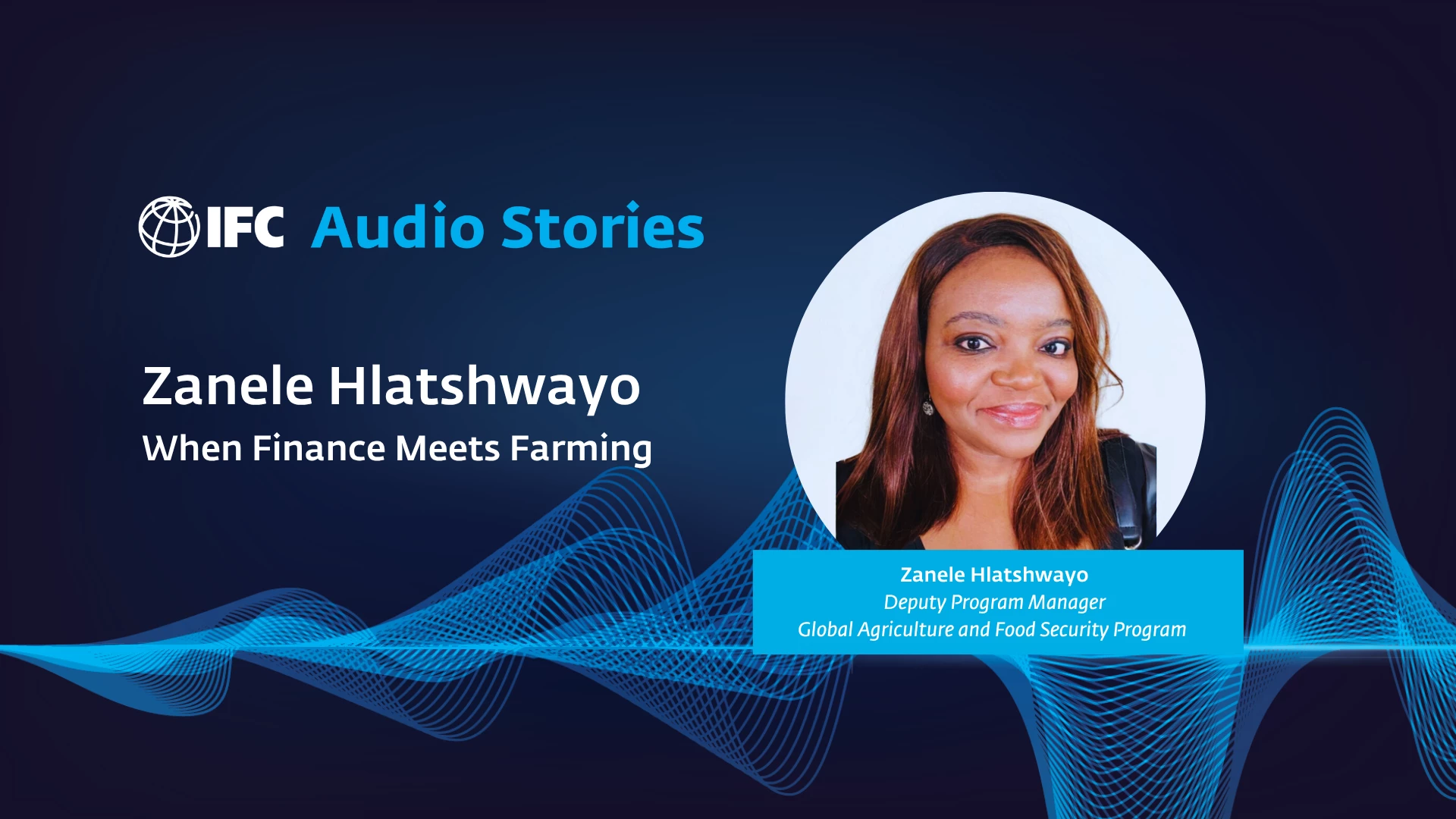
In this episode of My First Job on IFC Audio Stories, Zanele Hlatshwayo, Deputy Program Manager for the Global Agricultural and Food Security Program (GAFSP), shares how she transitioned from law to corporate finance, a shift that sparked her passion for development and agriculture. A farmer herself, Zanele discusses how GAFSP has supported over 90 agribusiness projects in 27 countries, reaching more than a million smallholder farmers, and why private sector investment is vital for resilient food systems and global food security.
Transcript
This is a podcast from the International Finance Corporation
Lindy Mtongana: Hello and welcome to IFC Audio Stories. Today we bring you another edition of My First Job, conversations with changemakers about their careers and their thoughts on the value of jobs as key drivers of economic development. Over the next few episodes, we're focused on jobs in the agribusiness sector. From farm to fork, the agribusiness value chain is an important investment area for the World Bank Group - with the potential to transform smallholder farming, create jobs and improve global food security. My guest today is Zanele Hlatshwayo, IFC's Deputy Program Manager for the Global Agricultural and Food Security Program. It's a multilateral partnership and financing platform that's dedicated to improving food and nutrition security in the world's poorest countries, specifically by supporting smallholder farmers.
Zanele, it's a real pleasure to have you on the show today. So welcome to my first job. Now, you've recently been appointed the Deputy Program Manager for an important platform for IFC's agricultural investments. And we will talk about that job and what it is you do today. But let's start at the very beginning. What was your first job and what key lessons did you learn from it?
Zanele Hlatshwayo: Well, great. Thank you for having me. It's such a delight to be here. So my very first job was in corporate finance, which was a bit of a shock to my system, if I'm being very honest, because I trained as a lawyer. I had gone through a couple of years of legal training. And then here I was immersed in balance sheets and deal models and also in the discipline of analytical rigor. But I can tell you that it taught me the value of precision and accountability, that every number tells a story and also that integrity and how you analyze and present information matters as much as the outcome itself. But more importantly, I think it taught me, Lindy, that you need to think systemically. So in that particular role, I had to think about how capital flows, what are the incentives and what are the governance structures that shape decisions across an organization. And so those early lessons became a foundation for me and how I approach development finance today with both commercial discipline, but also a very strong sense of purpose.
So today in my role at IFC, but also specifically within GAFSP (Global Agricultural and Food Security Program), I really feel privileged to sit at this intersection of public and private capital where I help design instruments and partnerships that can help de-risk investments in African agribusiness. And that's across the entire value chain, as you mentioned right at the beginning, from farm level production to regional food systems.
Lindy: Tell me more about this job with GAFSP and what excites you most about your specific role, about your work in the agribusiness sector.
Zanele: So the GAFSP Private Sector Window is a blended finance facility where we've supported over 90 agribusiness investment projects in over 27 countries and deployed over $500 million of funds. Our advisory projects, which help companies improve their productivity and standards, include about 88 projects across 33 countries with support of around $44 million. These projects have in my view, been instrumental in helping reach over one million smallholder farmers across the world. They've also enabled IFC to extend its reach into most fragile markets in the world, demonstrating that land and finance can indeed be a viable and also powerful model for mobilizing private capital for development priorities.
But broadly speaking, in terms of what excites me about agribusiness, well, you know, I think agribusiness, particularly as an African, it sits at the heart of the development story. It's where climate resilience, it's where nutrition, it's where job creation, and it's where inclusive growth converge. It's also deeply personal to me, Lindy. My family and I run a small farm here in Kenya. And so agriculture to me is not abstract. It's about food, it's about people, it's about dignity, it's about access to market, it's about sustainability. And so what keeps me motivated, not only in my role at GAFSP in terms of investments, but also in my sort of my part-time role in agriculture is seeing how finance can help farmers and agri-entrepreneurs move from subsistence, from survival to scale. How, for instance, an investment in cold chains or irrigation can shift entire communities. So working in agribusiness for me is deeply personal. It feels like shaping the front lines of the continent's future. And I deeply believe that not just Africa, but other places in the world where the continent, those other markets, they can feed themselves and they can also feed the world sustainably.
Lindy: Wow, that's so beautifully said. And I didn't really know that how personal farming is to you. And it's interesting then that you straddle these two worlds. So I'm curious to understand in your view, where can private sector investment make the biggest difference for smallholder farmers?
Zanele: I think, you know, private sector investment, it's absolutely critical that it goes beyond capital. I think it's important that it does three things. It needs to listen, it needs to localize, and it needs to leverage.
So, in terms of listening, I would say it's critical to understand farmer realities from, as I mentioned, access to markets, to the inputs, to the cost of finance. And so I think it's important to keep that at the center of conversations, right? So understand and listen to farmers' pains and where they think these sort of problems can be unlocked with capital.
The second is localizing. And I think what I mean by that is sort of structuring solutions around ecosystems that already exist. I think it's critical that we continue working with aggregators, with cooperatives, with woman led enterprises, and with local financial institutions. It's important to localize and it's important to make sure that the solutions that are being put on the table from a capital perspective are fit for purpose.
And then finally, leveraging. I think it's just, it's absolutely critical that we continue aligning public concessional resources with private innovation. So, and I think that's exactly where Blended Finance and GAFSP is well positioned to do this.
So through initiatives like the GAFSP, think, you know, private capital can play a critical role in de-risking, in addressing long-term capital, and also providing technical assistance that can make smallholder-focused investments viable. I personally think the real opportunity lies in building value chains that are not just profitable, but also equitable. And that's where farmers can finally become partners and not just beneficiaries.
Lindy: Thank you very much, Zanele