
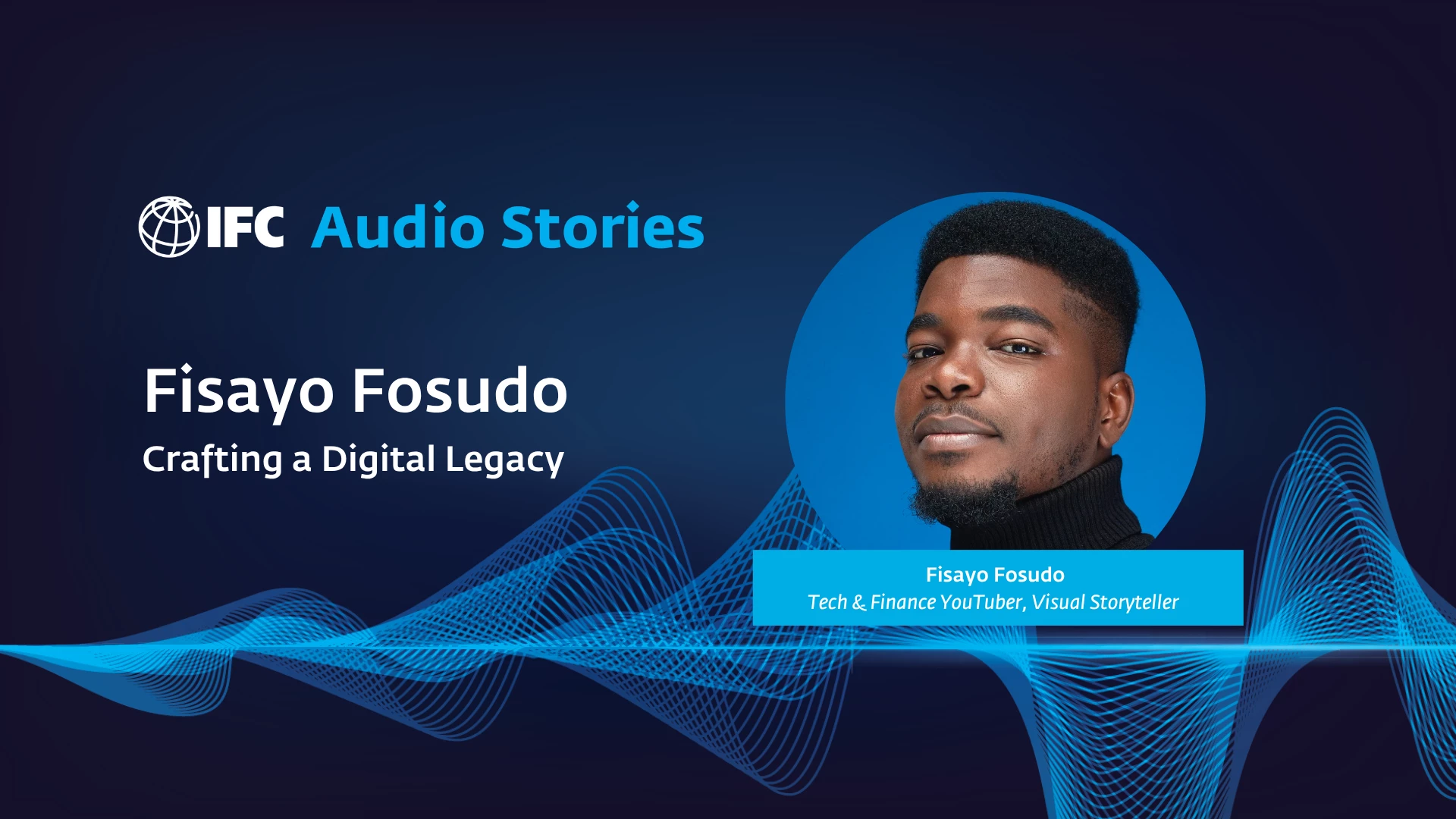
In this episode of My First Job, host Camryn Billett speaks with Nigerian tech and finance YouTuber Fisayo Fosudo about how his first job launched his career as a content creator. Starting as a social media manager and designer, Fisayo has built a reputation as one of West Africa’s most influential voices in technology and finance, with over 700,000 YouTube subscribers and millions of monthly views. In 2024, Pulse, a leading media group in Nigeria named Fisayo Tech Influencer of the Year. Tune in as Fisayo shares insights on the responsibility of influence in Africa’s digital economy, and how reimagining education and opportunity can shape the future for young people.
Transcript
Camryn: Welcome to IFC audio stories. I'm your host, Camryn Billett, and today we are diving back into My First Job, a series of episodes where we talk to senior leaders in their respective fields, getting insight into the beginnings of their career journey, as well as the challenges, triumphs and lessons learned along the way. Today I am joined by Nigerian tech and finance YouTuber as well as visual storyteller, Fisayo Fosudo, welcome.
Fisayo: Thank you. Thank you for having me.
Camryn: What better way to kick off than to ask you, you know, what was your first job? How did you get it? What did the experience teach you about work, creativity and even yourself?
Fisayo: So, yeah right out of school my first job was as a social media manager and a designer. Basically my whole experience on that job - and that's my only job actually, out of school - my whole experience from that is really what defined the last nine years of my creative career as a visual storyteller, Tech-YouTuber, finance-creator, interviewer, and a host of other things.
I remember in school I was heavy on graphic design. I majored in economics, and while doing that, I still, you know, I had this left brain, right brain thing where I love the numbers, I love the economy. I love to understand the economy. But I also like to draw, and I like to create a lot of visuals, because I know the power of something - a story - told visually. There's so much you can benefit from that visual, sensory engagement that you get from, you know, having something seen. And interpreting the numbers in this way makes it easily understandable.
I learned so much on the job. I actually learned what it meant to be a visual storyteller right on the job. They had a lot of resources for me. Very amazing company, very amazing founders, very amazing story. And everything I learned at the job really, really translated to my career as a visual storyteller, and sort of an influencer at this point.
Camryn: How do you feel about the term influencer?
Fisayo: It is a very interesting term, you know, there's, there's, there's the negative side, like, oh, who are these influencers, you know? And then there's also the other side. I know for sure I've used over 150 phones, smartphones, and when I talk about something, people purchase them, because I said so. And that is very powerful in a way, and I recognize that, and I'm always striving to be as accurate and as correct as possible.
Camryn: I think a big thing that I'm hearing like, when you say that is really the responsibility of being an influencer.
Fisayo: Yes, yes.
Camryn: Yeah, there's like, you know, the term itself is not bad, but it's when people don't use their position responsibly that is when it starts to have a negative connotation. I wanted to ask you, you've built a platform that informs and empowers 1000s of young, young Africans. What inspires you to like keep going and to keep being you know, the educational, empowering voice.
Fisayo: This is a very good question, and you're totally spot on. I always think about this topic, specifically education every single day. I have a note on my notes app, and it's: ‘If I was going to be the president, these are the things I would change’. And top of that list is we really, really need a better education system or something that makes education at least as attractive to people. I made a tweet or post on x, and it was, “I wish as Nigerians, we could glamorize education,” And it went super viral, and people were saying, this is never going to work, or, oh yes, you are totally spot on. And I was like, you know, we love entertainment. I can speak for, you know, Nigeria, heavy entertainment audience. We love music. We are one of the best in the world, at least, you know, with Afrobeats and that is amazing. Like we're exposing this culture. It is really beautiful to see. But how about, you know, how about science? How about, you know, AI. How about, like, computers, how about all of these other things that, actually, you know, they power the creative economy as well, they power the creative industry. How about inventing something? How about, you know, open waste burning, or, you know, waste suppression at source - they sound so boring, but they really mean so much. We can stop diseases, stop deaths because of all these things. How about we make that as glamorous as this other aspect. The thing that is keeping me going honestly, is I would love to be able to make a significant impact in some way when it comes to education for my populace.
Camryn: I’m glad you talked about education and that need for education, because it kind of segues into my next question, outside of, like, education and maybe education is the answer. But like, from your perspective, what are some of the biggest barriers preventing young people today from accessing quality jobs and leadership roles, especially in emerging markets?
Fisayo: So I think there's this one thing that young people really love, and it's when their peers love the same things. I think that there's there's this. This is, it might sound very unconventional, but I read somewhere that the mind of a crowd is one, and what this means is you can have a country like Nigeria. Nigeria is one. We are all Nigerians. But if you look deeper, there are 772 local governments. There are over 700 languages, I think. There's uh, different tribes, there's, like, all these other segmentations. But if you take it as a whole, we are all just one, and that is Nigerians. And if you can speak the language of this tribe, you can actually get into their minds. And I think something that I'll say is, how do we figure out the language that the that the young people of this generation speak and speak directly to that. That is one way I see us encouraging them to love the spaces, love education, love the deliberation of creating something. And also making the things that matter as attractive as possible.
This is on a macro level, or outside looking in, and then inside looking out for every individual. If anyone is listening to this, you know, as a young person in Nigeria, I'd say, you know, think of how you can make a positive change. Not everybody's going to be able to make so much change, but we can all collectively do something. Think of your sort of place in society, your role in society, how you can shape your own immediate environment, because that is what it really is. It's a cluster of every individual in their own individual environments. Think of how you can do that for your small circle. And a collective of you doing that for your small circles together, building up to a bigger circle, and then creating your own tribe that then go on to change things.
Camryn: I think people who really want to work are really looking for just meaning and purpose? Yeah, so what would you say? Like, what do you think? What are people really seeking in the job market today?
Fisayo: This is a good question too. And among my team we've had these highs and lows of the meaning of our work as well. And from what I've come to realize you do need to make money. You do need to have an opportunity that helps you make a lot of money, but also, or I would say, above it all, the opportunity that helps you learn the most. I think that that is where you find a lot of meaning. Helping you learn is giving you the tools to be able to stand on your own, or even if you even if you're not like an entrepreneur type, it will give you the ability to excel at the next level that you're heading to. There's so much value in being able to learn.
Camryn: Thank you for that. Those were all the questions that I have for you today. I want to thank you for lending your time to this podcast. I just wanted the audience to able to be inspired and and nurtured by the words of wisdom you had to give you. Thank you.
Fisayo: Thank you so much.
Camryn: This has been another edition of My First Jobs with Fisayo Fosudo. I am your host Camryn Billett. Until next time. Thank you for listening to IFC Audio Stories.