
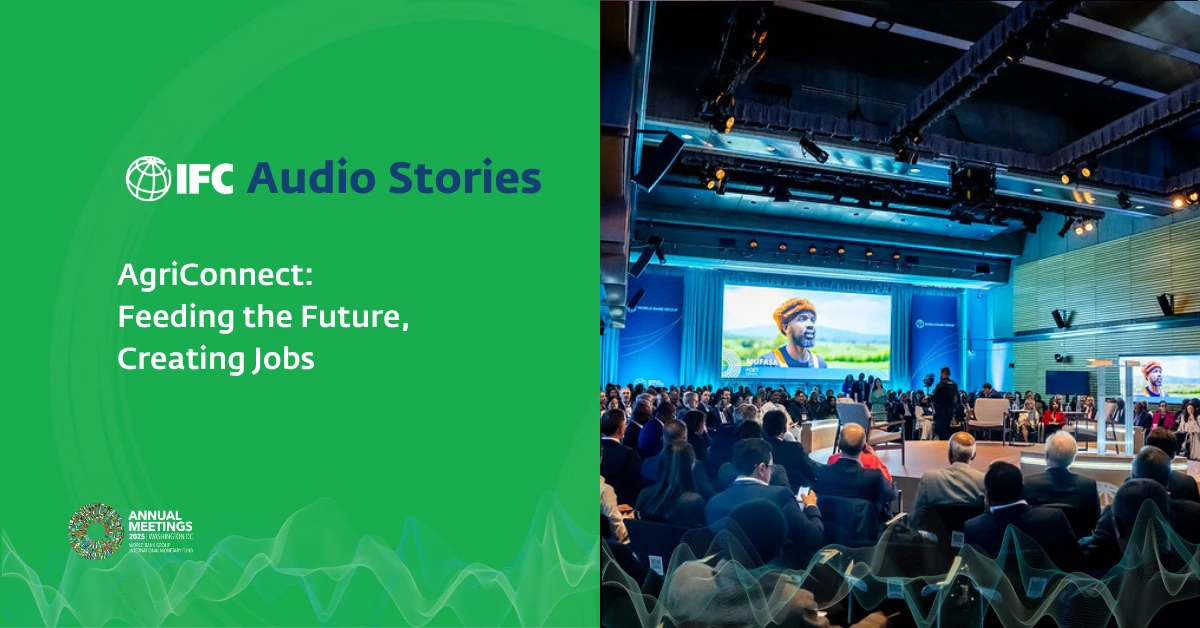
The World Bank Group has launched AgriConnect, a bold effort to transform smallholder farming. In this episode of IFC Audio Stories, we explore how global partnerships and private sector innovation can help farmers grow stronger businesses, create jobs, and build a more food-secure world.
Transcript
Lindy: The Annual Meetings, the World Bank Group and IMF’s biggest week of the year wrapped up with a headline announcement: AgriConnect. A new initiative focused on farms, firms, and financing to create jobs in agriculture. Today we look at what this means for farmers. And the central role of IFC and the private sector in making it a reality.
We’ll hear from Anup Jagwani, IFC’s Global Head of Agribusiness
Anup: What we need to do is enable the private sector to do what it’s best at: allocating capital, building efficient supply chains, developing solutions for farmers.
Lindy: And from Clifford Magoti in Tanzania, who shares his journey to becoming an agri-entrepreneur through an IFC-supported project that’s already offering lessons for AgriConnect.
Clifford Magoti: When I started, it was from zero - , but where we are now we have made some achievements. And from here we are encouraging other people to join the project.
You’re listening to IFC Audio Stories, I’m Lindy Mtongana.
Part 1 – Anup & Private Sector
Lindy: For millions of smallholder farmers, the struggle to grow food is also a struggle to make a living. Yet agriculture holds enormous potential to feed the world, create jobs and transform lives. To understand the moment we find ourselves in on food and jobs, and the World Bank Group’s response to the challenge I’m joined by Anup Jagwani IFC Global Head of Agribusiness. Thank you so much for joining us on IFC audio stories. Agribusiness has long been a key investment area for IFC. So why isAgriConnect being launched now? What problem, essentially, does it aim to solve?
Anup: Thank you for that question. The challenges in agribusiness continue to remain. You look at the number of people going to bed hungry each day, 700 million people, staggering . The acute food insecurity for over almost 300 million people. At the same time we have 1.2 billion coming into the job stream over the coming 2 decades, by 20250. And so it's been a sector that is extremely important.- Why AgriConnect now? It’s also a new way for us to work as a World Bank Group. So this is the new vision where we bring the public and private sector together to do more in this space and do it differently. And so as you said, we've already, we've been doing agribusiness investments for a long time. But how can we really scale those up? How can we create the enabling environment to really support smallholder farmers, over 500 million smallholder farmers in this space who supply food, and so how do we make a difference in their lives, is the reason we're launching AgriConnect now.
Lindy: How will AgriConnect work?
Anup: We've got three main pillars. We've got the foundations pillar, where we will work on both the hard infrastructure and the soft infrastructure. So you need the transport, you know, logistics. You need the power at the same time you need capacity. You know, that's a soft infrastructure we refer to: training people, bringing knowledge to them. The other piece is policy. We know policy can really significantly drive change, and so we need to look at the policies today. How can they be more conducive to unlocking this sector further and unlocking yields, unlocking supply chains to be more efficient? And finally, the big part is mobilizing finance. Once we have these conditions in place, the mobilizing finance goes side by side. And having that technology aspect, which I include in the foundations as well - but it is cross cutting technology - will help us also in mobilizing finance, understanding and reducing some of the risks in the both on farm and off farm.
Lindy: Tell me more about IFC’s s role and the private sector in this initiative.
Anup: I think the role the private sector plays is key. Almost all the food is produced by the private sector, entirely. If you look around. Who produces the grain, who produces the inputs, who produces the irrigation equipment? It is the private sector doing this right? So we need to see how can we support the growth of this private sector? So essentially, what we need to do is enable the private sector to do what it's best at doing. It's allocating capital, building efficient supply chains, developing solutions for farmers and we need to unlock that further, bringing the public and private sector together, rather than having them operate in different silos. And that's what we're looking to do with Agriconnect.
Lindy: Tell me, what does the success of ---agriconnect look like for you?
Anup: It's a very good question, and I say this because success in agribusiness can have many different dimensions, and so finding the right indicator, as you know, as a part of our scorecard, the number of people made food secure, is a key focus. But here we said, Okay, since farmers and and you know, smallholder farmers in particular are the center of this, the reach that we have to these farmers would be important indicators. So we set ourselves a target 250 million farmers at reach.
That's, that's the foremost indicator that we have. But the other piece is jobs. And jobs in particular, you know, as economies grow, they're often on-farm, jobs reduce, but the rest of the ecosystem, the jobs can increase. So think of irrigation. Think of the technology needed to produce those that equipment, deploy that equipment. Think of in terms of seeds, hybrid-seed plant being set up. There'll be jobs created there in the supply and the supply side, again, technology, when you want to help the farmer onboard them on certain technologies, financial products, insurance. So you'll create a whole set of jobs around that, that we hope to really catapult and bring the youth into this space, and for me, if we can change the landscape in agribusiness in the coming years, as we roll this out, that I think, is more like a five to 10 year plan, rather than the five year plan of how we do this differently and ultimately enhance food security, both the global dimension as well as the local dimension.
Part 2 – AgriConnect in action
Lindy: One way AgriConnect’s vision is coming to life is through the Better Life Farming (or BLF) alliance, a partnership between Bayer - a global leader in healthcare and nutrition, Netafim - the world’s largest irrigation company, Yara - a leader in crop nutrition, and IFC. Together, they equip smallholder farmers with training, finance, technology, and market access - helping them build sustainable businesses across Asia, Latin America, and Africa. My colleague Caitriona Palmer brought us this story from Tanzania.
Caitriona Palmer: This summer, we travelled to Tanzania’s Bunda District, in the Mara Region, where Better Life Farming has established 40 centres supporting more than 12,000 smallholder farmers.
Cliford Magoti runs one of them. But his path here began on Lake Victoria, where he once earned a living as a fisherman – an often precarious living .
Cliford Magoti: At first, I was involved in fishing activities, but later I decided to move into entrepreneurial activities such as horticulture. After that, I met people from BLF who convinced me that I could start a model farm for farmers to learn, and later, I could open a shop. I was given seeds for a model farm, and the income I earned from it helped me to start a shop. I had three phases of training. We were taught customer service, record-keeping, financial management, and loan application processes.
Caitriona: This is the heart of the Better Life Farming model. Step one: a local entrepreneur like Cliford opens a shop stocked with quality inputs — seeds, fertilizers, irrigation equipment. Step two: with the support of Better Life consultants, they set up a model farm to demonstrate best practices. And step three: the shop and farm together become a hub where neighboring farmers can buy inputs, get advice, and learn modern techniques.
Cliford: Through the BLF project, I serve many farmers, I train farmers in the field, and when the farmer comes to the shop to buy products, I must understand their needs and propose the right products.
Caitriona: The results are striking. Farmers who once relied only on traditional farming techniques now use quality horticultural seeds and drip irrigation. Yields are up, incomes are rising, and families can expand their farms.
Cliford: Many farmers have improved their living standards. Their income has increased and enabled them to afford the financial ability to serve their families, and they have expanded their farms from one acre to another.
Caitriona: The project has also created jobs.
Cliford: We employ young people to maintain our farms. We have also participated in buying manure from people in the villages, contributing to their earnings. People are transporting goods from our farms through their vehicles, such as motorbikes and cars, to the markets. So, we have created jobs through the whole chain.
Caitriona: For Cliford, the change has been deeply personal
Cliford: Through working with BLF, I have increased my income to the point of having a modern house. And I am assured of taking care of my family's needs. When I started, it was from zero, but here I am. We are going to encourage other people to join the project through the agricultural sector. They will be farming while relying on the BLF centre that I lead, own and run.
Caitriona: Cliford’s journey shows how Better Life Farming connects smallholders to the tools, training, and markets they need. Multiply his story by thousands, and you see the promise of AgriConnect.
....
Lindy: AgriConnect is about scaling what works: building infrastructure and skills, improving land and policy systems, de-risking private capital, and helping smallholders boost productivity and resilience.
For more on this: visit worldbank.org/agriconnect
I’m Lindy Mtongana this is IFC Audio Stories. Thanks for listening.