
About the Ripple Effect Series
For the International Finance Corporation, the World Bank Group’s private sector arm, impact starts when a project closes. Sometimes, that's precisely when the real story begins. In this series, we look beyond the end results, tracing what happened after the intervention, who benefited beyond the direct partner, and how a single decision can set off a chain of change that reaches further than anyone anticipated, the real impact. Each story follows the same logic as a ripple in water: one stone dropped, and waves moving outward, first to the partner, then to the community, then to the system itself. This is the Ripple Effect.
Pakistan is one of the world's largest sugarcane producers. Yet in 2019, before IFC's intervention, sustainable practices were still an emerging conversation in the sector. Farmer engagement was largely relationship-based, water management was evolving, and formal alignment with global sustainability standards had not yet taken root. Then IFC dropped a stone.
What started as a targeted supply chain intervention with one sugar group would go on to change how an entire sector thinks, operates, and competes. This is that story.
Key Statistics
-
30%Reduction in water use
-
2,423Jobs created
-
16.6KFarmers reached & supported
About the Project
In 2016, IFC provided financing to Coca-Cola in Pakistan. Seeking to build a more sustainable supply chain, IFC engaged Almoiz Group, a key Coca-Cola supplier and one of the country's largest and most progressive sugar producers and one of its key local sugar suppliers. This became the foundation of a dedicated advisory engagement.
The objective was clear: help Almoiz build a supply chain that was not only more reliable, but more sustainable, one that could meet growing international standards and create lasting value for farmers, mills, and the broader sector.
"We saw an opportunity to bring something new to Pakistan, expertise that hadn't existed here before, partnerships designed to last, and a different way of thinking about sustainability in the sugar sector."
These are the words of Muddassir Shafique — one of the hands that dropped the stone.
About Muddassir
Muddassir Shafique joined IFC in 2018, bringing with him over 25 years of experience working across agri-food systems, value chain development, and private sector engagement in emerging markets. A mechanical engineer with an MBA, he has spent his career at the intersection of agriculture and private sector development.
At IFC, he serves as Sector Lead for Agribusiness and Upstream, covering the MCA region with a focus on pre-investment work in Pakistan.
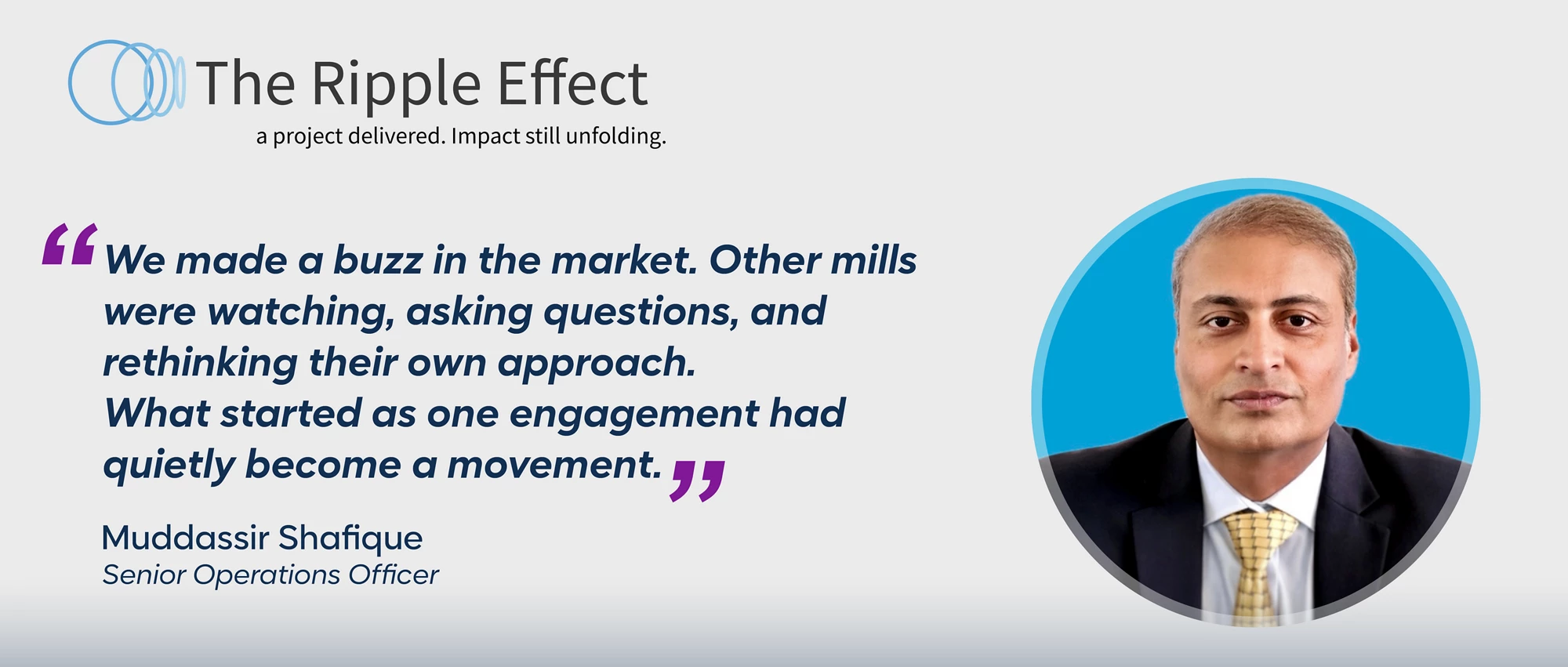
"We made a buzz in the market. Other mills were watching, asking questions, and rethinking their own approach. What started as one engagement had quietly become a movement."
Dropping the Stone
When IFC began its advisory engagement with Almoiz, it worked closely with the group's leadership team, equipping them with the knowledge and frameworks to transform how their field teams engaged with farmers. Improved agronomic practices changed how sugarcane was grown. Irrigation scheduling was introduced with precision through simple, farmer-friendly methods such as pan evaporation and hand-feel soil moisture assessment — enabling immediate adoption without reliance on complex or costly technologies. Diesel-powered tube wells were replaced with solar pumps, reducing energy costs, cutting emissions, and providing a more sustainable source of power for farming operations.
Equally central was the investment in people. IFC engaged with Almoiz's leadership first, cascading knowledge down to field teams who became master trainers, each capable of supporting farmers independently, creating a system designed to sustain itself long after IFC stepped away.
The results were both encouraging and, in some ways, surprising. Over 16,600 farmers were reached — not through a campaign, but through direct, structured engagement built on trust and knowledge transfer. Yields grew by around 30%, a number that for a smallholder farmer translates directly into a better harvest and a more stable income. Water use fell by approximately 30%, a significant shift in a country where water scarcity is a growing pressure. More than 100 solar tube wells were installed, avoiding around 3,800 tons of CO₂ emissions during the project lifecycle, with sustained emission reductions expected beyond the project period. The project also contributed to 2,423 jobs being created, extending its impact well beyond the fields. And at the center of it all — IFC introduced Bonsucro to Pakistan for the very first time, enabling the first certified mills the country had ever seen. For Almoiz, sustainability was no longer a cost. It had become a competitive advantage.
The Ripple Effect
The project concluded in 2021. But what had been set in motion did not stop there.
Almoiz's trained field teams kept working, carrying the knowledge forward and reaching thousands of farmers beyond the original scope. Word spread across the sector. Other mills had been watching — and they liked what they saw. Drawn by the clear commercial case that Almoiz had demonstrated, they began asking questions, seeking guidance, and pursuing the same path. One by one, they followed.
Today, 7 mills in Pakistan hold Bonsucro certification. Before this project, there were none. Pakistan is now listed among Bonsucro-certified countries, a signal to international buyers and investors that sustainable sugarcane production here is real, growing, and commercially and socially viable. The numbers are clear, but the real measure of what changed is simpler than any metric: an entire industry that once stood outside the global sustainability conversation is now part of it, and it got there because one intervention proved that a different way was possible.
The Ripple Reaches the Shore — The Takeaway
Every ripple eventually reaches the shore. For this project, that shore is a sector that thinks differently, farmers who earn more, mills that compete globally, and a country now recognized on the world sustainability map.
What began as a single stone dropped into Pakistan's sugar industry in 2019 has become something no results framework could have fully predicted, a shift in mindset that continues to move outward, long after the project closed.
"This project taught us that real change doesn't announce itself — it spreads quietly. We didn't set out to transform an industry. We set out to support one partner, do it well, and prove that a different way was possible. The rest followed. That, to me, is the most powerful thing development finance can do, not just fund a project, but plant an idea that others choose to carry forward."
Interview by Bilal Kobeissi