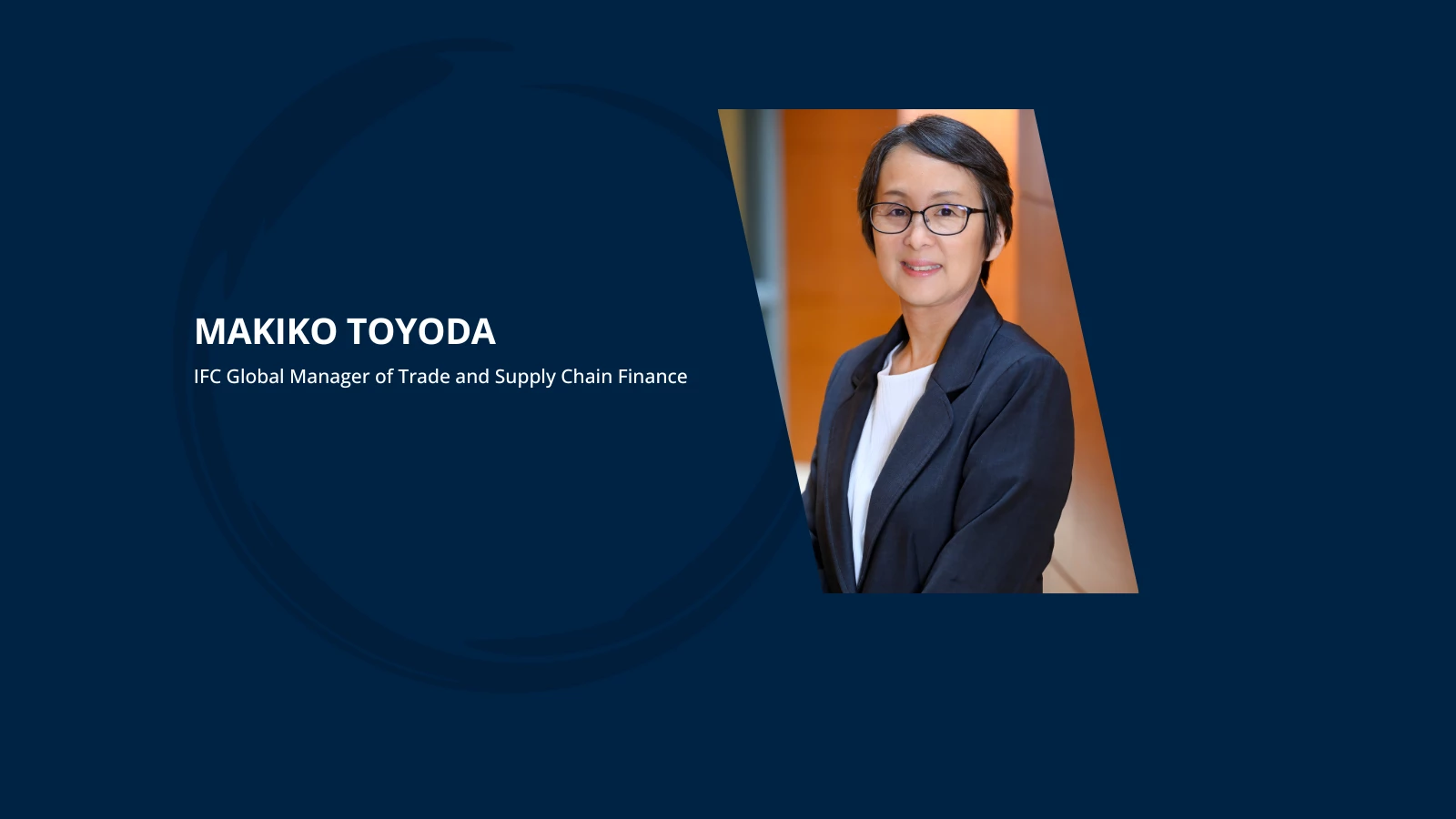
Trade and supply chain finance is a critical driver of economic growth in emerging markets, helping to keep essential goods flowing, supply chains functioning, and businesses thriving. Here we talk to Makiko Toyoda, IFC Global Manager of Trade and Supply Chain Finance, about the persistent trade finance gap facing businesses in emerging markets, why it matters, and what’s being done to address it.
The global trade finance gap is estimated to have doubled between 2017 and 2025 to $2.5 trillion, with emerging market economies being the most affected – meaning, firms in these markets have a more difficult time accessing trade finance than those in developed economies. Why should we pay attention to this?
Trade drives job creation, poverty reduction, and economic growth. Trade expands markets by connecting local businesses to regional and global value chains. And trade does not happen without trade finance. If emerging markets are going to strengthen their economies and create more jobs, their local businesses need better access to trade and supply chain finance.
As you mentioned, the trade finance gap is huge, and it is most acute in emerging markets. This leaves SMEs (small and medium-sized enterprises)—the economic backbone of these economies—without the financial resources they need to grow and thrive. And for many of these businesses, trade and supply chain finance is often the only financing available to them. So, when it disappears, the results can be dire. Shelves empty, supply chains collapse, and job creation weakens.
Recent reports from the World Bank Group and elsewhere suggest that growing trade tensions and policy uncertainties are slowing the growth of trade globally. How do you see this playing out in terms of demand for trade and supply chain finance?
While global trade may be slowing, the changing environment in which we find ourselves only serves to increase the demand from our clients for trade and supply chain finance. Supply chain finance, in particular, is growing because of unmet demand.
Efficient and reliable supply chains are a critical part of trade. In fact, about half of global trade is supply chain trade. But as traditional trade patterns are disrupted, which is what we see happening now, supply chains become increasingly fragmented. Trade corridors shift. Exporters look for new buyers. Manufacturers reassess sourcing strategies. These actions can destabilize importer/exporter networks, decrease efficiency, and increase transaction costs—all of which result in supply chain participants seeking stable financing sources and risk mitigation.
Apart from the current macro environment, empirical evidence shows the same need for more supply chain finance. Joint studies conducted by IFC and the World Trade Organization (WTO) on Central America and Mexico, the Mekong Region, and West Africa demonstrate that the availability of supply chain finance in emerging markets is even scarcer than traditional forms of trade finance, such as letters of credit or trade loans. As a result, local suppliers remain cash-strapped since they must pay cash in advance for their input, while at the same time receiving delayed payment for their output. This limits their growth prospects due to suboptimal levels of working capital needs.
What has the market’s response been to this lack of supply chain finance in emerging markets?
We’ve seen a broad response from the development community. During last year’s World Bank Group Annual Meetings, in October 2024, six multilateral development banks together with the WTO issued a joint statement committing to increase financial and advisory support of supply chain finance.
IFC is certainly leaning in to address this growing need by increasing the limit on our Global Supply Chain Finance Program from $1 billion to $3 billion. This program is among the most important tools IFC has to support SMEs in emerging markets. IFC also helps emerging market banks strengthen the skills and expertise required to introduce supply chain finance products to new markets. Much of this training has taken place in the poorest and most fragile markets, where it is needed most.
The potential is clear. Scaling up supply chain finance could unlock billions in working capital for SMEs, improving their capacity to grow. This is particularly significant given that SMEs are the primary source of employment in emerging market economies.
What is the role of global and regional financial institutions when it comes to expanding the availability of trade and supply chain finance in emerging markets?
Global and regional financial institutions play an important—and necessary—role when it comes to expanding trade and supply chain finance in emerging markets. As critical partners in this space, “confirming banks”, which means that they guarantee the letters of credit issued by the emerging market banks.
The involvement of Development financial institutions (DFIs), such as IFC, is necessary here for two reasons. First, DFIs facilitate the relationships between the global/regional banks and the emerging market banks. These relationships wouldn’t exist without us providing the platform. And the second reason is that DFIs mitigate the payment risk of the emerging market banks by providing guarantees to the global/regional banks.
These guarantees are necessary, of course, because of the macro-risk environment. Global banks face pressure when it comes to establishing banking relationships with emerging market banks due to significant “Know Your Customer” requirements, higher capital charges required by regulators, and constraining single-obligor limits. IFC’s backing enables these global and regional banks to expand their activities in new high-risk markets and/or increase the amount they are willing to finance in developing economies.