
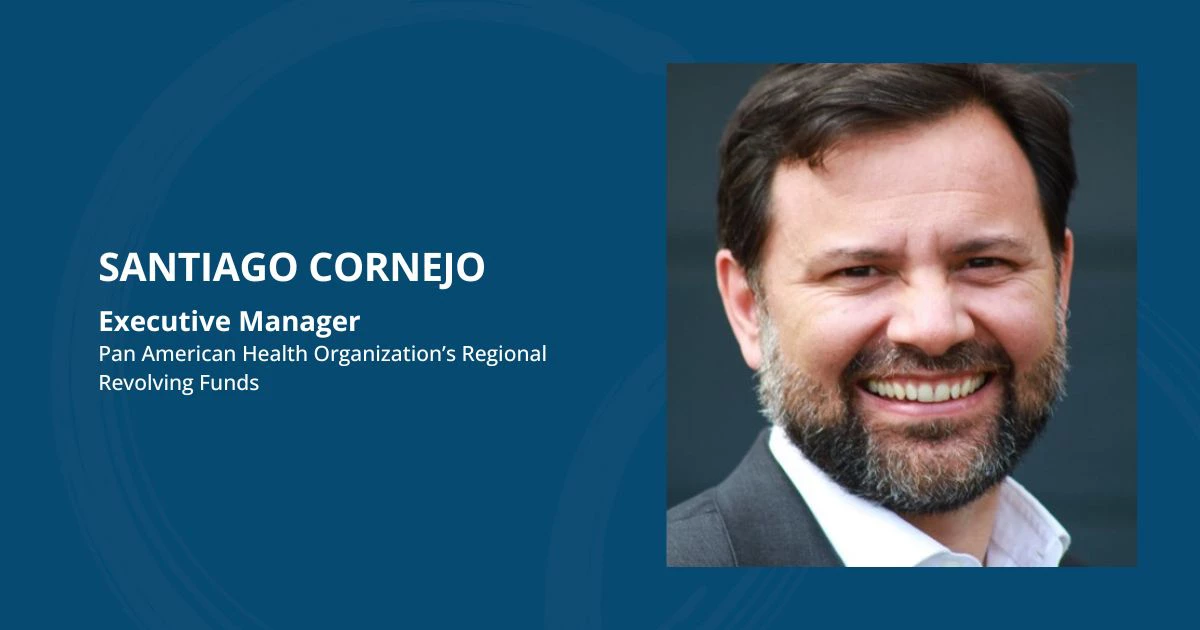
“For us, the private sector is at the center of any initiative to strengthen local pharmaceutical and vaccine manufacturing.”
Interview with Santiago Cornejo
Executive Manager for Pan American Health Organization’s Regional Revolving Funds
Limited funding, unpredictable demand, and heavy reliance on external suppliers hamper efforts to build up regional manufacturing of pharmaceuticals and health supplies, says Santiago Cornejo, Executive Manager for Pan American Health Organization’s (PAHO) Regional Revolving Funds. In an interview with IFC, Cornejo outlines how PAHO supports low- and middle-income countries through innovative mechanisms to ensure equitable access to essential medical products. He emphasizes the role of public-private collaboration and regional solidarity in strengthening local pharmaceutical manufacturing and supporting long-term health resilience.
What are the biggest obstacles to achieving true health security in low- and middle-income countries?
The most obvious challenge is securing dedicated funding for health products and services. Developing countries face significant budget constraints and competing priorities, making it difficult to invest in preventing future health threats. Second, health systems in many of these countries are fragmented and have limited capacity—especially in surveillance, early detection, lab diagnostics, and rapid response staffing. Third, there’s a high external dependency on health technologies and supplies, including basic medical countermeasures. Many low- and middle-income countries rely heavily on a small group of high-income or major manufacturing countries, like India and China, for access to essential tools needed for health security.
How has PAHO supported access to essential medical products in Latin America and beyond?
We have a unique mechanism called the Regional Revolving Funds, which PAHO created in the late 1970s. It ensures equitable access to health supplies—not just vaccines, but also medicines, diagnostics, equipment, and even vector control in Latin America. What sets this apart is that this mechanism is not just a procurement tool but what we call a technical cooperation platform. We work with countries throughout the full cycle: from planning and product selection, to demand estimation, procurement, logistics, navigating regulations, and implementation—guided by our technical experts.
And, of course, a key component is consolidation of demand, allowing countries to access better prices and conditions, while also providing predictability to manufacturers. This predictability—not just high volume—is critical for manufacturers to plan production. We recently signed an agreement with the Africa CDC to help them establish similar models for pooling demand.
We also support financing. PAHO doesn’t provide capital, but we advise governments on budget planning and, when needed, we have a financial mechanism to provide short-term liquidity to ensure timely procurement of essential medicines and health devices. In fact, 96 percent of the roughly one billion dollars’ worth of health supplies we purchase each year is funded by the countries themselves, using their own budgets. The Revolving Fund is truly an end-to-end mechanism that supports both country needs and market stability.
Many countries are now looking to strengthen the local manufacturing of pharma, including vaccines, to build more regional self-sufficiency—what role does the private sector play in this?
It plays a critical role. For us, the private sector is at the center of any initiative to strengthen local pharmaceutical and vaccine manufacturing. When you look at vaccine investment, you’re talking about a minimum period of 10 years. It’s a long-term investment, a long-term proposition. Whatever one does, it needs to be sustainable.
The first step behind any successful project is a strong business case. The private sector is very good at evaluating the cost of production, market demand, competitiveness, technology solutions, and capital needs. While political will is important, relying solely on it can lead to instability if priorities shift. The private sector helps translate political commitment into sustainable, long-term strategies.
Another factor is how quickly technologies are advancing in the health industry. We can treat and even prevent diseases that 20 years ago, we were only dreaming about. We really need the private sector to bring the drive and innovation to keep up with the pace of change.
How do public and private sectors work together to improve access to drugs?
Public and private sectors really need to work together to improve access to medicines. On the public side, it’s about creating the right environment—setting up programs and strong regulations and pooling demand, which requires investment in skilled people and know-how. Meanwhile, the private sector brings in the investment, innovation, and willingness to take risks. Vaccine production, especially biologicals, demands high quality standards and significant upfront investment, with returns realized over time. In the end, the public sector provides clear rules and predictability, and the private sector drives innovation and brings in resources.
What are the primary challenges around strengthening local capacity?
There are a few challenges in strengthening local capacity. One obstacle is around financing. But it’s not just about securing capital—many manufacturers actually have access to funding but struggle to get risk financing at competitive rates. High interest rates can make their products too expensive, so affordable risk financing is key.
Second, having the right ecosystem is crucial—this means stable, predictable national policies, strong regulatory systems, skilled human resources, and policies to incentivize investment.
Finally, access to markets is a big factor. Through mechanisms like the Revolving Fund, manufacturers get access to a larger regional market across Latin America and the Caribbean, which helps create economies of scale. This reduces costs and makes products more affordable. The Fund also simplifies regulatory approval by providing trusted reviews accepted by multiple countries and secures financing based on clear demand. Negotiating prices and navigating regulatory requirements one country at a time would not be sustainable.
What advice would you give to governments looking to develop their regional manufacturing capacity in the context of health products and procurement?
First, demand consolidation is critical. Regional manufacturing only works if there’s predictable and reliable demand across countries. It's not just about having high demand—it’s about being able to forecast and pool that demand in a coordinated way. Second, as I keep coming back to, governments need to prioritize quality. It's not enough to make affordable products—those products need to be safe, effective, and trusted. And third—this might be the hardest—is solidarity. Regional manufacturing works best when countries see beyond their own interests and commit to a collective vision. That means larger countries may need to lead—not because they benefit most directly in terms of price, but for the benefit of a region.
This interview has been edited for length and clarity.
Published in July 2025.
In 2022, Mr. Cornejo was appointed as Chief of the Revolving Fund for Access to Vaccines at the Pan-American Health Organization (PAHO) and is currently the Executive Manager for PAHO’s Regional Revolving Funds, which include the Revolving Fund for Access to Vaccines and the Strategic Fund of Essential Medicines and Strategic Health Supplies. PAHO’s Regional Revolving Funds enhance equitable access to health technologies, including vaccines, diagnostics, and medicines, to 42 Member States in the Latin American and Caribbean regions.
Santiago has over 20 years of work experience in health financing and equitable access to health commodities. He started his career in academia at the Center for Global Health at George Washington University and later worked for six years at The World Bank on many projects related to health and immunization financing at the global and country levels. He joined the Gavi Alliance in 2008, where he held different responsibilities, including developing and managing Gavi’s eligibility, co-financing and transition policies and Gavi’s middle-income strategy. In his last two years at Gavi, Santiago was a member of the team that developed the COVAX Facility, leading the design of countries’ eligibility, benefits, and contributions. Santiago was Director of Country Engagement in the Office of the COVAX Facility, overseeing the team responsible for managing the relationships with countries, particularly Middle and High-Income countries.
Mr. Cornejo has a master’s degree in international development studies from George Washington University.