
About the Breaking Barriers At Work Series
IFC teams often work on particularly complex development projects, facing major challenges and obstacles, especially in some of the world's most fragile places. In this series, we share how they are #BreakingBarriersAtWork, often against all odds, highlighting their approaches and sharing lessons that can also be useful to others. The focus of this round of stories is on manufacturing, agribusiness, and services in the Middle East, Central Asia, Türkiye, Afghanistan, and Pakistan.
We often recognize people for their achievements and impact. But what gets them there - and how do they overcome the challenges and barriers they may face at work?
Yusuf Ongoren, Principal Investment Officer at IFC, shares his journey, including the obstacles he’s encountered and how he’s learnt to overcome them.
About Yusuf
Yusuf, from Türkiye, joined IFC nearly 20 years ago, driven by a passion not just for investments, but also for serving communities, fostering economic growth, and inspiring people to aim higher. Over the years, he has worked on projects across Europe, Asia, and Africa. He now co-leads business development for IFC’s Manufacturing, Agribusiness, and Services (MAS) team in Türkiye and serves as the portfolio lead for Türkiye and Central Asia, focusing on sustainable projects that drive economic growth.
The Barrier
"The perception of risk versus opportunity can be a significant barrier. In many cases, I’ve seen investors and clients focus more on what could go wrong than on what could go right."
This is particularly true in Türkiye, a dynamic market closely tied to the global economy and sensitive to economic fluctuations, exchange rate volatility, and evolving regulations. Macroeconomic uncertainty remains a major challenge, shaping how investments are structured and managed, especially since project life cycles span many years. In recent years, these challenges have become even more pronounced. Since 2016, the Turkish lira has depreciated more than tenfold against major currencies, reflecting increased macroeconomic volatility.
This can make companies hesitant to take on new challenges or explore new approaches, such as investing in innovative technologies, adopting new business models, or entering unfamiliar markets. That hesitation may stem from a lack of access to global trend analysis or proven experience with how alternative solutions have worked in other markets. It can also reflect a certain reluctance to rely on trial and error, limited resources, or uncertainty about potential returns.
Yusuf’s Approach
Yusuf and his team act as a strategic bridge, helping clients explore alternative approaches to traditional investment processes while ensuring that no additional risks are taken.
His approach to Breaking Barriers at Work is rooted in foresight and collaboration.
“Perceptions are often some of the biggest barriers. This is why you need to approach discussions with a problem-solving mindset, balancing risks and benefits to build trust. Success comes from aiming for consensus, reliability, strong action plans, and lasting partnerships.”
By working closely with IFC’s global experts, industry specialists, and local country teams, Yusuf and his team ensure that proposed investments are both strategic and resilient. They play a crucial role in helping clients explore all options, mitigate risks, improve market standards, and enhance their competitiveness in the global economy.
This collaborative approach involves dedicating significant time to clients through brainstorming sessions to evaluate various alternatives. Relevant experts are engaged to provide deeper insights and further discuss these alternatives. Clients highly value this approach as it fosters a deeper relationship and a more thorough understanding of what is at stake, while tapping into the comprehensive support that IFC offers. Consequently, the discussions become less transaction-oriented and more focused on long-term strategic partnerships.
Example
In Türkiye, Yusuf and his team have been supporting their real sector clients in identifying alternative sources of funding, as traditional funding methods frequently fall short of meeting their financing needs. The team proposed issuing bonds, with IFC taking on the role of anchor investor. By anchoring a bond, IFC—leveraging its financial strength, global reputation, and long track record—sends a strong market signal that helps broaden the investor base, making it easier for clients to raise funds from a diverse range of sources.
These bonds offer an added advantage: in recent years, green, sustainable, and blue bonds have gained significant traction among investors, financing a wide array of impactful projects. Green bonds focus on environmental benefits like renewable energy and pollution prevention, while blue bonds target water, wastewater management, and fisheries. Such bonds have drawn the interest of leading companies in Türkiye, including IFC clients Rönesans, a contracting and investment company, Ülker, a food and beverage manufacturer, and Çimko, a leading cement manufacturer, all of whom issued bonds in the last twelve months with IFC acting as anchor investor.
While Rönesans’s sustainable Eurobond was aimed at funding renewable energy solutions, enhancing healthcare access, and supporting other sustainable initiatives, Ülker's sustainability-linked bond included ambitious targets for reducing greenhouse gas emissions. Çimko’s Eurobond will help decarbonize and strengthen the company’s operations, especially in the regions affected by the 2023 earthquakes. This initiative marks a continuation of IFC's support to Sanko, Çimko's parent company, following a green loan in 2023 aimed at facilitating earthquake recovery and sustainable expansion.
The Takeaway
Through a client-focused approach grounded in open communication, flexibility, and continuous learning, Yusuf has turned challenges into opportunities.
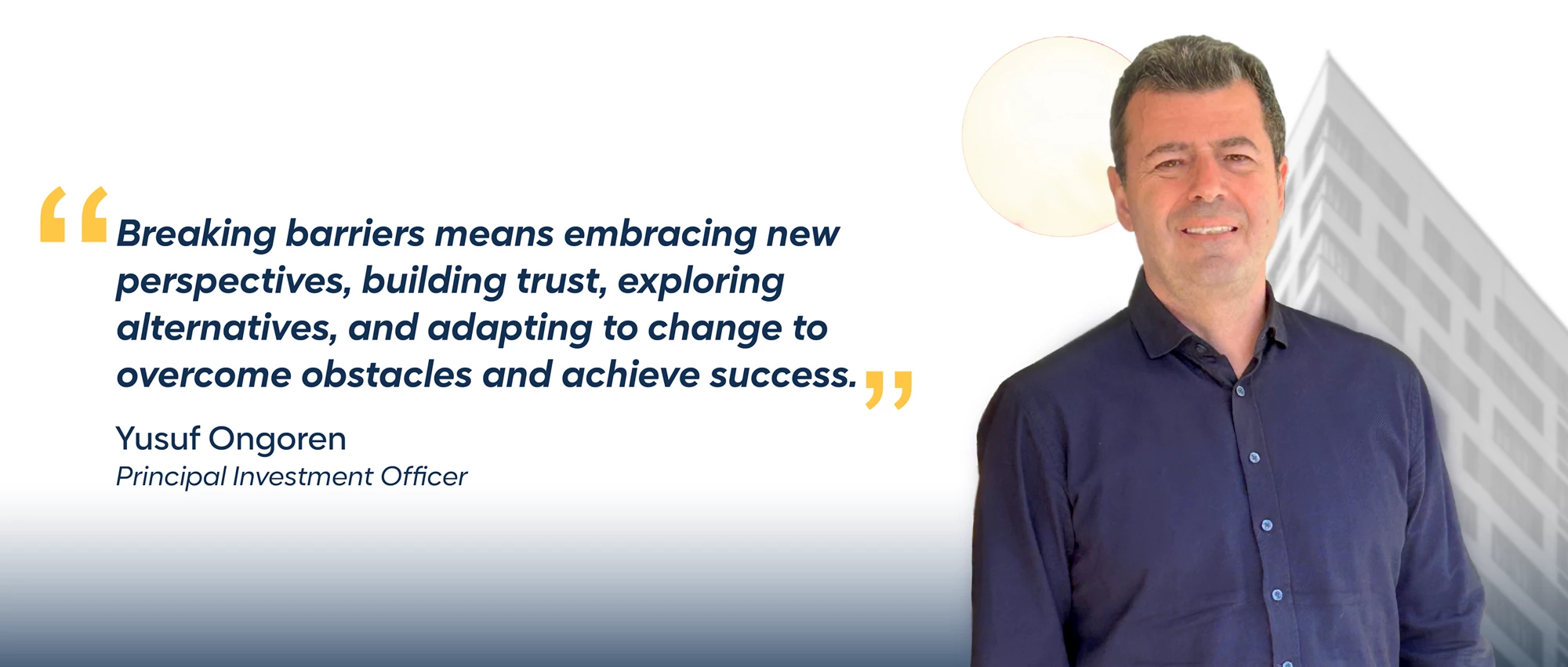
"Breaking barriers means embracing new perspectives, building trust, exploring alternatives, and adapting to change to overcome obstacles and achieve success."