Download
Full Report | Executive Summary
Waste systems are under growing pressure. The rapid growth of municipal solid waste is straining waste management, particularly in emerging markets. Global volumes are projected to rise by 50 percent by 2050, from 2.6 billion tonnes in 2022 to 3.9 billion tonnes. In lower-income countries, waste volumes are expected to more than double, and in some regions triple. With waste management already accounting for 20 to 40 percent of municipal budgets, the cost of inaction is estimated at $361 billion annually from health and environmental impacts. This challenges municipalities and private operators to manage rising volumes without proportional increases in budget or staff.
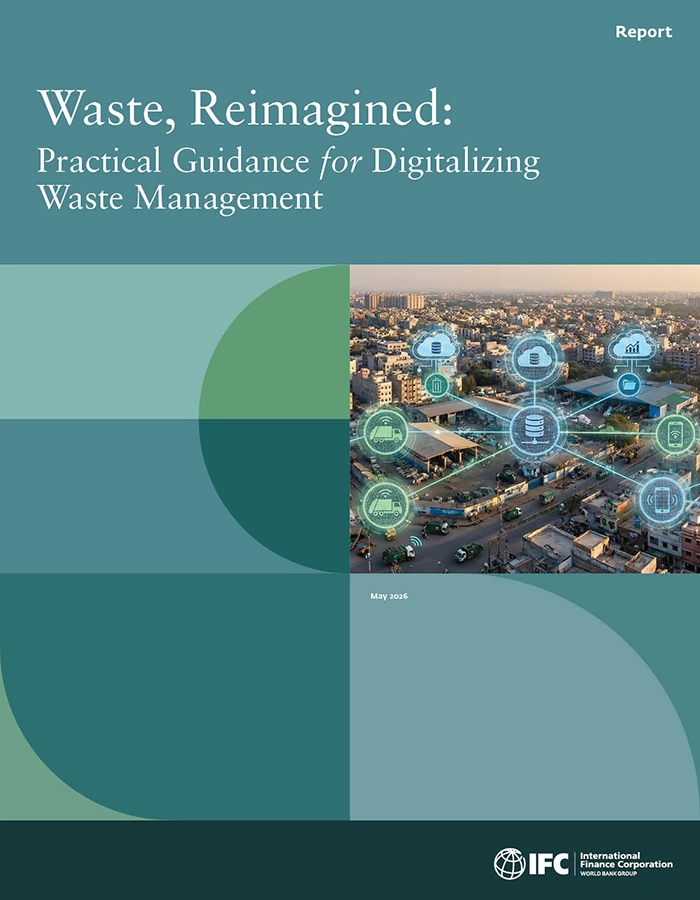
This report from IFC offers practical waste management solutions, informed by $1.5 billion in committed investments. It addresses a global knowledge gap on how to deploy waste management technology cost-effectively across the waste value chain.
How can digital tools provide cost-effective waste management solutions?
The report’s central finding is that digitalization offers low-cost, high-impact returns at every income level. It shows that digitalization is not just about technology but about using better data to make waste systems more reliable, transparent, and financially sustainable. Drawing on global evidence, the report demonstrates that digital tools can deliver rapid operational returns, often at a fraction of the cost of physical infrastructure. These improvements include reduced collection times, lower fuel use, improved sorting accuracy, and expanded service coverage through integrated GPS and digital billing platforms.
What guidance does the report offer for digitalizing waste management?
The report provides a structured guide to market-ready digital tools across four operational areas: citizen and business engagement, collection and logistics, treatment and facility management, and digital trading platforms. It also sets out an implementation framework for building more automated waste systems. This framework covers priority-setting, operational readiness, integration with legacy systems, phased rollout, and lifecycle planning. Particular attention is given to data governance, staff adoption, and the institutional and financing conditions that determine success.
Case studies from Barcelona, Battambang, Chengdu and Suzhou, Cotonou, and Seoul illustrate how cities have used these tools to expand service coverage, improve cost recovery, and accelerate circularity. When digital investments are paired with strong governance, they can support systemic transformation and meaningful progress on circular economy objectives.
What are the specific benefits of digital waste management for cities and operators?
Digital waste management solutions can help cities and operators:
- Optimize collection routes and reduce fuel use.
- Improve billing and fee collection.
- Track service delivery in real time.
- Increase citizen participation in recycling.
- Improve sorting, recovery, and material quality.
- Support circular economy goals through better transparency and traceability.
Related