Summary
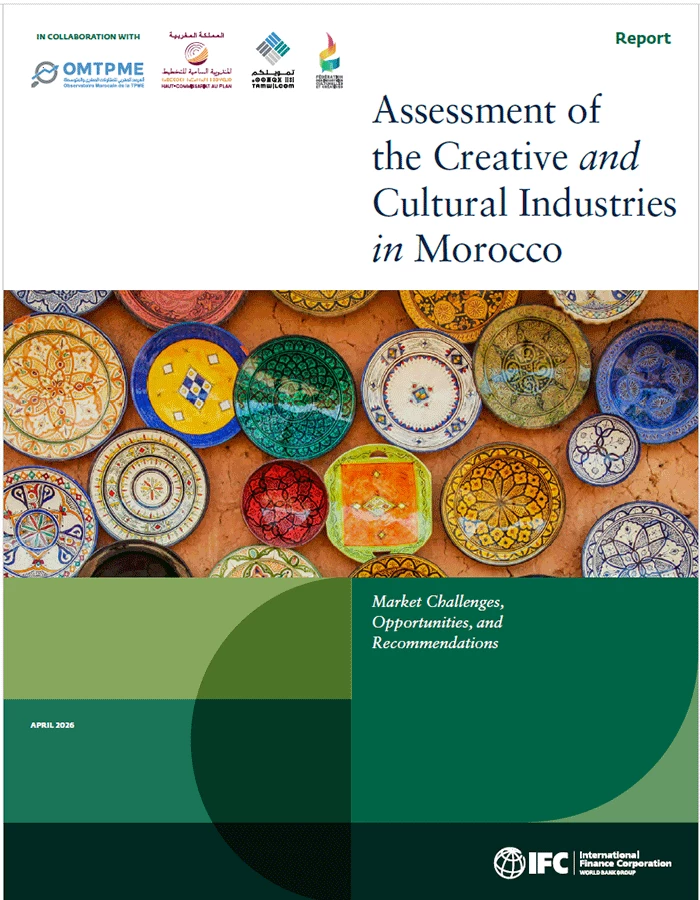
IFC’s Assessment of the Creative and Cultural Industries in Morocco (April 2026) provides a data-driven market assessment of Morocco’s creative economy, spanning subsectors such as film and audiovisual, music, crafts, design, fashion, gaming, and digital arts. Developed in close partnership with Moroccan stakeholders — including the Moroccan Federation for Cultural and Creative Industries (FICC), the Observatoire Marocain de la Très Petite, Petite et Moyenne Entreprise (OMTPME), the Haut Commissariat au Plan (HCP), and Tamwilcom — the report helps address data and market-intelligence gaps by mapping the ecosystem, estimating the sector’s economic footprint, and identifying barriers that prevent creative firms — many of them micro and informal — from scaling sustainably.
Using the latest available national accounts and enterprise data — including firm-level administrative data mobilized with OMTPME and national accounts inputs from HCP—the assessment estimates that Morocco’s creative and cultural industries contributed around 2.4% of GDP in 2022 and generated approximately MAD 43 billion in revenue in 2023 (including informal and nonprofit activity), supporting more than 116,000 jobs across roughly 9,500 companies. The report also underscores the sector’s inclusion potential, with women holding about 34% of CCI jobs — often higher than in many other productive sectors.
The assessment finds that growth is constrained by limited access to fit-for-purpose finance, gaps in intellectual property protection and monetization, and insufficient revenue traceability and market-access “infrastructure” needed to scale domestically and internationally. Access to finance remains a major gap: the report highlights that in 2021 creative and cultural industries received less than 0.5% of total business credit and only about 3% of creative businesses accessed formal financing. It concludes with practical recommendations for public and private stakeholders — such as tailored financial products and risk-sharing mechanisms, strengthened intellectual property commercialization, improved formalization and data, and export readiness measures — to unlock investment and accelerate structured, sustainable growth.
Related Links