
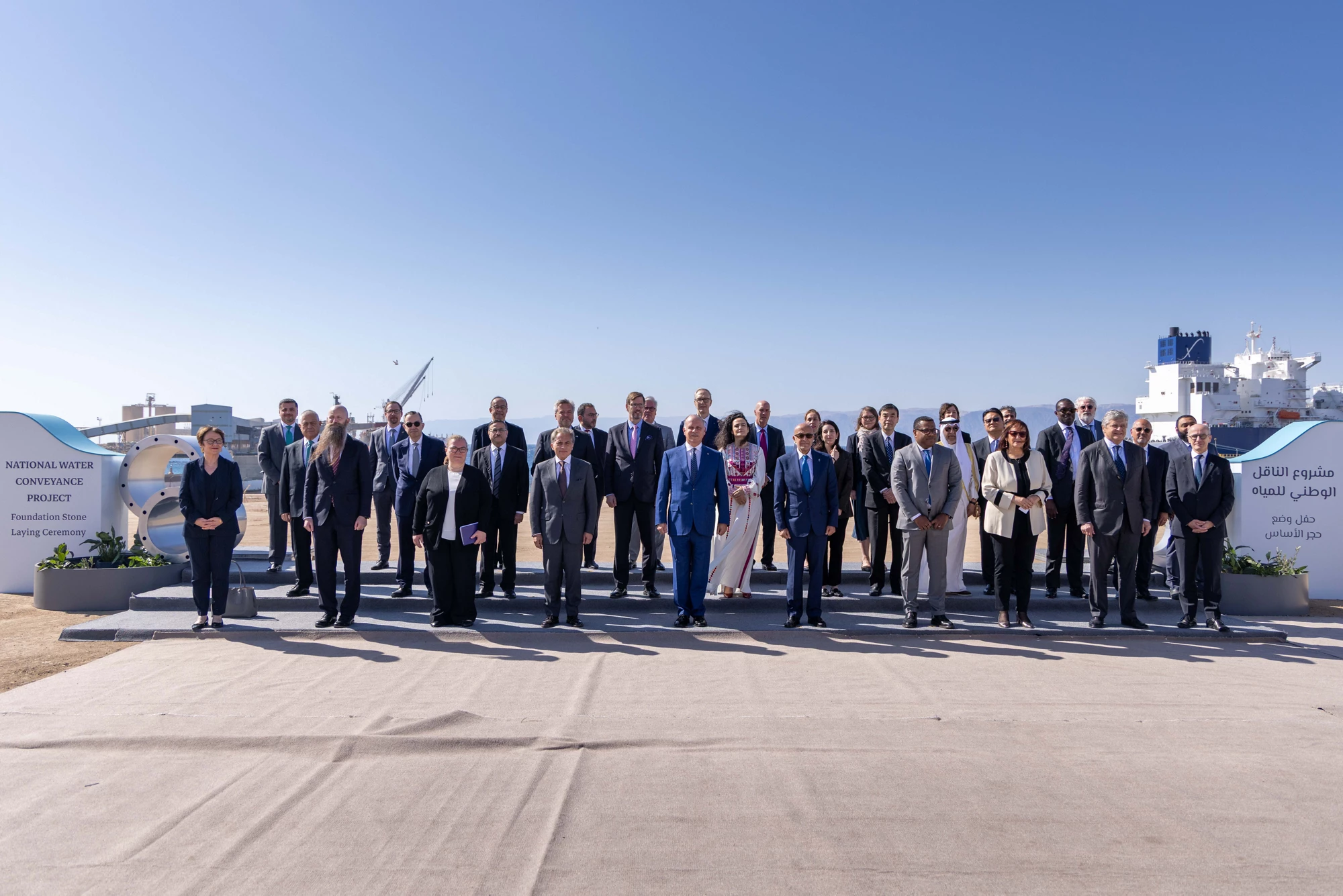
- Upon completion, the project will supply around 40 percent of the country’s drinking water demand.
- The project will deliver drinking water to over 5 million people and create more than 35,000 direct and indirect jobs in Jordan.
Amman, Jordan, November 26, 2026 – Jordan has secured more than $6 billion in financing for the Aqaba-Amman Water Desalination and Conveyance Project (AAWDCP), a landmark investment that will help address the country’s severe water scarcity. One of the world’s largest desalination projects, it is expected to supply around 40 percent of Jordan’s domestic water needs upon completion.
The project will also strengthen Jordan’s climate resilience by integrating renewable energy into its operations.
Jordan is one of the world's most water-scarce countries, with only 61 cubic meters of available water per capita per year, significantly below the absolute water scarcity threshold of 500 cubic meters per capita per year. Climate pressure and population growth are further deepening Jordan’s water crisis and placing additional pressures on already scarce supplies. The project addresses this critical development challenge by providing reliable water supply, delivering 110 liters of water per person per day.
The project is being developed by the National Carrier Project Company (NCPC), owned by Meridiam, Suez International, and the Jordanian Social Security Investment Fund (SSIF). NCPC will construct, operate and maintain the project. Meridiam is a global infrastructure investor and asset manager associated with more than 130 projects worldwide spanning water, transport, and energy. Suez is a global leader in water and wastewater services with 160 years of experience across both developed and emerging markets, having designed and built over 3,200 water production plants and 260 desalination plants. SSIF manages the Jordanian Social Security Corporation’s investments with a focus on generating sustainable returns and preserving asset value. Its portfolio includes strategic investments across real estate, banking, mining, services, pharmaceuticals, energy, tourism, and agriculture.
“This project represents a major step forward in Jordan’s efforts to address water scarcity and strengthen the country’s long-term water security. Today’s announcement marks an important milestone as we move into a new phase of implementation. The Government remains committed to ensuring the project progresses according to the approved schedule, working closely with all partners and relevant stakeholders to meet technical and environmental requirements and deliver on its objectives. Together with ongoing efforts to improve water supply efficiency, reduce water losses, and diversify water sources, this project will play a vital role in securing a more sustainable water future for Jordan,” said Jordan’s Minister of Water and Irrigation Eng. Raed Abu Soud.
“The Aqaba-Amman project is much more than a major infrastructure project. It addresses one of the most fundamental needs of the Jordanian people: reliable access to water. This is what infrastructure is ultimately about: anticipating critical needs and delivering lasting impact for people, communities and the environment. We are proud to contribute our long-term vision and expertise, alongside our partners, to making such a complex and essential project a reality,” Thierry Déau, Founder and CEO of Meridiam, said.
IFC, a member of the World Bank Group that works with the private sector, provided financing and played a central role in mobilizing private capital for the project alongside more than 20 development finance institutions, commercial banks, and impact funds. As part of the overall financing, IFC is also the Accredited Entity for the Green Climate Fund (GCF), which is providing its largest commitment for a single country in this project. IFC has supported the project since 2022, helping shape its structure and environmental and social standards.
“In Jordan, where water security is a national priority, this project shows what One World Bank Group looks like in practice. By bringing together public resources, private capital, derisking instruments and our combined expertise and financial products, we are helping secure water for millions of people, create thousands of jobs, and support the country’s adaptation to rising climate pressures,” said IFC’s Regional Vice President for the Middle East and Central Asia, Imad N. Fakhoury. “Just as importantly, the project demonstrates that replicable private sector solutions are possible in the most challenging infrastructure sectors, including water, where private sector participation has historically been limited.”
“GCF's $295 million investment in concessional loans and grants will improve the water security for 40 percent of the population in the second most water-scarce country in the world. Our concessional finance will help maintain affordability for 5 million Jordanians on terms that other financiers are not in a position to take. This is what GCF’s mandate is all about: combining grants and concessional finance at scale, flexibly, so that transformational climate investments can happen,” Mafalda Duarte, Green Climate Fund Executive Director, stated.
The Multilateral Investment Guarantee Agency (MIGA), home of the World Bank Group Guarantee Platform, will provide political risk insurance to Meridiam and Suez, helping de-risk their equity investments in the project.
The project is part of a One World Bank Group approach in Jordan to address the country’s water crisis and enhance its long-term reliability. The financing from IFC and its partners for new water supply builds on the International Bank for Reconstruction and Development’s (IBRD) ongoing Water Sector Efficiency Project which aims to improve service delivery by reducing non-revenue water, enhancing energy efficiency and strengthening drought management.
Together, these efforts reflect the priorities of Water Forward, a multistakeholder coalition launched by the World Bank Group that aims to deliver water security for more than one billion people by 2030.
Notes to Editor
In addition to acting as the Accredited Entity for the Green Climate Fund’s $295 million loan and grants package, IFC is also providing a $375 million loan and has mobilized $215 million from Japan International Cooperation Agency (JICA) and OPEC Fund to support the AAWDCP project.
Other financiers include the Asian Infrastructure Investment Bank (AIIB), the U.S. International Development Finance Corporation (DFC), the European Bank for Reconstruction and Development (EBRD), the European Investment Bank (EIB), and Agence Française de Développement Group’s subsidiary Proparco, and a group of local commercial banks.
Impact results communicated in this press release are based on IFC's calculation methodology and should be interpreted accordingly.
About IFC
IFC — a member of the World Bank Group — is the largest global development institution focused on the private sector in emerging markets. We work in more than 100 countries, using our capital, expertise, and influence to create markets and opportunities in developing countries. In fiscal year 2026, IFC committed a record $105 billion to private companies and financial institutions in developing countries, leveraging private sector solutions and mobilizing private capital to create a world free of poverty on a livable planet. For more information, visit www.ifc.org.
Stay Connected with IFC on social media.
Contacts
Stay Informed
Sign up to have customizable news & updates sent to you.