
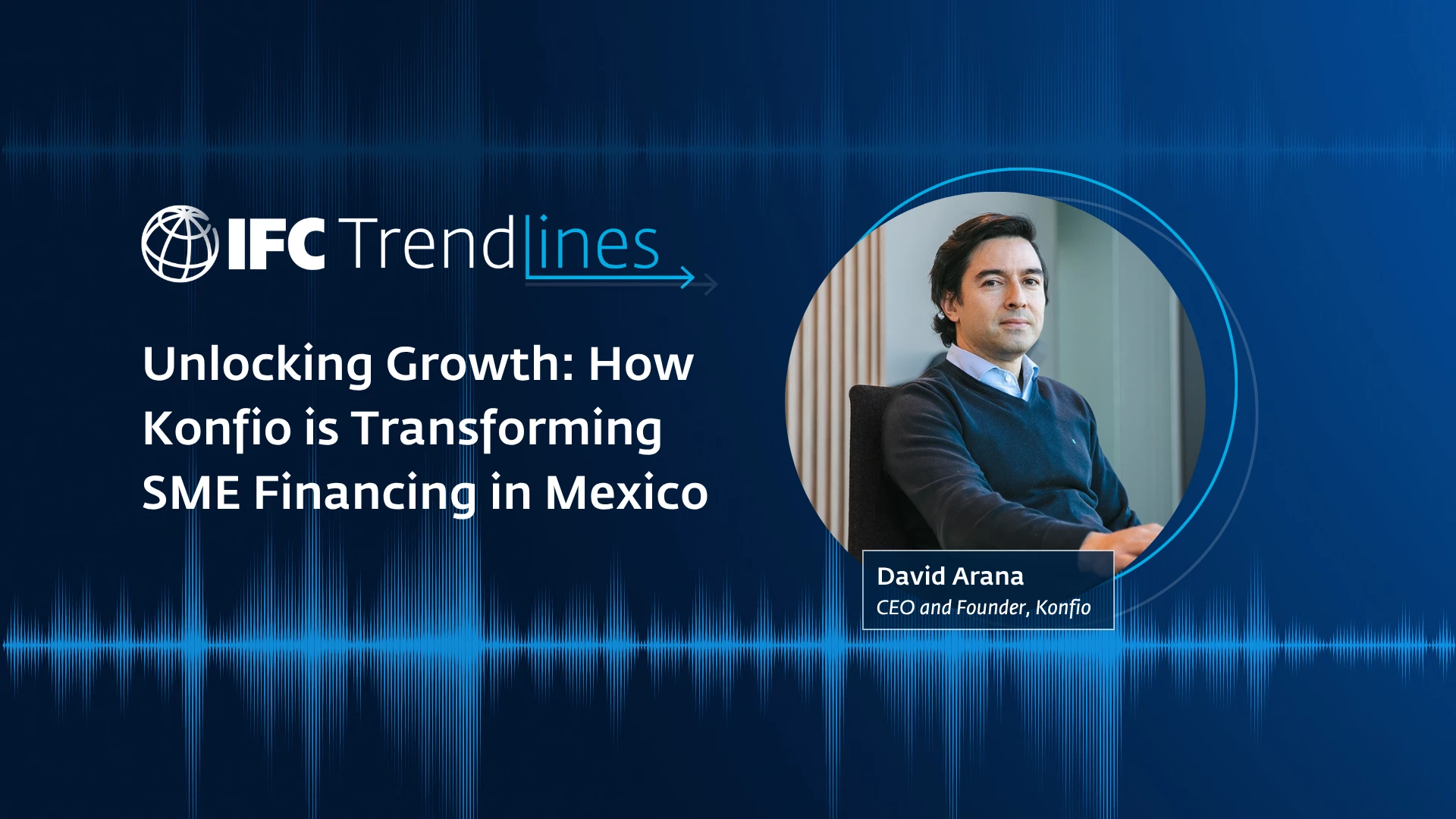
IFC Trendlines: Season 1, Episode 5
In this episode of IFC Trendlines, host Farid Fezoua speaks with David Arana, CEO and founder of Konfio, a financial services platform dedicated to empowering small and medium-sized enterprises in Mexico. They explore the challenges SMEs face in accessing traditional finance and how Konfio leverages data and AI to provide loans to businesses often overlooked by banks.
Transcript
Farid Fezoua: Hello and welcome to IFC Trendlines, a podcast from the World Bank Group where we explore how private sector investment supports jobs and opportunities in emerging markets, and how IFC is mobilizing capital to make that possible. I'm Farid Fezoua, the Global Director for Equity, Funds and Venture Capital at IFC.
Small and medium sized businesses are the backbone of most economies. In developing markets, they account for the majority of jobs, and yet, for decades, they have been systematically excluded from formal finance. In Mexico, as in much of Latin America, millions of viable businesses have never had access to a business loan, not because they're poor entrepreneurs, but because traditional banking models were never designed to understand them. No credit history, no collateral, no balance sheets that fit neatly into a spreadsheet.
Today's conversation is about what happens when that changes.
I'm joined today by David Arana, the CEO and founder of Konfio, a company that set out to build the bank that Mexico's small businesses never had using data, technology and a very different view of risk to unlock growth for entrepreneurs who had long been invisible to the financial system.
David, thank you for joining us and looking forward to the discussion. I would start from the beginning.
So let's take you back to the beginning of Konfio. And my first question is about how did the idea of funding a financial institution like Konfio come from? And what did the early years teach you? It's often, you know, a lot of learning that you apply, you know, for the rest of the growth of the company. So please take us back to the beginning.
David Arana: Farid, first of all, thanks for having me here. It's a pleasure. And so let me go back and think about the early days. After finishing my math degree, I spent several years in New York working in the financial services industry, doing structured products, trading and that really taught me that, you know, saw a lot of businesses that were very sizable but weren't necessarily blue chip, and they all struggled to get access to financial products, especially credit. And I said, look, the world is moving in a direction where transactional data is growing exponentially. You know, back then it was the rise of mobility, digital payments, etc. And I said, there has to be a better way to understand and work with these companies. It can't just be, you know, a company with a public bond pricing out what credit risk is, and then trying to figure out a way of working with them or asking for collateral.
So, I left New York, moved to Mexico City. There was also a personal part. I wanted to move back, be closer to family. I had been away for a very long time. And I wanted to work on something where I could see a tangible impact on the work that I was having. So I left, started Konfio, and Konfio today is a financial services platform focused on SMEs in Mexico. In terms of scale we are - if we were a bank today, we would be the number three in terms of number of borrowers. Balance is roughly number eight. So we've gotten to some scale in roughly over 10 years. But I think the most interesting part of what we've built is that we’ve focused on a segment that doesn't have access to any sort of credit. [For] 84% of our customers - it's their first business loan. And we've also measured the impact of that.
And if I can kind of go back and think of what the early days taught us; we basically went through the process of starting a company and going through lots of obstacles, making lots of mistakes, and seeing kind of what the landscape is, both on financial services, suppliers, productivity, how to build a team - so we understand the psyche of our customers extremely well. And I think, you know, we've tried to build a platform around those challenges, around the, you know, the difficulties that a lot of business owners have - trying to build a company which, in many cases, you know, it's a small team running it, it's a family, and I think, you know, always being focused around what our customer feels, what the challenges are, and that's been, I think, the key to what we've always focused on.
Farid: Traditional banks, you know, rely on collateral, credit scoring and history. You know, Konfio looks at something very different in the way you look at, you know, your customer, understanding the need, but also understanding the risks you face. So what are you seeing in the data that gives you the comfort that you can take risks where traditional banks wouldn't?
David: The premise of lending is understanding payment capacity and willingness. And the way that we've done that is, you know, one of the primary sources that we rely on is transactional data. Mexico has the benefit of having really good infrastructure on the fiscal front, where we can, basically, with the user's permission and consent, build something that looks like an income statement in seconds, and we are today, approving roughly, or, you know, 98.6% of our decisions are fully automated given the information that we ask for. So we don't have to ask for, you know, financials or audited financials. A lot of the companies that we serve don't have, you know, that level of order or the numbers or scale yet to, you know, spend resources or time on that. So what we've done is, you know, build out an engine that pulls this very quickly and in real time, essentially provide that information back to the customer, which is already insightful, but also provide a product that's going to help them keep growing the business.
Farid: Could you elaborate on the role that technology, including AI, play in in your model and in your future growth?
David: At Konfio technology and AI are at the core of what we do. Even before, you know, AI started to become, you know, more and more, something that we talk about in the media, kind of mainstream, we've been using applications of AI for the underwriting part, and that's how we got to 98.6% of our decisions being fully automated, and we've been doing that for over 10 years.
A lot of our team, you know, is highly technical, and we always knew that transactional data would allow us to build a model with a very low cost-to-serve, starting with the underwriting part, moving on to, you know, other types of applications.
I think one of the things that was difficult to address were some of the edge cases. But now with the you know, how fast and quickly technology and AI have improved, it is possible now to address all those edge cases, and that's what makes everything so exciting. So I think we have an exciting roadmap ahead of us where we see a future where we become faster, better at making decisions, at, you know, serving our customers, monitoring the relationship, where we can make all of our team kind of super humans, in a way, and we invest significantly also in innovation. So we're, you know, very, very excited
Farid: There's a persistent belief in the market that small enterprises / entrepreneurs are, you know, inherently a higher risk than you know, mid cap or large cap companies. So based on your own experience, what do you think this market misunderstanding comes from? Because the fintechs like you have demonstrated the contrary. So could you elaborate on the reasons behind that misbelief or misperception?
David: What a lot of people don't understand, what we learned along the way is that the customer segment that we serve basically live in a very tough environment all the time, which gives them the ability to adapt. So when there's a shock in the system, and we've seen this every time - one obvious that comes to mind is covid, but we've had several of these – whenever there are changes in the market, our customer base is used to having to, you know, adapt to very adverse circumstances.
In Latin America there are lots of changes. Now globally, there have been lots of changes in the world. These companies have the size and have the knowledge of their, you know, they’re domain experts in what they're doing, to adapt to change. So what we found is, if we're able to identify, you know, these business owners, their ability to adapt to change is very high, and that's what's led to having, you know, very resilient loan book and customer base along the way.
The other thing is, because they've been, you know, very underserved, once we start a relationship, the level of trust - we basically create a very special bond, and it's a good way of maintaining a relationship. So it becomes a very sticky relationship as well. It's not about, you know, price, it's not about, you know, commoditized type of offering, but it's really, hey, you know this, this is the entry to the financial services world on the credit side, and let's build, let's be partners for the future.
Farid: Konfio’s clients, are receiving their first ever business loan, which is transformative, in a way, for the way they can run the business and grow the business. So what does it tell us, one, about the size of the opportunity that has remained completely untapped to a large extent; the level of transformation you're bringing in terms of reach and access as well, which you know, for us from a World Bank Group impact is important to note; and last but not least is the responsibility and the accountability you have in extending that first ever loan and help those companies grow.
David: So I think what that tells us is that we're going after a segment that historically has been ignored completely by the traditional players. I mean but yeah, absolutely, it's a enormous opportunity. If we measure it roughly, think less than 4% of GDP accounts - that's the size of the SME portfolio. And if you compare that to other countries in Latin America, that's like half of the penetration, roughly. And Latin America is already under-penetrated versus developed countries. So lot of work to be done on the credit front.
You know, there needs to be platform like ours or many in order to capture the actual size of the opportunity. But a lot of work to be done also, from, how do we formalize more businesses? How do we bring more payments to be digital? And all of these can work together in a very positive way. And I think the end beneficiary of this will be, you know, the Mexican economy, business owners, etc. So I think that we're just a very small piece of the, you know, of the puzzle that needs to be solved. But very optimistic for the future.
Farid: No doubt it's making a huge difference in terms of access to capital for these enterprises, and a difference in terms of jobs for the economy. I know Konfio - and we've been discussing that - is pursuing that bank license. So it's kind of counterintuitive sometimes to see fintechs or, you know, NBFI’s looking to acquire a banking license, and that to look more like a bank? So what would that banking license really allow you to do that you're not doing today or prevented from doing today?
David: I mean, for us, it's about the continuity of our model. So our model has proven that we can, you know, focus on the SME segment that you know, for most part, it's their first business loan, scale it get the unit economics to work. But if we really want to keep scaling the platform in terms of, you know, size, product offering, trust. There's a trust element as well for our customers. It's the right platform. It's the necessary platform.
And I think all of this started actually with our customers asking us, well, they said, Hey, we really like the experience on the credit side, a corporate credit card, et cetera. What else can you guys do? Can you guys manage my money? Because I don't like logging into multiple platforms. I want everything in one and that makes sense, right? If you think about a business owner that doesn't have a very sophisticated team or a large team, you value that time that it saves doing everything on one platform like a one stop shop. So for us, it made a lot of sense.
We think that's going to strengthen the relationship with our customers. And then on the other side, it'll allow us to offer other things, other credit products, so that we can continue to have a relationship with our customers. Today, we can only go up to a certain amount, but later on, we can think of different structures, sizes, etc. And then businesses have different needs. They have they have payroll, you know, they have employee base they need to think about and different types of things that, unless we have a bank charter, that's not going to be possible. So, you know, for us, it's, it's very important for that to be the next stage. Now it's something that will take time, because we want to do it correctly. We want to do it, you know, partnering up with the regulators and make sure we're all comfortable moving forward. But we're excited with that next step as well,
Farid: I'd like to take a couple of minutes just reflecting on our own partnership. IFC has been an equity partner for Konfio since 2017 so it's been a few years that we've been on this journey together. So from your perspective as a founder, what did an institution, a development finance institution like IFC, a long term development partner, but also investor, bring to Konfio in critical moments of its growth. And also, you know, from an external standpoint, what do you think having an IFC in Konfio’s cap table meant to attract other investors or to be more credible in the market?
David: So I mean IFC for us, in addition, you know, to capital part, I think, has been a really important investor because it brings, alongside a very strong institutional, you know, knowledge, lot of best practices on the corporate governance side.
And I think the other really important element which comes to mind is IFC definitely facilitated our entry and to getting access to institutional capital on the debt side. So IFC was our, you know, in conjunction with another lender, we put together a credit facility which was large enough for several years of growth with, you know, fair terms, and allowed us to gain scale and then continue on that journey. But it was definitely a bridge to getting access to good capital market solutions, debt funding. And had we not had IFC, I think it would have taken longer. So very helpful there, and we feel very fortunate to be partners.
Farid: We're very glad and proud to be an early partner with Konfio. I'll just end up with two questions which are really around sharing you know, your experience, your journey, for a common good. So if you were to talk to an entrepreneur that really wants to build a FinTech in an emerging market today, what are the two or three things you would share and recommend or advise them to do
David: So, I think one is in emerging markets, when building out a company, you kind of have to build out several companies within one. I mean, in developed countries, you have a lot of services, API's that'll get you access to information. For us, the main source of transactional information that we pulled from, we built out that motor. We built out the engine from scratch. There are standalone companies that try to do this, but for us, I mean, that was one of the biggest challenges initially, and it's a, it's still an effort, you know, to run and scale that make it better every single day. So that's, you know, that's, that's one of the obstacles that we had to go through. And I think that's true in emerging markets. There's still a lot of opportunities out there. So for building out a company, you kind of have to do several within.
The other is to focus on the really hard problems. There are a lot of, you know, social issues, I think still in emerging markets, lot to be done, but the impact that that can generate is massive. So I would absolutely, you know, try to think of what are the hardest problems in my geography - those might not exist in others, in other places, but in emerging markets, absolutely huge opportunities that need to be addressed, and those are the ones that are going to create the biggest impact. And then the third is always, you know, focus on, on a team that is in love with the mission. Yes, because that's the, the most important thing, I think.
Farid: If you were to talk to investors, institutional or commercial investors or DFI watching us today, what would you wish they more understand about SME lending in emerging markets like Mexico.
David: So one, it can be done at scale. And two, there's lots to be done from an impact perspective. We, we've done a study. It was done by someone third party. It's public, but we measured the impacts of of the platform that we've built on the credit side. And the conclusion is that, after you know, obtaining a loan on our platform, customers are growing 19.4% in terms of sales, and that's significantly above where you know, GDP for the SMEs are is growing, and then when it's a primarily woman led business, that number actually jumps to 42% so I think we shouldn't underestimate the size of the impact that this can have, you know, in the economy, if we were to scale this. So there's a lot to be done on the SME space, both in credit and other things that I mentioned earlier, but it's, it's a very important market for, you know, for emerging markets and beyond.
Farid: Thank you, David, thanks for this enlightening conversation. But beyond that, thanks for what you do, because we realize that, and you've touched on it, the multiplier effect of what you do in terms of providing access to capital to small and micro enterprises is critical. It's critical. And this is something that at IFC and World Bank Group, we value tremendously. You augment the reach, you augment access and we value that.
That's all we have a time for today on IFC trend lines, I'm Farid Fezoua. Thanks for listening.