
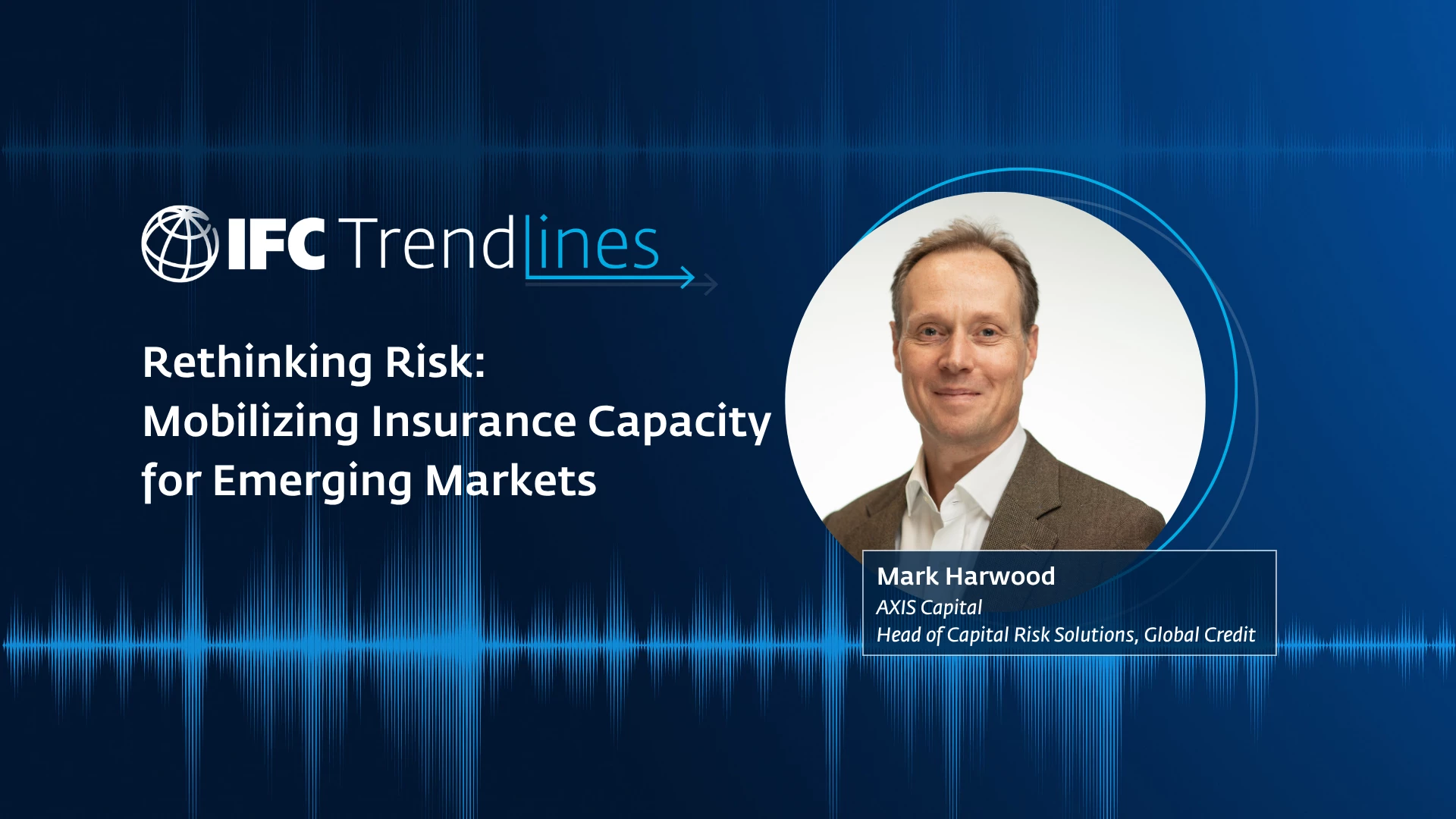
IFC Trendlines: Season 1, Episode 6
How can the global insurance industry help unlock private capital at scale for investment in emerging markets? IFC's Jamie Smouse speaks with Mark Harwood of AXIS Capital about how well-structured risk can create attractive opportunities in emerging markets and how IFC partners with insurers to expand lending to businesses that create jobs and drive economic growth.
Transcript
Mark Harwood:
For me, a poor risk is just a badly structured risk. You know, whether it be in the emerging markets or in the developed markets, if a risk is well structured, well supported, has DFI involvement, then you know it should be a good risk.
....
Jamie Smouse: My name is Jamie Smouse. I'm a principal investment officer at the IFC. And this is IFC Trendlines, a podcast from the World Bank Group where we explore how private sector investment supports jobs and opportunities across developing economies, and how IFC is mobilizing capital to make that possible.
One area where that work is evolving is in our partnerships with the global insurance industry. We've done this through our Managed Co Lending Portfolio Program or MCPP.
But what does it take to make these partnerships work? And how do you balance risk, return and development impact at scale? To explore that question, I'm joined by Mark Harwood, Head of Capital Risk Solutions for Global Credit at AXIS capital, one of IFC's partners in the MCPP Program. Mark, welcome to Trendlines
Mark Harwood: Thank you for having me, James.
Jamie: So Mark, let's start out broadly and talk about risk in emerging markets and how AXIS capital views the commercial case for investing in emerging markets. I'm curious to understand, you know, you're a non Life Insurance Company. Most of the risks are in, you know, natural disasters and other types of product lines. How do you guys view this business line as a component of your investment and growth strategy?
Mark: Yeah, I mean, I think, like any other insurer, this has evolved over time from traditional political risks into what we now call, sort of fully comprehensive non-payment insurance. AXIS has been writing that for 20 plus years now. And its certainly for us really become a growth business line, you know. We see it very much as a diversifier. It has low correlation with other specialty lines. And also, I think it really gives enhanced sort of risk-adjusted returns for the company.
Jamie: So then, if you're thinking about underwriting decisions in emerging markets, you know what really, what really drives them? What are the variables that that matter most?
Mark: Within capital risk solutions we do a lot of project finance, and actually we do a lot of aircraft finance in emerging markets. On the project finance side, we're very focused on how strategic is that project? Is it structured onshore or offshore? How strong are the sponsors? What's the regulatory framework like, and in terms of - once projects are constructed - the off take risk? Is it local currency? Is it structured offshore with hard currency? So those are sort of few things that we build into our sort of underwriting decisions. And then once we've done our full due diligence, we rate every transaction, and then that really drives our pricing adequacy.
Jamie: So if you think about MCPP, this is a portfolio approach, right? You're not doing single deals. You're, in a sense, giving IFC the pen. We originate the deals over a period of time, and then you come on risk as we commit to those transactions. How do you see that shift from, you know, single deals to portfolio level risk or treaty-based solutions?
Mark: I mean, there's no question that the actual concepts of the MCP Program is very attractive to insurers. It gives us that diversification across countries, industries and obligors. But it wasn't that easy a sell at the start for us internally. I mean, as a reinsurer, we are reinsuring other credit insurers and have been for well over a decade. So, there's a lot of experience in underwriting, what I would call sort of blind portfolios, in that sense. But in terms of, as you say, giving the IFC, quasi-delegated authority, albeit with set criteria around, that really comes from trust. Yeah, and for us, like many other insurers, that trust has been built up on a single transaction basis over one over 10 to 20 years.
Jamie: I'd be interested to understand how you see, you know, emerging market DFI risk-sharing with IFC. How does that stack up with other returns you might see in the emerging market credit space?
Mark: The enhanced returns are really driven by the, I suppose, halo effect of working with DFIs versus traditional commercial banks. We work with commercial banks in the emerging markets all the time. But I think when we're working with DFIs and this is in the sort of credit space and the sovereign space, we're much more in the credit space. You know, it's those, it's the risk mitigants that gives us comfort, and that is boots on the ground, relationships with governments and obligors, that mitigates the, one, political risk, whether that be expropriation, nationalization, or whether it be and generally in what the business we do, currency and transfer. Exactly.
Jamie: Because you guys would provide those products to the market. Do you write that kind of risk?
Mark: My team doesn't do that much of that but, but our syndicate team does. But what we do look at very much is, is the recovery, and recovery data, and ultimately the loss, the loss given defaults. And there's no question that over history, and we have decades and decades of loss history from DFIs, that we apply a higher recovery rate and therefore enhanced returns.
Jamie: You're right. I mean, there's evidence to back that up. I mean, the DFIs just released, the GEMS data which came out, where we pooled all our data. And I think that did show that recovery rates are as high or higher than corporate bond markets and developed markets.
So, let's keep talking about the DFI difference, and talk a little bit about how you see underwriting, you know, alongside IFC, how does that change the risk picture?
Mark: Well, first and foremost, I mean, alignment of interest is key. And the IFC, you retain a lot of a lot of risk lien, which is very attractive. I think patience, being patient lenders in the emerging markets. You know, we've had situations - an example going back probably 10 years - where we paid out a claim on an FI risk with with a DFI, and we're still sitting there, but we've got two thirds of it back so far. And actually the debt was converted into equity, and slowly but surely, we are making returns. I don't think that would have happened had we been behind a commercial bank for it.
Jamie: Yeah, indeed, right, our recovery process as well we're patient, and we're willing to wait to get those returns. So you mentioned trust earlier, and I'm interested to hear from you. So how do we do that over time? How do you build trust between an insurer and a DFI like IFC, which you know more broadly, will help us ultimately scale these programs even further than they are today.
Mark: Well, one, it comes down to long term partnerships, understanding and having come up with how the IFC is originating risks, how they manage those risks over time. Transparency, information flow is absolutely critical, and then how they act in a claim situation.
Jamie: Yeah, you mentioned trust taking time to establish and, I mean, I think it's interesting. If I think about the insurance industry, it's almost built around this long term trust, long term vision, right? Once you get in, you're kind of committing to a long process so that you can replicate, if you will, our portfolio over time. Could you talk a little bit about how insurers Look at that?
Mark: We don't really step into any line of business unless we want to see a flow of that business. We're not really ones for doing ad hoc transactions. So when we entered our project finance space, when we entered our aircraft finance space and equally our structured credit space, we spent a long time with senior management, getting senior management buy in, you know, going through the pros and cons of the sector, why we want to focus on it, loss history, and really what the you know, the growth expectations are for that business, so that we can replicate those transactions going forward. And the more we replicate, the more experience and knowledge we develop. So really that, yeah, the long term partnerships are absolutely key and to make the business repeatable.
Jamie: So thank you, Mark. This has been an interesting conversation. I just want to close with, with, with one question, which is, you know, what from your point of view, if you had to pick the single most important insight you've gained from working in this space, you know that maybe the broader insurance industry is just coming around to or is yet to internalize, you know, what would that be?
Mark: With emerging markets, there's this sort of perception that emerging market risk is sort of difficult risk or you know, is poor risk. I mean, for me, a poor risk is just a badly structured risk. You know, whether it be in the emerging markets or in the developed markets. If a risk is well structured, well supported, has DFI involvement, for example, then you know it should be a good risk.
Jamie: Yeah. I'm a hiker, and so hikers often say there's no such thing as bad weather, just bad clothing, right? So yeah, if you're prepared for the risk, then it should be able to be priced and be structured.
Mark: And, yeah, if you are comfortable with the restructure, with structural mitigants, with country risk mitigants, then I think anything can be underwritten.
Jamie: Thank you, Mark.
As we've discussed, partnerships between IFC and the insurance industry are helping unlock new flows of private capital into emerging markets, expanding investment opportunities while supporting jobs, businesses and economic growth where it's needed most.
Again, my name is Jamie Smouse. Thank you for listening to IFC Trendlines.