
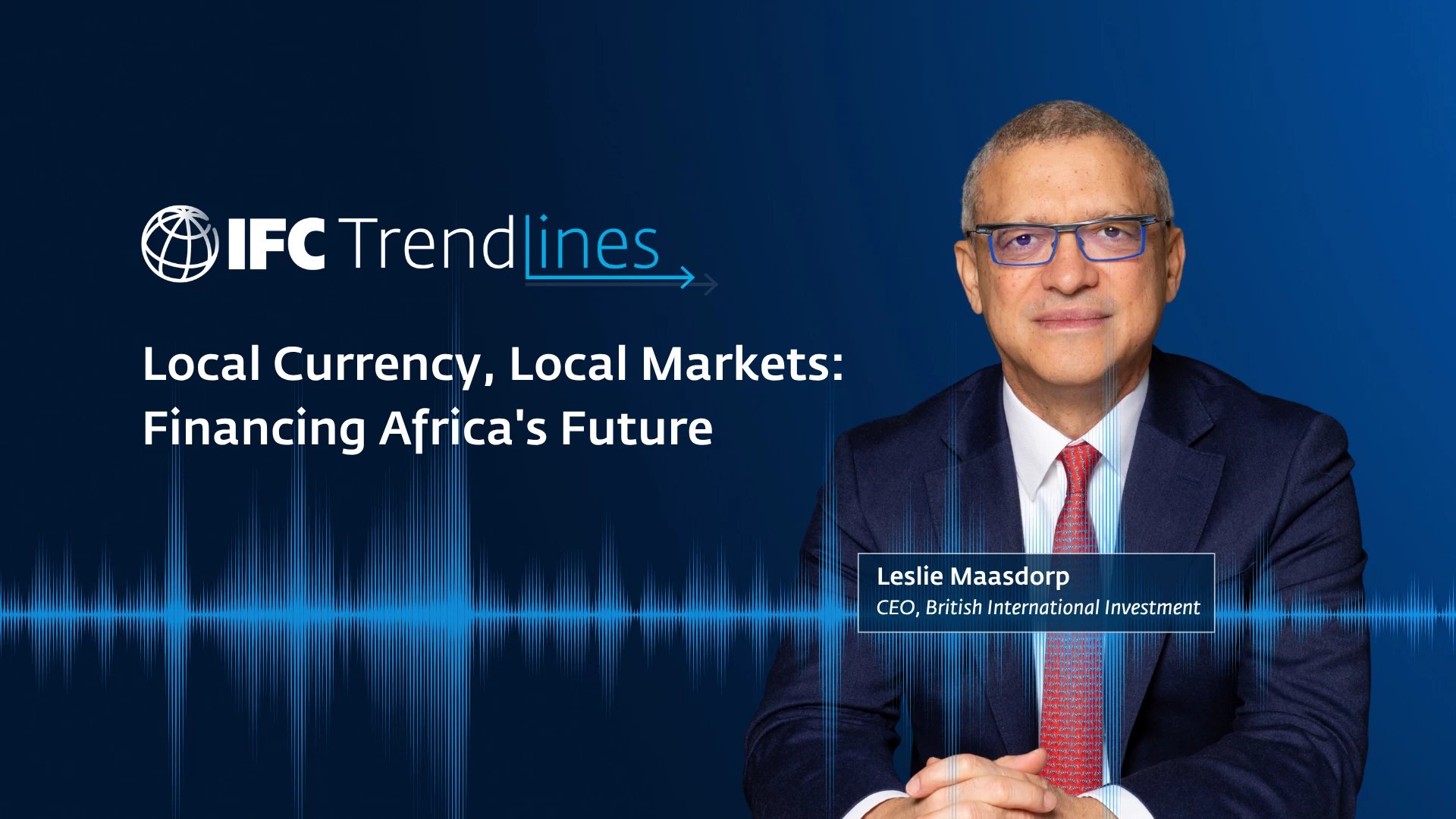
IFC Trendlines: Season 1, Episode 7
In this episode of IFC Trendlines, Ethiopis Tafara, IFC’s Vice President for Africa, speaks with Leslie Maasdorp, CEO of British International Investment, about why local capital markets are central to closing Africa’s financing gap. Private capital mobilization in Africa by the World Bank Group nearly tripled in fiscal year 2026, but meeting the continent’s needs requires greater scale. The conversation explores the market conditions, instruments, and partnerships needed to channel investment into businesses that create jobs and drive growth.
Transcript
Opening Quote: The actual risk perception versus real risk - there's a big mismatch there. Our role is to use our capital in catalytic ways to take that first loss, to improve risk-return profiles. To take the approach that we want to crowd-in commercial capital has to inform, ideally, every transaction that we do.
Ethiopis Tafara: Hello and welcome to IFC Trendlines, the podcast where we explore how private investment is transforming emerging markets and creating jobs where they're needed most. I'm Ethiopis Tafara, IFC's Vice President for Africa, and today's episode gets to the heart of one of the continent's most important economic questions: the world has money to invest, and Africa has vast, compelling needs. So, what does it take to connect the two at the scale this moment demands.
We're seeing real progress on this front. The World Bank Group just closed its strongest year yet for mobilizing private capital, $112 billion globally in fiscal year 2026, more than tripling in just four years. And in Africa, that number nearly tripled too, growing from roughly $9 billion in FY 22 to $22 billion in FY 26, so the momentum is real.
The question now is how we sustain it and scale it further. That comes down to the strength of local financial markets and what it takes to build them, so they become powerful engines for channelling investment into local businesses and creating jobs, that's the work we're in the middle of, and it's what we're here to discuss today.
Joining me is Leslie Masdorp, Chief Executive Officer of British International Investment, affectionately known as BII, the UK's development finance institution, with over 60% of its investments directed to Africa. Leslie is one of the most experienced voices in development finance, and BII's ambitious new strategy makes this a particularly timely conversation. Leslie, welcome.
Leslie Maasdorp: Thank you for having me.
Ethiopis: Leslie, we're seeing some real progress in mobilizing private capital, but closing Africa's financing gap remains a challenge. IFC and BII, between us managing tens of billions of dollars of exposure across the continent, we've made both local capital market development central to our strategies, precisely because of that gap. From where you sit at BII, why are local capital markets so central to the solution?
Leslie: Ethiopis, thank you very much. That is such a central question for development finance and for Africa in particular. One of the first points I'd like to make is that each one of us, we are individual development actors within a broader sort of landscape, so one of the important ingredients of developing local capital market is for us to function more as a system.
For example, you have great ability to shape the policy and regulatory environment because you've got upstream capability that you've honed in over many years. We have the capacity to originate transactions and have patient risk-bearing capital. We can deploy equity, for example, in some very risky markets.
All of us play a role in developing what we call local capital markets. There is no way that Africa will become prosperous over the medium term without fully functioning local financial markets. No country, Ethiopis, as we know, have ever really flourished and produced sustainable, long-term wealth for its people, unless it has a well-functioning, developing local financial and capital markets. So we are very focused as BII to contribute to the building of the institutional fabric for local capital markets. We don't just do transactions; we shape markets. So all of our activities are focused on contributing to developing the framework for local capital markets to emerge.
Ethiopis: So, what is the hardest barrier you've encountered in trying to get this domestic institutional capital, whether it's pension funds or insurers, to invest in local markets?
Leslie:I think, firstly, there is a very conservative paradigm that you find in a conservative outlook that is almost hard coded in the minds of trustees. Understandably so, Ethiopis because they have certain fiduciary mandates, right? So when they interpret fiduciary duty, they look at it through a very risk averse lens. The actual risk perception versus real risk, there's a big mismatch there.
So 2009, as you know, very famously, the European Investment Bank, IFC, created the GEMS database. We now know today that there's a huge gap between the actual default rates and the recovery rates than what people perceive them to be. We can show over the last sort of 35 years, that the perception around the default rate is significantly higher, and that we have much better recovery rates in the private markets in Africa. So, what is required is to kind of overcome that risk perception barrier.
Ethiopis: Let’s shift a little bit and talk about a related topic, and that's local currency. IFC's own experience has taught us that local currency financing isn't a nice to have. It's really a development imperative. Does that match BII's own experience? What evidence have you seen in your portfolio or in the market, that local currency financing changes outcomes for businesses and investors.
Leslie: There's just two transactions I want to reference very briefly. The one is called GIP Ghana Growth Investment Partners for Ghana, and we've got a similar one for Zambia. In these two countries, what we did, because of the funding gap that we saw, many small medium enterprises they lack the ability to tap into growth capital, capital between sort of $500,000 and $2-2.5 million. They have difficulty accessing growth capital from the formal financial institutions. So what did we do? We set up a specialized funding platform. We crowded in other development finance institutions alongside us. In the case of Ghana, we brought in NorFund, for example. And very importantly, we were able to persuade the local pension fund in Ghana to invest alongside us. We have been on the continent, as you know, Ethiopis for decades and decades. This is now the first time that we see local pension fund actors recognizing that there is opportunity in investing in in medium, smaller medium businesses. Which, as you know, that's how you create jobs on the African continent. Jobs is right at the center of your mandate, and it's an outcome that all of us focus on.
In addition to the funding, we also provide auxiliary services. We provide, for example, financial management skills. We don't just provide capital to a business, flexible funding, but local currency funding. Many businesses, unless you in the export sector, they need local currency because the FX mismatch is a significant risk for these businesses, because you know as the local currency depreciates, their debt servicing cost goes up. These businesses struggle to service their debt.
And Zambia, we worked with NAPSA. NAPSA is the National Pension Sovereign Authority, the largest pension fund in Zambia. There, we were able, through a long effort, to ensure that the government pushes the regulator to make a rule change to allow them to invest in a vehicle like the one that we have set up.
So you see an increasing awareness by the ministries of finance, the ministries of labor, and a lot of these countries that they need to work more closely with DFIs, to unlock and create local currency, flexible financing structures. So those are two examples. We now want to replicate that. We know we can replicate it in places like Kenya, in Tanzania, in Egypt, in South Africa, and a lot of these markets where there are reasonably strong pension funds: Zambia, Botswana, and so on.
Ethiopis: Thats’ a perfect segue to the next question I wanted to ask you because, you know, typically traditionally MDBs and DFIs have been financiers, but there's a growing consenssus that we need to do more to create markets and build markets and solve problems. It'll be interesting to hear from you how BII approaches that. In other words, how is it you go about identifying problems and bringing clients to the problems as opposed to waiting for clients to come to you for financing?
Leslie: That is exactly the structural shift that underpins the new five-year strategy that BII just announced. That strategy marks a shift away from us financing individual transactions, project by project, and us looking at it through that market-level impact lens.
Let me give an example, four or five years ago, BII invested alongside Vodafone with Safaricom in the second mobile operator in Ethiopia. There was a monopoly before in the telecoms, mobile telephony in Ethiopia. As a consequence of our investment, we brought, of course, in competition. The cost of data went down by 55 percent. The impact and the multiplier impact and the benefit of the cost of data going down for small businesses just had a significant developmental sort of impact in Ethiopia.
When we look at investments now, we look at what is the market barrier, the market failure that we're trying to solve through that investment, and we take that approach, the deliberate market shaping sort of lens. You spoke about market creation of shaping markets. It's been probably hard coded in in your lexicon for at least probably the last decade and a half, but it is now becoming the central sort of architecture of how we look at the business of development finance.
Ethiopis: You probably know our president Ajay Banga has been pushing us to mobilize far more than we have historically, and indeed, we had a record year this year. And looking for us to not so much focus on our volumes, but using our own money to mobilize as much private sector capital into projects and into development. We use a range of instruments to accomplish this mobilization, both at origination and at distribution, we use guarantees, securitization. From a peer's perspective, which of these tools do you think is the most underutilized in Africa right now?
Leslie: Firstly, congratulations. When I saw the number that you were able to treble over the last four years your mobilization ratios. I mean, I was really struck by just how significant an achievement that is. It shows that the entire development finance system is now moving in that direction.
For BII, for example, in our new strategy, we have 8 billion pounds that we have committed over the next five years, and we intend to mobilize 7.5 billion pounds alongside our own capital. Naturally, we want to increase that number significantly higher. But we are kind of earlier in the journey relative to the IFC. IFC is very much being kind of pioneers in this domain, you know. The rest of the system is now migrating towards what is now the consensus view around originate-to-distribute.
The model, the structural shift in the thinking - that we are aggregators, that our role is to use our capital in catalytic ways to take that first loss, absorptive capacity, for example, to improve risk-return profiles, to look at you know, the capital stack, to take the approach that we want to crowd in commercial capital - has to inform ideally every transaction that we do.
We also took note that the IFC, for example, and the World Bank, together with MIGA, IDA, you've created a standardized guarantee platform. Guarantees is one I think of the most underutilized instruments, powerful instruments, so you can do credit enhancement and put wrappers around your structures.
But you are paving the way for what comes next, which is repeatable, standardized structures.So I don't think there's one formula. I think it's going to be a range of approaches, and we're still in the design rooms right now to identify what would be the best sort of framework to attract at scale larger volumes.
Ethiopis: Job creation is our north star, largely driven by what we see in terms of demographics around the world, but in particular in Africa, where you have 70% of the population under the age of 30, in some countries 50% under the age of 15, and it's a dividend provided we're creating jobs for all this youth that's coming to the market. So my question is, what gives you confidence that we can actually mobilize private capital at scale to create the jobs that we need to create and to achieve the growth that is necessary in Africa.
Leslie: I think the shocks over the last few years, including the significant decline in overseas development assistance, the contraction of available additional fiscal resources by the developed world have made African policymakers realize that Africa needs to, by its own bootstraps, create the necessary conditions for it to develop, for us to develop our economies.
Firstly just the recognition from policymakers that foreign resources and offshore investment flows is just a complementary pool. It's domestic resources that ultimately needs to be unlocked - is the first point.
Secondly, Africa cannot grow unless we overcome a couple of big things. But one in particular, which is power, you cannot develop an economy, you can't get out in in the morning, a clinic can't function, women can't give birth, kids can't go to school unless you've got power, unless you've got energy, right? Which is why Mission 300 is such a vital campaign and why energy is so important amongst the sort of sector priorities on the continent.
So when we talk about job creation, jobs is an outcome. In order for those jobs to be created, firms, small businesses need to have access to power. We've not even spoken yet about digital infrastructure. We've not spoken about the AI revolution and the potential of new technologies. I'm just talking about foundational infrastructure.
So there's a newfound energy, commitment, and momentum around the power sector in particular that gives me a lot of confidence.
Ethiopis: That's where we leave it for this edition of IFC Trendlines. A big thank you to my guest Leslie Masdorp. I'm Ethiopia Safara. Thank you for watching and listening. Goodbye.