
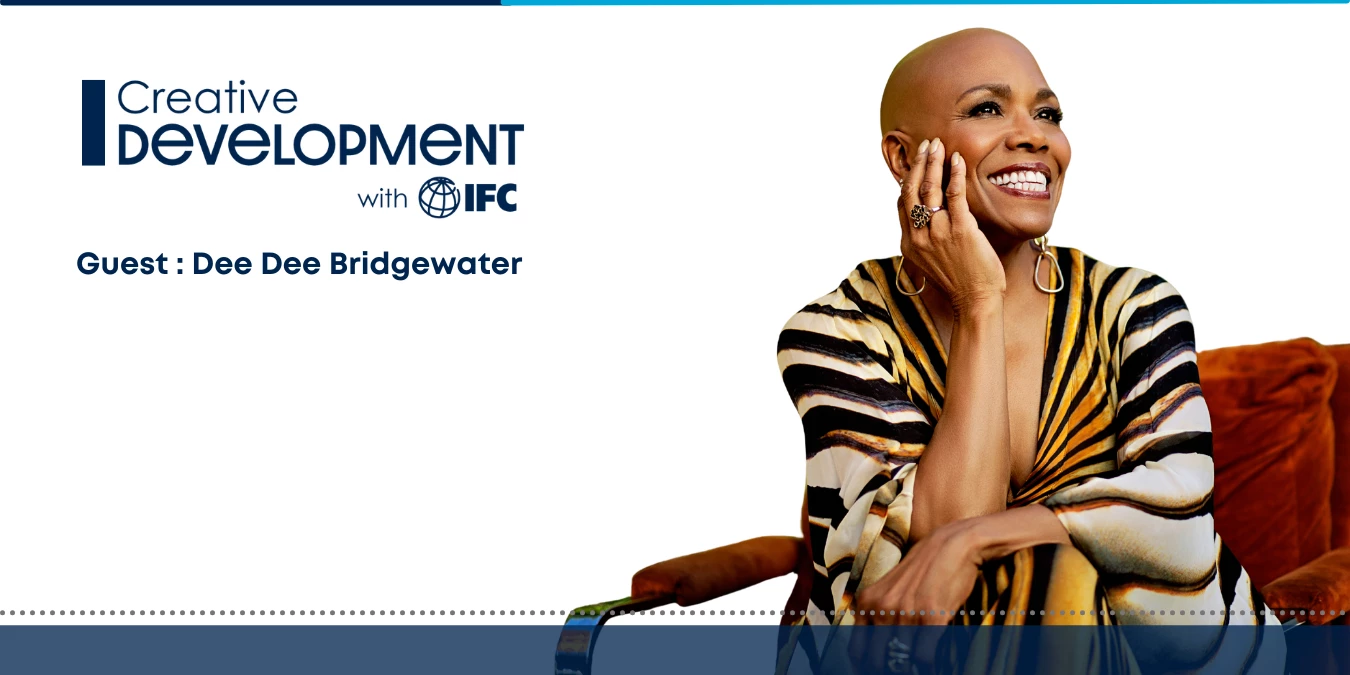
Season 7 | Episode 1
Acclaimed jazz artist Dee Dee Bridgewater joins IFC Managing Director Makhtar Diop to reflect on a remarkable five-decade career. She discusses the experiences that have influenced her work, from Memphis to New York and Paris, as well as her acclaimed Red Earth project, which deepened her connection to her African heritage. The conversation explores mentorship, women’s empowerment, artistic ownership, and her advocacy as a UN FAO Goodwill Ambassador, offering insights on leadership, legacy, and the power of culture to drive impact.
Saison 7 | Épisode 1
Figure emblématique du jazz, Dee Dee Bridgewater s'entretient avec Makhtar Diop, directeur général d’IFC, sur un parcours exceptionnel de plus de cinquante ans. De Memphis à New York puis Paris, elle revient sur les expériences qui ont façonné son œuvre, son projet Red Earth et son rapprochement avec ses racines africaines. Une conversation inspirante sur le mentorat, l’autonomisation des femmes, le leadership et le pouvoir de la culture comme moteur de changement.
Transcript in English
Makthar Diop: Hello, and welcome to Creative Development with IFC. I'm Makhtar Diop, Managing Director of the International Finance Corporation.
My guest today is Dee Dee Bridgewater, a true icon of jazz. Over a remarkable career spanning more than five decades, she has won three Grammy Awards, recorded dozens of albums, and performed on stages around the world. At seventy-six, she continues to create, perform, and inspire. She's also a passionate advocate, mentoring young women in jazz and serving as a Goodwill Ambassador for the UN Food and Agriculture Organization, FAO, in the fight against hunger.
So, Dee Dee, it's a huge pleasure to host you on today's podcast, and for me, who is a big fan of your music, it's a tremendous pleasure to have this conversation with you. Let's start with the origins from Memphis, Tennessee to Paris, New York, the rest of the world, and you are here where you are with all the achievements that you had. Tell us how all this started.
Dee Dee Bridgewater: Oh, you know, I always wanted to sing Makhtar, and at the age of seven, I announced to my parents when I grew up I was going to be a very famous, well-known jazz singer, respected by musicians, and that I was going to live in Paris, France. So that happened! And then I always sang. I created a trio called The Iridescence with two girlfriends at 16, and we sang at talent shows around Flint, Michigan, and Detroit, Michigan. And when I went to university, I was majoring in English, but I had wanted to take a year off before starting college, so I wasn't the best student in all of my courses. And I ended up taking some side jobs to support myself singing. And I discovered that I could make decent money singing, and gave up my college career as an English major, and I moved to New York City. I met and married my first husband, Cecil Bridgewater. I worked in New York for four years with a big band called the Thad Jones Mel Lewis Orchestra and through that band, which was my formal music education, I met many of the great jazz musicians that I worked with, and that helped to really launch my career.
I'm also an actress. I did a musical, a Broadway musical in 1974, from 74 to 76, called The Wiz. I was one of the principal performers. I played Glinda, the Good Witch of the South, and I won a Tony Award for that. And from that I was able to start recording. I guess we could say I started a kind of recording career, so music has always been the backbone of everything that I've done.
Makhtar: But what is amazing is that you've been able to perform at the highest level as a singer and as an actor. But let me just talk about first your career as a singer because there's something quite amazing. You always do amazing tribute to the tradition. It's amazing for me the versatility that you have, because singing Billy Holiday and singing Ella Fitzegerald is a different ranges, it's different technique, it's different emotions. So how do you manage to move from one genre to another. It looks like you really, when you prepare this album, become really the person. You understand the spirit in it.
Dee Dee: Well, I mean, that is really just what I feel I must do out of respect for the individuals that I'm honoring, and also out of respect for the history of this music. I want to bring as much authenticity to whatever project I'm doing, and also I'm very cognizant of the fact that people see me as you know this kind of elevated jazz singer. So I'm always, no matter what project, what musical project I'm doing, I'm trying to keep that connection, that jazz connection, even if the music may not necessarily be, you know, straight ahead jazz. It can be another genre of jazz. The jazz is the thread. It's the common thread that you will find in all of the different projects that I do because it is my root. It is my soul. It's my I don't know my raison d'être.
Makhtar: You're too modest and too humble for instance, for me I was just you know amazed by Red Earth because coming from West Africa - I'm from Senegal - I know it's complicated to be able to bring the jazz tradition. So to be with your friend Oumou Sangare, to bring Cheick Tidiane Seck and all these people, and bring another tradition is very powerful. And you were able to really, for me, brings that common spirit that people don't necessarily see between those two parts of the world.
Dee Dee Bridgewater: Well, you know, Makhtar, for me, that whole project was born out of a personal search of mine to find my African ancestry. So I decided I wanted to visit Mali. It was because the music that a musician who was working with me, Ira Coleman would play for me all of these Malian albums, or Senegalese albums, and I would know the melodies of a lot of these griot songs. I could sing along, and it just it was in my head. I knew these melodies. So I decided I needed to get a better understanding of that, and that's when I had hooked up with Cheick Tidiane Seck. He had done an album with Hank Jones, and I had loved that album.
And so with Cheick as my guide, I went to Mali for the first time, and that's when I met Oumou. We also would go out to where music was being played, and I was always able to sit in and to improvise using my scat on top of all the different drum rhythms that were being played. So you know we both found that uncanny, and coupled with you know knowing these griot songs, you know Cheick says, "I think this is your country, I think you know, Mali is your country.
So Cheik helped me to put together all the musicians for that Red Earth album. But it was it was a very spiritual project because I felt a connection with just about everyone that performed on that album. I think we had like over 47 musicians. But just every time I would meet someone, it was like the spiritual connection would happen. That project resonated on so, so, so many levels. You know, I really felt like I found home for myself.
You know, when I went back to record, I had to record in Mali. I shipped over equipment for the studio by ship, and we used the studio called Bogolan Studio because I believed so much in in what was happening. I think that doing that project really kind of changed my life, and finding my African connection because it's really special. It's really part of my soul and who I am.
Makhtar: What I saw in it is not only our connection with your roots from West Africa and Mali. I saw something when I saw you performing it and singing [and it is] Sisterhood, and it was very present in your in your in your concert, the sisterhood with Oumou Sangare, but beyond Oumou Sangare, with all women, who have been suffering from different parts because of race, because of gender, and so forth. And I felt that it was something very important for you.
Dee Dee: You know, Makhtar, I am a woman, and I have always been very sensitive about the position of of the woman in the jazz world, or the position of the woman in life, and how we are treated. And so, this is something that I am just now really seeing. It's that my whole life, I have always been a defender of of the woman, and the woman in the space, and the female rights, and very conscious of the injustices and the inequalities that I see for women in in any space, but in particular in the jazz space, because that's my world. You know the inequality in pay and just the way that women are treated. And I have tried to strengthen young women. I created a program called the Woodshed Network, with my oldest daughter who does my management. Her name is Tulani Bridgewater Kowalski, and together we created this program, the Woodshed Network, which we had for four years. It was a nonprofit program for young women who were entering their careers or who were having issues with really getting their careers underway. And that was a very very good project. And I was able to provide information about creating your career and financing and mental and physical health and you know being on the road, and share with them, you know, how I did it and things that I think that they can do to better themselves. So it's just as part of who I am.
I have found Makhtar that as I have gotten older, that it is, I feel almost that it is a necessity for me, as a person and as an artist, to give back, to share all that I have learned with the younger generations, to try and help them to have more ease in getting to their goals as performers, you know. And I think that that's part of why I was put here. And at this last in this last quarter of my life, you know, to be able to help as many young young women as I can, I now have a a quartet that I call We Exist, and it's all women, and we are doing socially conscious songs.
I'm trying to speak out to all of the anxiety, the world anxiety that we have with the political instability that's going on around the world, and just try to bring hope.
Makhtar: I really like very much what you have done and what you what you represent.
I know that also you are working with FAO as an ambassador for agriculture and hunger. I know that you share that passion with another actor, Idris Elba, who also was with me here and who also working in that space, but tell me, how did you come to to work with FAO and support the fight against hunger?
Dee Dee I was approached by Jacques Diouf, who was the general director at the time. It was his brilliant idea, to start this cooperative outreach through the FAO, and he had the idea to create ambassadorships so that he could get other individuals who shared this concern about world hunger, to bring a voice to the program and to the fact that we do have massive world hunger still today. So I was one of the first four ambassadors that he selected. So I was alongside Miriam Makeba, Gina Lollobrigida, and Dr. Rita Levi-Montalcini, who was a Nobel Prize winner for her cancer research for women. And I decided though that if I was going to be an ambassador, I needed to go and visit some places where he had established this cooperative program.
So Jacques Diouf invited me to do a missive with him in Senegal where I visited some 24 villages, and saw firsthand these different cooperatives that had been set up in these villages. And I was very pleased that these cooperatives were set up with women in charge. And you know, being that this is my thing it really lent itself to this inner feeling that I have of of protecting women in any space and making sure that our voices are heard. It was a fantastic union that I had, and it was eye opening to go on these missives.
Makhtar: We are trying to do. We are also pushing the same direction. One of the priority for the World Bank Group and is to develop agriculture, and we have a big initiative called AgriConnect, whereby we are trying to support the increase of agricultural production throughout the world, particularly in the poorest part of the world. And the things that we will be doing, and we're doing more and more, is to support the supply chain and the value chain. For instance, we are helping communities to which produce shea butter in Mali, to be able to be part of the supply chain to increase the value addition, which is going to the farmers. We are working with cooperatives, which are aggregating the production of agriculture production. We're working very closely with FAO, with IFAD around those initiatives
But let me tell you something. You've been also an entrepreneur. You decided to have your own label. This is not an easy thing to do.
Dee Dee: Mine is more of what we would call a kind of boutique label, I mean. So my label is DDB Records, so it really houses all of my recordings because I produce myself, and you know get my own distribution deals and lease my product to a major label for distribution but you know it's just a way for me to maintain my freedom as an artist, my artistical freedom, my personal integrity. So that's what creating that label was about.
I was very much aware of the importance of ownership, and in the jazz world, it's a community where, for some reason, the musicians feel that they have to let others intercede for them, and I've always been a fighter, and so I've always felt no, we can do it ourselves. It's a little extra work, but in the long run, the gains are enormous. So I've created assets for my family something that I can pass down to my children, my grandchildren. And that's something that's important to me. It's just part of my personality, I don't know.
Makhtar: Another part of your personality is France. So you, for family reason, you know, you settled in Paris, but also, for you, this you were telling me that when you were seven years old, you had already decided that you will live in Paris.
Dee Dee: I'm very spiritual. I don't know how I saw that in my young self at seven to announce that, but it came to pass. You know, I went to Paris the first time with the Thad Jones Mel Lewis Orchestra. Well, not Paris. I went to France, and I was so well received. And there was something about being in the country that just spoke to my spirit. Now it could have had something to do with my Catholic upbringing, and the fact that all of the saints that were my favorite saints were French saints. But I had studied French in at Michigan State, but I never really practiced it. And came to France definitively with a play based on the life of Billie Holiday that I had to do in French, so I had to learn the play in French. I think that that helped to give me another perspective of the culture of France, having an idea of the language. I was really also interested in the culture. I was also very much aware of the fact that a lot of our great jazz musicians had found a kind of safe haven in France, and there was an acceptance for jazz music in France that was I didn't find in the United States.
Makhtar: When I was younger and I was in France, it was a time when you have Kenny Clark there, and there was this longer tradition of having people like you know you know Kenny Clark. Obviously, Miles Davis spent some time there. I can tell you that as a young African who was in in Paris with my friends French, we read a lot about the the jazz, which actually I find one of the among the the best books written on jazz are written sometimes by some of the French philosophers or authors because they're trying to really go beyond just the music, but also to try to see some of these links. So I enjoyed reading a lot of their books because I was passionate about it.
But tell me something, there are very few jazz musicians who are also actors, and you are an actor. And it's like it's two separate things, but you mix them also because when you're on stage, it's not singing only. You are living your songs.
Dee Dee: Every song that I do has its own personality. It's telling its own story, and I inhabit it differently. And I try to project that energy from that story through my physical performance while singing the song. And it's been very interesting Makhtar because as I'm getting older, the storytelling has become more intense, and I've had the opportunity for the last five years to work off and on with a very brilliant pianist by the name of Bill Charlap, and we've been doing duet shows, just piano and voice. And in fact, we did an album that my daughter and I co-produced, Elemental, that got a Grammy nomination. So Elemental is the name of it, but working with Bill, and just having the two instruments, brought home the importance for me of the improvisation and telling the story.
So I just find that if I inhabit that story physically and let the story come through me, physically, that it creates a totally different experience for the audience. And I have since I've been working with Bill and just do the American songbook, Gershwin's, Cole Porter's, that sort of thing, Ellington, people come up to me and they say, "But I never understood that song until I saw you do it, and just the way you tell the story, I now understand the greater sense of the song". So I have been able to now infuse another kind of storytelling or acting, I would say, into the performance. From doing that with the songs that I do with Bill I've now been able to take this newfound way that I'm doing material back into the music that I'm doing outside of of the duo shows. So with this quartet that I have now, which is all female - because I'm trying to drive home a couple of messages - One that I say “we exist” because we as women need to exist more in the jazz space. We as women need to be respected more in general. In every situation, we need to be seen. But I'm just trying to bring more love onto the stage. I want people to see and understand what it is like to be in a situation where there is a complete democracy, where everyone is valued and everyone has a moment and everyone is lifted, and that it is all female. And then I'm doing songs that are talking about the importance of people and people power and sharing and loving and helping and being aware, politically, socially, you know, but doing it through the music with a kind of gentleness that has, I believe, created a kind of there's this kind of wave of need for this music.
Makhtar: But I think you are your seeds are growing. I see more and more band leaders, women playing instruments that you didn't have a lot of women in it. Esperanza Spalding, others are just you know you have sax players who are band leaders, women. Yes. 30 years ago, you did not see. They were pianists or singers your seeds are growing, and you can be proud of what you have done, Didi, to do that. But it was a tremendous honor to talk to you.
Dee Dee: Oh, I enjoyed it so very much
Transcription française
Makhtar Diop : Bonjour et bienvenue dans Creative Development with IFC. Je suis Makhtar Diop, directeur général de la Société financière internationale (IFC). Mon invitée aujourd'hui est une véritable icône du jazz : Dee Dee Bridgewater. Au cours d'une carrière exceptionnelle de plus de cinquante ans, elle a remporté trois Grammy Awards, enregistré des dizaines d'albums et joué sur les plus grandes scènes du monde. À 76 ans, elle continue de créer, de se produire et d'inspirer. Elle est également une militante engagée, qui accompagne de jeunes femmes dans le monde du jazz et agit comme ambassadrice de bonne volonté de l'Organisation des Nations Unies pour l'alimentation et l'agriculture (FAO) dans la lutte contre la faim. Dee Dee, c'est un immense plaisir de vous recevoir aujourd'hui. Et pour moi, qui suis un grand admirateur de votre musique, cette conversation est un véritable privilège. Revenons au début de l'histoire. De Memphis, dans le Tennessee, à Paris, New York et au reste du monde, vous avez eu un parcours extraordinaire. Comment tout cela a-t-il commencé ?
Dee Dee Bridgewater : Vous savez, Makhtar, j'ai toujours voulu chanter. À l'âge de sept ans, j'ai annoncé à mes parents que, plus tard, je serais une chanteuse de jazz célèbre, respectée par les musiciens, et que je vivrais à Paris, en France. Et finalement, c'est exactement ce qui s'est passé !
J'ai toujours chanté. À seize ans, j'ai créé un trio avec deux amies, The Iridescence. Nous participions à des concours de talents à Flint et à Detroit, dans le Michigan. Lorsque je suis entrée à l'université, j'étudiais la littérature anglaise. J'avais envie de prendre une année sabbatique avant mes études, donc je n'étais pas forcément l'étudiante la plus assidue. J'ai commencé à faire quelques petits boulots pour subvenir à mes besoins, notamment en chantant. C'est là que j'ai découvert qu'il était possible de gagner correctement sa vie avec la musique. J'ai alors abandonné mes études de littérature anglaise et je suis partie m'installer à New York. J'y ai rencontré et épousé mon premier mari, Cecil Bridgewater. Pendant quatre ans, j'ai chanté au sein du grand orchestre de Thad Jones et Mel Lewis. Cette expérience a constitué ma véritable formation musicale. Grâce à cet orchestre, j'ai rencontré de nombreux grands noms du jazz avec lesquels j'ai ensuite travaillé, et cela a véritablement lancé ma carrière.
Je suis aussi comédienne. Entre 1974 et 1976, j'ai joué dans la comédie musicale de Broadway The Wiz. J'y interprétais Glinda, la bonne sorcière du Sud, l'un des rôles principaux. Cette prestation m'a valu un Tony Award. Grâce à cela, j'ai pu commencer à enregistrer mes propres albums. On peut dire que c'est à ce moment-là que ma carrière discographique a réellement débuté. La musique a toujours été le fil conducteur de tout ce que j'ai entrepris.
Makhtar : Ce qui est remarquable, c'est que vous avez réussi au plus haut niveau à la fois comme chanteuse et comme actrice. Restons d'abord sur votre carrière musicale parce qu'il y a quelque chose qui m'impressionne particulièrement. Vous rendez toujours un hommage extraordinaire à la tradition du jazz. Ce qui me frappe, c'est votre incroyable polyvalence. Chanter Billie Holiday ou Ella Fitzgerald demande des registres, des techniques et des émotions totalement différents. Comment parvenez-vous à passer ainsi d'un univers à l'autre ? On a l'impression que, lorsque vous préparez un projet, vous incarnez véritablement la personne à laquelle vous rendez hommage. Vous en saisissez l'esprit profond.
Dee Dee : Je pense que c'est simplement une question de respect. Du respect pour les artistes que j'honore, mais aussi pour l'histoire de cette musique. J'essaie d'apporter le plus d'authenticité possible à chacun de mes projets. Je suis également consciente que beaucoup de personnes me considèrent avant tout comme une chanteuse de jazz. Alors, quel que soit le projet musical auquel je me consacre, je veille toujours à conserver ce lien avec le jazz. Même lorsque la musique s'aventure vers d'autres territoires, le jazz reste le fil rouge. C'est ce qui relie tous mes projets. Le jazz, c'est ma racine, mon âme, ma raison d'être.
Makhtar :
Vous êtes bien trop modeste. Prenons par exemple Red Earth. Pour quelqu'un comme moi, originaire d'Afrique de l'Ouest et plus précisément du Sénégal, ce projet est extraordinaire. Réunir la tradition du jazz avec des artistes comme Oumou Sangaré, Cheick Tidiane Seck et tant d'autres musiciens africains, c'était quelque chose de très puissant. Vous avez réussi à mettre en lumière cette parenté profonde entre deux mondes que beaucoup perçoivent comme séparés.
Dee Dee : Vous savez, Makhtar, ce projet est né d'une quête personnelle : celle de retrouver mes origines africaines. À l'époque, un musicien qui travaillait avec moi, Ira Coleman, me faisait régulièrement écouter des albums maliens ou sénégalais. Ce qui était troublant, c'est que je connaissais déjà les mélodies de nombreuses chansons de griots. Je pouvais les chanter naturellement. Ces musiques vivaient déjà quelque part en moi. J'ai donc ressenti le besoin de mieux comprendre cette connexion. C'est à ce moment-là que j'ai rencontré Cheick Tidiane Seck. Il avait enregistré un album avec Hank Jones que j'adorais.
Avec Cheick comme guide, je me suis rendue au Mali pour la première fois. C'est là que j'ai rencontré Oumou Sangaré. Nous sortions écouter des musiciens jouer et, presque naturellement, je pouvais improviser en scat sur les rythmes des percussions. Cela nous semblait à tous assez incroyable. Entre cette familiarité avec les chants de griots et ce sentiment immédiat d'appartenance, Cheick m'a un jour dit : « Je crois que c'est ton pays. Je crois que le Mali est ton pays. »
C'est également lui qui a réuni les musiciens de l'album Red Earth. Ce projet a été profondément spirituel pour moi. J'ai ressenti une connexion particulière avec presque tous ceux qui y ont participé. Nous étions plus de quarante-sept musiciens, mais à chaque rencontre, il se passait quelque chose de très fort. Ce projet a résonné à tellement de niveaux différents. J'ai vraiment eu l'impression d'avoir trouvé un foyer.
Lorsque nous avons enregistré l'album, je tenais absolument à le faire au Mali. Nous avons même fait venir du matériel de studio par bateau pour enregistrer au Bogolan Studio, parce que je croyais profondément en ce que nous étions en train de créer. Je crois sincèrement que ce projet a changé ma vie. Retrouver ce lien avec l'Afrique a eu une importance immense pour moi. Cette connexion fait aujourd'hui pleinement partie de mon identité et de mon âme.
Makhtar : Ce qui m'a frappé dans ce projet, ce n'est pas seulement votre lien retrouvé avec vos racines ouest-africaines et maliennes. J'y ai aussi vu une autre dimension : la sororité. Elle était très présente dans vos concerts, à travers votre complicité avec Oumou Sangaré, mais aussi au-delà d'elle, dans votre rapport à toutes les femmes qui, partout dans le monde, ont dû faire face à des discriminations liées à leur genre, à leur origine ou à leur condition. J'ai senti que c'était quelque chose de très important pour vous.
Dee Dee : Vous savez, Makhtar, je suis une femme, et j'ai toujours été très sensible à la place des femmes, que ce soit dans le monde du jazz ou plus largement dans la société. Aujourd'hui, avec le recul, je réalise que j'ai toujours été une défenseure des femmes, de leurs droits et de leur visibilité. J'ai toujours été profondément consciente des injustices et des inégalités auxquelles elles sont confrontées, dans tous les domaines, mais particulièrement dans le jazz, puisque c'est mon univers.
Je pense notamment aux écarts de rémunération et, plus généralement, à la façon dont les femmes sont traitées. J'ai toujours essayé de soutenir les jeunes musiciennes. Avec ma fille aînée, Tulani Bridgewater Kowalski, qui s'occupe également de ma carrière, nous avons créé un programme appelé The Woodshed Network. Pendant quatre ans, cette organisation à but non lucratif a accompagné de jeunes femmes qui démarraient leur carrière ou qui rencontraient des difficultés à trouver leur place dans l'industrie musicale. Ce fut une expérience formidable. Nous leur avons proposé des conseils sur la construction d'une carrière, la gestion financière, la santé mentale et physique, la vie en tournée... Je leur ai partagé mon expérience, ce que j'ai appris au fil des années et ce qui pouvait les aider à avancer plus sereinement. Au fond, cela fait simplement partie de ce que je suis.
En vieillissant, j'ai réalisé qu'il était presque devenu nécessaire pour moi, en tant qu'artiste et en tant que personne, de transmettre ce que j'ai appris. J'ai envie d'aider les nouvelles générations à avancer plus facilement vers leurs objectifs, à éviter certains obstacles. Je crois que c'est aussi pour cela que je suis là. À ce stade de ma vie, je souhaite accompagner autant de jeunes femmes que possible. J'ai aujourd'hui un quartet entièrement féminin qui s'appelle We Exist. Nous interprétons des chansons engagées, qui abordent des questions de société.
J'essaie de parler de l'anxiété qui traverse notre époque, de l'instabilité politique que l'on observe un peu partout dans le monde, tout en apportant un message d'espoir.
Makhtar : J'apprécie énormément ce que vous faites et ce que vous représentez. Je sais également que vous travaillez avec la FAO en tant qu'ambassadrice dans la lutte contre la faim. Vous partagez d'ailleurs cet engagement avec un autre acteur, Idris Elba, qui est également venu sur ce podcast.
Comment en êtes-vous venue à collaborer avec la FAO et à vous engager dans ce combat contre la faim dans le monde ?
Dee Dee : C'est Jacques Diouf, qui était alors directeur général de la FAO, qui m'a approchée.
Il a eu cette idée brillante de mettre en place un réseau d'ambassadeurs afin de mobiliser des personnalités sensibles à la question de la faim dans le monde et capables de porter ce message auprès du grand public. J'ai eu la chance de faire partie des quatre premiers ambassadeurs qu'il a sélectionnés. Je partageais ce rôle avec Miriam Makeba, Gina Lollobrigida et la Dre Rita Levi-Montalcini, prix Nobel et pionnière de la recherche scientifique. Mais j'ai estimé que si je devenais ambassadrice, je devais aussi aller sur le terrain pour comprendre concrètement ce que faisait l'organisation.
Jacques Diouf m'a donc invitée à participer à une mission au Sénégal. Nous avons visité une vingtaine de villages et découvert de nombreuses coopératives mises en place dans les communautés locales. J'ai particulièrement apprécié de voir que beaucoup de ces coopératives étaient dirigées par des femmes. Comme vous pouvez l'imaginer, cela résonnait profondément avec mes convictions. Cette expérience a renforcé mon désir de défendre la place des femmes et de faire entendre leur voix. Ce partenariat avec la FAO a été extrêmement enrichissant, et ces missions ont véritablement ouvert mes yeux sur de nombreuses réalités.
Makhtar : C'est un objectif que nous partageons également. L'une des priorités du Groupe de la Banque mondiale est aujourd'hui le développement de l'agriculture. Nous avons lancé une importante initiative appelée AgriConnect, qui vise à soutenir l'augmentation de la production agricole, en particulier dans les régions les plus pauvres du monde. Nous travaillons de plus en plus sur les chaînes de valeur et les filières agricoles. Au Mali, par exemple, nous aidons les communautés productrices de beurre de karité à mieux s'intégrer dans les chaînes d'approvisionnement afin que davantage de valeur ajoutée revienne aux producteurs eux-mêmes. Nous collaborons également avec les coopératives agricoles qui regroupent la production locale, ainsi qu'avec la FAO et le FIDA sur ces questions. Mais j'aimerais aborder un autre aspect de votre parcours. Vous êtes aussi entrepreneure. Vous avez créé votre propre label, ce qui n'est pas une démarche anodine.
Dee Dee : Mon label est plutôt ce qu'on pourrait appeler une structure indépendante, à taille humaine. Il s'appelle DDB Records et il regroupe essentiellement l'ensemble de mes enregistrements. Je produis moi-même mes albums, je négocie mes accords de distribution et je peux ensuite conclure des partenariats avec de grandes maisons de disques pour diffuser ma musique. Pour moi, c'était avant tout une manière de préserver ma liberté artistique et mon intégrité.
J'ai toujours été très consciente de l'importance de la propriété et du contrôle de son travail. Dans le monde du jazz, beaucoup de musiciens ont tendance à laisser d'autres personnes prendre les décisions à leur place. Moi, j'ai toujours eu le tempérament d'une battante. J'ai toujours pensé que nous pouvions faire les choses par nous-mêmes. Cela demande certes davantage d'efforts, mais les bénéfices à long terme sont considérables. J'ai ainsi créé quelque chose que je pourrai transmettre à mes enfants et à mes petits-enfants. J'ai constitué un véritable patrimoine familial, et c'est quelque chose qui compte beaucoup pour moi. Peut-être est-ce simplement dans ma nature.
Makhtar : Une autre facette importante de votre personnalité, c'est la France. Pour des raisons familiales, vous vous êtes installée à Paris, mais ce qui est fascinant, c'est que vous me disiez tout à l'heure qu'à l'âge de sept ans, vous aviez déjà décidé que vous vivriez un jour à Paris.
Dee Dee : Je suis quelqu'un de très spirituel. Je ne sais pas comment cette certitude s'est imposée à moi à cet âge-là, mais je l'ai affirmée, et c'est devenu réalité. La première fois que je suis venue en France, c'était avec l'orchestre de Thad Jones et Mel Lewis. Je ne suis pas allée tout de suite à Paris, mais j'ai découvert le pays, et j'y ai été merveilleusement accueillie. Il y avait quelque chose dans cette culture qui parlait profondément à mon âme. Peut-être cela avait-il un lien avec mon éducation catholique. Beaucoup des saints que j'admirais étaient français. J'avais également étudié le français à l'université du Michigan, même si je le pratiquais peu à l'époque. Je me suis installée définitivement en France plus tard, à l'occasion d'une pièce inspirée de la vie de Billie Holiday. Je devais jouer en français, ce qui m'a obligée à apprendre tout mon texte dans cette langue. Cette expérience m'a permis d'acquérir une autre compréhension de la culture française. Connaître la langue, même imparfaitement, ouvre forcément une porte différente sur un pays. J'étais aussi très attirée par la culture elle-même. J'avais également conscience du fait que de nombreux grands musiciens de jazz américains avaient trouvé en France une forme de refuge. Le jazz y bénéficiait d'une reconnaissance et d'un respect que je ne retrouvais pas toujours aux États-Unis.
Makhtar : Quand j'étais jeune et que je vivais en France, c'était encore l'époque où l'on parlait beaucoup de musiciens comme Kenny Clarke, qui s'y étaient installés. Miles Davis y avait également passé du temps. Je peux vous dire qu'en tant que jeune Africain vivant à Paris, mes amis français et moi lisions énormément d'ouvrages sur le jazz. Certains des meilleurs livres consacrés à cette musique ont d'ailleurs été écrits par des auteurs et des philosophes français. Ce qui me plaisait, c'est qu'ils ne s'intéressaient pas seulement à la musique elle-même, mais aussi à tout ce qu'elle raconte sur l'histoire, la société, les liens entre les cultures. J'ai toujours pris beaucoup de plaisir à lire ces ouvrages.
Mais j'aimerais aborder un autre sujet. Très peu de musiciens de jazz sont également acteurs, et vous faites partie de ces rares artistes qui maîtrisent les deux disciplines. Ce qui est frappant quand on vous voit sur scène, c'est que vous ne vous contentez pas de chanter. Vous vivez vraiment vos chansons.
Dee Dee : Chaque chanson possède sa propre personnalité. Chacune raconte une histoire différente, et j'essaie d'habiter cette histoire à sa manière. Lorsque je chante, je cherche à transmettre cette énergie à travers mon interprétation, mais aussi à travers mon corps, ma présence sur scène, mes gestes. Ce qui est intéressant, Makhtar, c'est qu'en vieillissant, cette dimension du récit est devenue encore plus importante pour moi. Depuis plusieurs années, je collabore régulièrement avec le pianiste Bill Charlap, qui est un musicien extraordinaire. Nous donnons des concerts en duo, simplement voix et piano. Ma fille et moi avons d'ailleurs coproduit avec lui l'album Elemental, qui a été nommé aux Grammy Awards. Travailler de cette manière, avec seulement deux instruments, m'a rappelé à quel point l'improvisation et la narration sont essentielles.
Je me suis rendu compte que lorsque je laisse l'histoire traverser mon interprétation, y compris physiquement, cela crée une expérience totalement différente pour le public. Depuis que je travaille avec Bill sur les grands classiques du répertoire américain, les chansons de Gershwin, Cole Porter, Duke Ellington et bien d'autres, des spectateurs viennent souvent me voir après les concerts pour me dire : « Je n'avais jamais vraiment compris cette chanson avant de vous entendre l'interpréter. Grâce à votre façon de raconter l'histoire, j'en comprends maintenant tout le sens. » Aujourd'hui, j'intègre davantage cette dimension théâtrale dans tous mes projets. Avec mon quartet actuel, composé exclusivement de femmes, j'essaie de transmettre plusieurs messages. D'abord, son nom, We Exist (« Nous existons »), est déjà une déclaration. Les femmes doivent être davantage visibles dans le monde du jazz. Elles doivent être davantage respectées, plus largement dans la société. Nous devons être vues, reconnues et entendues. Ensuite, j'essaie simplement d'apporter davantage d'amour sur scène. Je veux montrer ce que peut être un véritable espace de démocratie, où chaque personne est valorisée, où chacune a sa place, son moment pour s'exprimer et briller. Le fait que ce groupe soit entièrement féminin est important. Mais il y a aussi les chansons elles-mêmes, qui parlent de solidarité, de dignité, de partage, d'engagement citoyen et de conscience sociale.
J'aborde les grands enjeux de notre époque, qu'ils soient politiques ou sociaux, mais j'essaie de le faire avec douceur, à travers la musique. Et j'ai le sentiment qu'il existe aujourd'hui un véritable besoin pour ce type de message.
Makhtar : Je crois que les graines que vous avez semées portent leurs fruits. On voit de plus en plus de femmes diriger leurs propres formations de jazz et jouer d'instruments où elles étaient autrefois très peu représentées. Prenez Esperanza Spalding, par exemple. On voit aujourd'hui des saxophonistes, des instrumentistes, des cheffes d'orchestre. Il y a trente ans, c'était beaucoup plus rare. Les femmes étaient davantage cantonnées au rôle de chanteuses ou de pianistes. Votre influence est réelle, Dee Dee, et vous pouvez être fière de ce que vous avez accompli. Cela a été un immense honneur de converser avec vous.
Dee Dee : Le plaisir est entièrement partagé. J'ai vraiment beaucoup apprécié cet échange.