
Closing the trillion-dollar development gap needs new tools. See how IFC's B Bonds mobilize private capital at scale and create jobs by turning IFC loans into global investment opportunities.
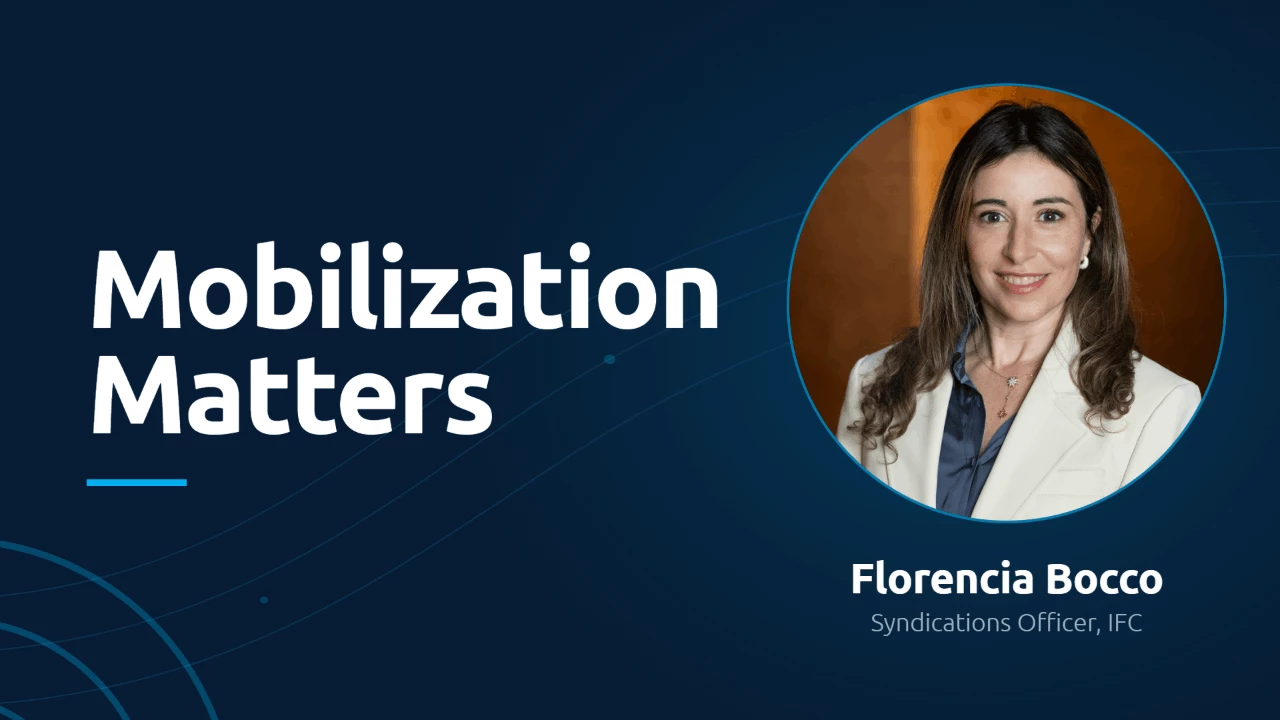
In this interview, Florencia Bocco, Syndications Officer at IFC, talks about B Bonds, a different kind of bond backed by institutional investors, and why she believes they can become a global platform for mobilizing private capital at scale for development.
For those unfamiliar with the product, what exactly is a B Bond?
Think of a B Bond as bringing IFC’s syndicated lending model, where multiple lenders come together to finance a single borrower, to the capital markets.
For decades, IFC has worked with commercial banks through B Loans, its workhorse mobilization product, where banks participate alongside IFC. B Bonds build on that proven model by opening the structure to a broader investor base, including institutional investors, asset managers, and pension funds.
Through B Bonds, investors gain exposure to an IFC loan by purchasing rated, tradable securities issued through a special purpose vehicle or SPV. An SPV is an entity set up to solely participate in the IFC loan and facilitate the B Bond transaction by issuing notes backed by the loan.
This makes the underlying loan accessible to private investors who may not be able to invest directly in private loans, while enabling them to share the same credit risk as IFC on a pari passu basis.
The result is a structure that combines IFC’s development expertise and credit discipline with the scale and depth of the capital markets. By turning a single loan into an investment opportunity for many institutional investors, B Bonds enables IFC to mobilize private capital faster and at greater scale.
B Bonds had a record year for IFC. What made this year’s transactions stand out?
In fiscal year 2026, IFC mobilized over $1.4 billion in private capital through two B Bond transactions in Guatemala. One of the transactions will finance the operations of Energuate, the largest electricity distributor in Guatemala, helping to connect more rural households to the grid and expand access to reliable electricity for the company’s 2.5 million customers, many of whom live outside the country’s main urban centers.
The market response to B Bonds has been exceptionally strong. The financing for Energuate, for example, was five times oversubscribed, attracting more than $3 billion in orders from over 200 investors. The transaction comprises a $100 million IFC loan and a $670 million B Bond, marking the first use of the structure in Guatemala.
The success of this transaction demonstrates that institutional investors are eager to diversify their portfolios and invest in high-quality, highly developmental emerging-market assets when they are priced and structured in line with their investment appetite. They also need structures that are familiar and transparent.
B Bonds provide that bridge. The combination of a strong credit structure, IFC’s track record, and the opportunity to invest in emerging markets creates a compelling proposition for institutional investors.
Are there common misconceptions about B Bonds?
Yes. One common misconception is that B Bond investors somehow are structurally subordinated to IFC’s A Loan tranche. The truth is they aren’t. Investors participate pari passu with IFC and share the same credit risk and conditions.
Another misconception is that B Bonds are complex to execute. Our recent transactions show that B Bonds can be structured efficiently while maintaining IFC’s rigorous standards. Guatemala was a proof point: one of the transactions went from kickoff to market in just three months, demonstrating that we can bring this innovative mobilization tool to market with both speed and discipline.
Beyond the numbers, why do B Bonds matter?
Today’s development financing gap is measured in trillions of dollars. No single institution or financial instrument can close this gap on its own. It will require using every tool in our toolbox to attract more institutional investors to emerging markets and connect global pools of capital with projects that create jobs, expand opportunities, and support growth.
B Bonds are one piece of the solution. Their ability to attract hundreds of investors to a single transaction demonstrates the power of financial innovation to broaden the investor base, channel more private capital into emerging markets, and help close the development financing gap.
What comes next for the product?
Guatemala showed what’s possible, but this is just the beginning. Looking ahead, we are exploring opportunities in new markets and expect to see the product evolve.
More transactions are already in motion, more jurisdictions are on the table, and there is appetite to explore thematic structures. Many IFC clients already use debt capital markets instruments, so B Bonds are a natural next step rather than a foreign concept.
As this asset class matures the way the B Loan did decades before it, our ambition is simple: to make B Bonds a global platform for mobilizing private capital for development.