Download
- Full Report (English)
- Executive Summary (English | Russian)
The Kyrgyz Republic has maintained strong economic growth despite the constraints of a small domestic market, landlocked geography, and exposure to external shocks. However, translating this growth into higher productivity, diversified exports, and more and better jobs remains a challenge.
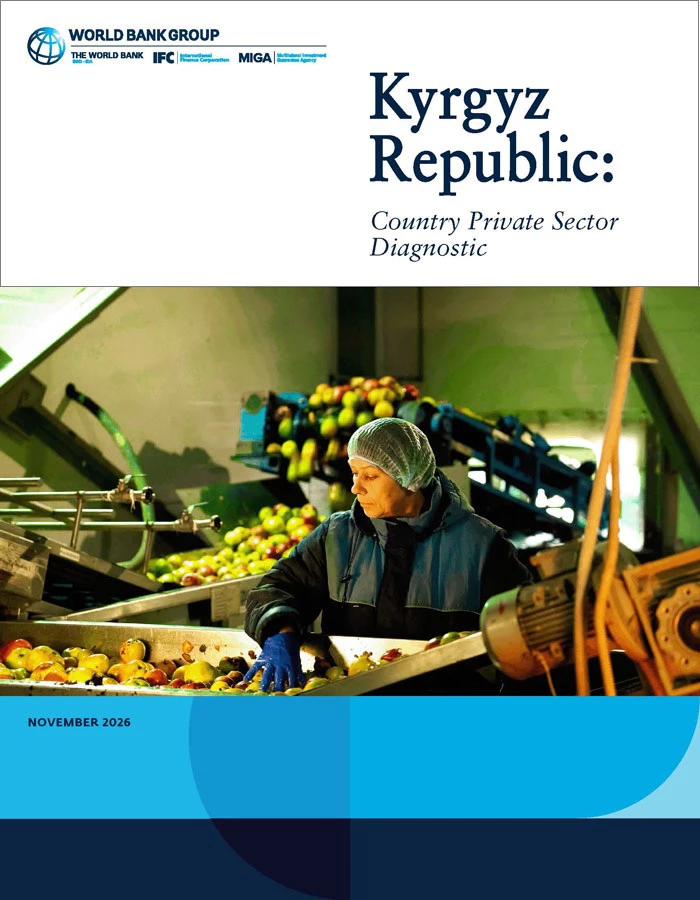
The Kyrgyz Republic Country Private Sector Diagnostic, prepared by the World Bank Group, identifies opportunities for targeted reforms to unlock private investment in four sectors: nature-based tourism, fruit and berry production and processing, trout aquaculture, and garment manufacturing. These opportunities build on the country’s natural assets, production capabilities, and access to regional markets. Together, the recommended actions could catalyze up to US$618 million in private investment and create as many as 67,600 more and better-paid jobs over the medium term.
Nature-based tourism: The Kyrgyz Republic’s mountains, lakes, glaciers, and cultural heritage provide a strong foundation for higher-value nature and adventure tourism. Although visitor numbers and tourism revenues have recovered strongly since the pandemic, the market remains dominated by short-stay, lower-spending regional travel. Uncertain land rights, fragmented permitting, inadequate destination infrastructure, border-zone access requirements, and limited air connectivity discourage investment in quality accommodation and year-round tourism products. Addressing these constraints through clearer land rights and permitting, improved destination infrastructure and border-zone access, and greater international air connectivity could unlock up to US$220 million in private investment and generate as many as 20,800 jobs.
Fruit and berry production and processing: Favorable agroclimatic conditions and growing demand in neighboring Eurasian Economic Union markets create significant opportunities in intensive orchards, berries, cold storage, processing, and export logistics. Yet rising production has not been matched by comparable gains in yields or value addition, and only a small share of output is processed. Uncertain land procedures, limited accredited testing and certification services, restrictive input approvals, inconsistent tax treatment of productive assets, weak producer aggregation, and major cold-chain gaps deter investment. Standardizing land-use procedures, strengthening internationally recognized laboratory capacity, streamlining approvals for agricultural inputs, clarifying VAT treatment, and simplifying permits for storage and processing facilities could mobilize up to US$250 million in private investment and support as many as 24,000 jobs, particularly in rural areas.
Trout aquaculture: Abundant cold-water resources, high-altitude lakes, and hydropower reservoirs give the Kyrgyz Republic clear advantages in trout production, while strong demand in Russia, Kazakhstan, and other regional markets provides room for further expansion. However, unclear environmental and site-approval procedures, insufficient controls over imported fish eggs and aquafeed, and gaps in veterinary therapeutants management, residue testing, and traceability expose producers to disease, production losses, and interruptions in export market access. Establishing risk-based environmental procedures, coordinating land and water approvals, establishing biosecurity and enforceable feed standards, introducing effective controls over the use of veterinary therapeutants, and implementing an interoperable traceability system could unlock up to US$70 million in private investment and create as many as 8,400 jobs across farming, processing, logistics, and input supply.
Garment manufacturing: Garment production is one of the country’s largest private/manufacturing employers and benefits from a flexible network of small and medium-sized producers, rapid turnaround capabilities, and preferential access to Eurasian Economic Union markets. Its potential is nevertheless constrained by widespread informality, limited testing and certification capacity, unpredictable export logistics and transit conditions, and persistent skill shortages. Stronger accredited testing and certification services, more predictable road and air export logistics, industry-aligned technical and digital training, and labor-market reforms that support flexible short-term hiring and predictable access to foreign technical workers could help attract up to US$78 million in private investment and generate as many as 14,400 more and better-paid jobs.